Frustrations Over Bougainville
pp. 25-27 · Read in the full issue
By DAVID RANSOM, who was in Bougainville for the Arawa meeting on secession.
The small group of top Papua 'lew Guinea public servants arrived ►ack at the expensive Davara Hotel n Kieta angry and frustrated and •ought a small carton of beer. In he haus wind near the swimming 001, they bit the bottle tops off with heir teeth and made no secret of
heir disappointment.
The men—experts in such fields s labour relations, law and finance— ere members of the government ; am sent to Bougainville to attempt settlement with the secessionists.
For weeks before they had eglected their regular duties to ickle what Chief Minister Michael omare saw as a priority issue.
The reason for their frustration as clear. For the Arawa meeting ad looked hopeful.
The government had sent a high awered team headed by the Minister >r Foreign Relations and Trade, Sir laori Kiki, and including the Minis r for Finance, Mr Julius Chan, and ie Minister for Justice and Minister sponsible for provincial affairs, Mr bia Olewale.
Mr Olewale had left Bougainville few weeks before confident that cession could be avoided.
“Secession can be overcome and ill be,” he said.
He claimed his feelings were based i discussions he had with village
elders and chiefs on a tour during which he attended 24 public meet ings.
The presence of Sir Maori Kiki for the Arawa meeting heartened the secessionists. Bougainville District Planner Leo Hannett had described Sir Maori as one of the few govern ment men who understood Bougain ville’s problem.
Both sides had drawn up lists of agenda items.
The government mentioned the transfer of financial and administra tive powers. It did not mention secession.
The Bougainvillians said secession remained a priority. But it appeared beforehand that they would settle for less. They would give no indication as to when they would break away or exactly how they saw secession being achieved.
The teams met at the Bougainville District Assembly’s headquarters, commonly known as “the white house”. They filed inside and sat at long tables on opposite sides of the room. The leaders, Sir Maori Kiki and Bougainville Provincial Assembly Interim Chairman, Mr Aloyisius Noga, made speeches of appreciation and agreed that the press be told to leave.
Several times throughout the meet ing the Bougainvillians left the room
to discuss in private a government offer which totalled 4.2 million kina for the current financial year—an in crease of half a million kina on a previous offer. The kina is on a par with the Australian dollar.
The meeting continued through lunch with members eating sand wiches as they talked. But when the talks ended early in the afternoon
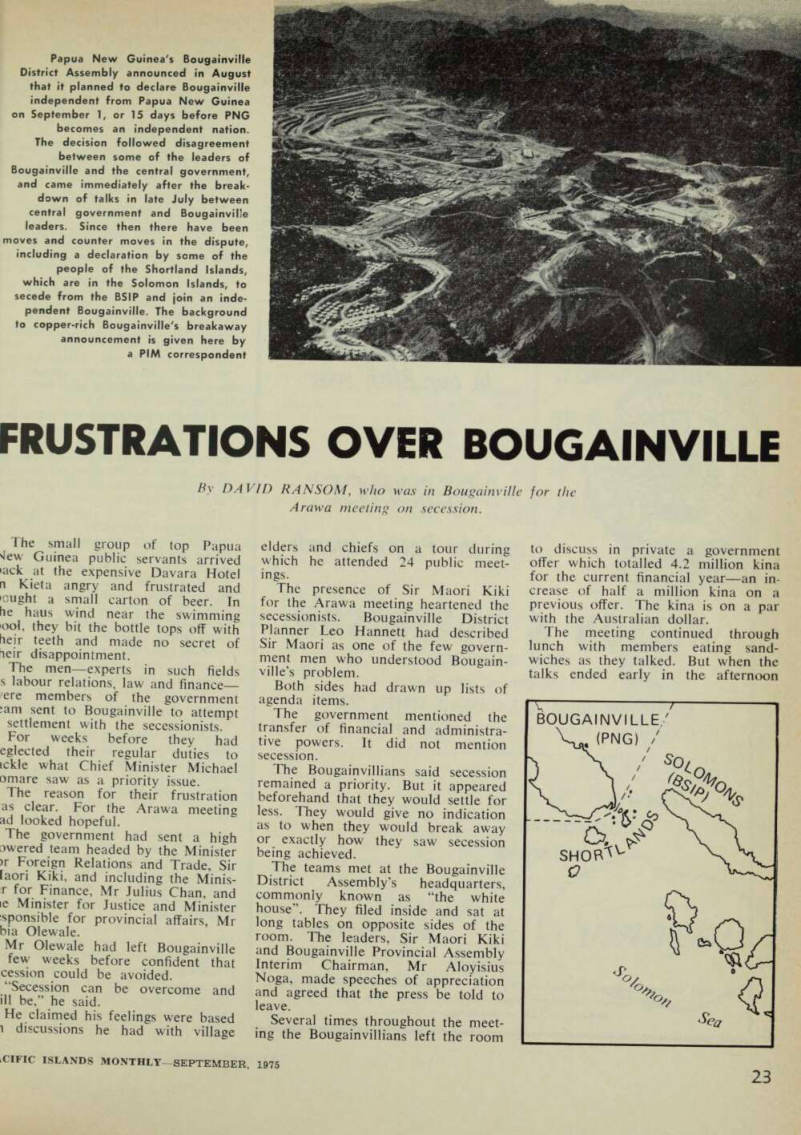
Papua New Guinea's Bougainville District Assembly announced in August that it planned to declare Bougainville independent from Papua New Guinea on September 1, or 15 days before PNG becomes an independent nation.
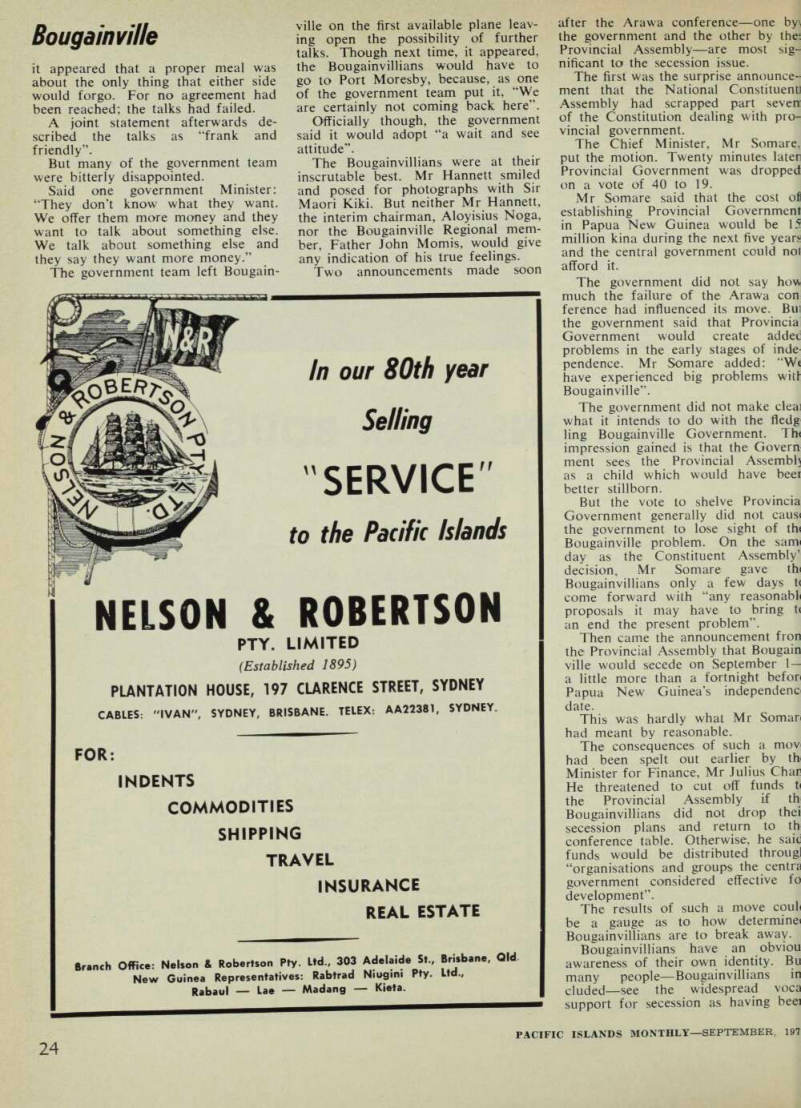
The decision followed disagreement between some of the leaders of Bougainville and the central government, and came immediately after the break down of talks in late July between central government and Bougainville leaders. Since then there have been moves and counter moves in the dispute, including a declaration by some of the people of the Shortland Islands, which are in the Solomon Islands, to secede from the BSIP and join an inde pendent Bougainville. The background to copper-rich Bougainville's breakaway announcement is given here by a PIM correspondent
Bougainville
it appeared that a proper meal was about the only thing that either side would forgo. For no agreement had been reached; the talks had failed.
A joint statement afterwards de scribed the talks as “frank and friendly”.
But many of the government team were bitterly disappointed.
Said one government Minister: “They don’t know what they want.
We offer them more money and they want to talk about something else.
We talk about something else and they say they want more money.”
The government team left Bougain
ville on the first available plane leav ing open the possibility of further talks. Though next time, it appeared, the Bougainvillians would have to go to Port Moresby, because, as one of the government team put it, “We are certainly not coming back here”.
Officially though, the government said it would adopt “a wait and see attitude”.
The Bougainvillians were at their inscrutable best. Mr Hannett smiled and posed for photographs with Sir Maori Kiki. But neither Mr Hannett, the interim chairman, Aloyisius Noga, nor the Bougainville Regional mem ber, Father John Momis, would give any indication of his true feelings.
Two announcements made soon
after the Arawa conference—one by\ the government and the other by the; Provincial Assembly—are most sig nificant to the secession issue.
The first was the surprise announce ment that the National Constituent!
Assembly had scrapped part seven of the Constitution dealing with pro vincial government.
The Chief Minister, Mr Somare, put the motion. Twenty minutes laten Provincial Government was dropped on a vote of 40 to 19.
Mr Somare said that the cost ofi establishing Provincial Government in Papua New Guinea would be 15 million kina during the next five years and the central government could not afford it.
The government did not say how much the failure of the Arawa con ference had influenced its move. Bui the government said that Pfovincia Government would create added problems in the early stages of inde pendence. Mr Somare added: “W«
have experienced big problems with
Bougainville”.
The government did not make deal what it intends to do with the fledg ling Bougainville Government. Th< impression gained is that the Govern ment sees the Provincial Assembly as a child which would have beer better stillborn.
But the vote to shelve Provincia Government generally did not caus< the government to lose sight of th< Bougainville problem. On the sanv day as the Constituent Assembly’ decision, Mr Somare gave th< Bougainvillians only a few days t< come forward with “any reasonabh proposals it may have to bring t( an end the present problem”.
Then came the announcement fron the Provincial Assembly that Bougain ville would secede on September 1— a little more than a fortnight befon Papua New Guinea’s independence date.
This was hardly what Mr Soman had meant by reasonable.
The consequences of such a move had been spelt out earlier by the Minister for Finance, Mr Julius Char He threatened to cut off funds t< the Provincial Assembly if th Bougainvillians did not drop thei secession plans and return to th conference table. Otherwise, he saic funds would be distributed througl “organisations and groups the centra government considered effective fo
development”.
The results of such a move couh be a gauge as to how determine!
Bougainvillians are to break away.
Bougainvillians have an obviou awareness of their own identity. Bu many people—Bougainvillians in eluded—see the widespread voca support for secession as having beei
sparked or at least rekindled by political opportunists.
They ask whether villagers really understand the issues involved. And if they do, would they be so willing to secede if made aware of the economic sacrifices required.
Bougainvillians, like Papua New Guineans everywhere, are constantly calling on the central government to provide more development in the rural areas.
The central government’s clever use of funds for roads and bridges on Bougainville could help persuade the people they are better off remaining Papua New Guineans.
Pitted against the central govern ment is the member for Bougainville Regional, Father John Momis, who has been a constant critic of the coalition government, accusing it of moral bankruptcy from which only corruption, opportunism, dictatorship and even the use of force can come.
Father Momis—the former deputy chairman of the Constitutional Planning Committee—spends more time on Bougainville now after hav ing seen many of the proposals he favoured for Papua New Guinea’s Constitution rejected. He is a strong advocate of decentralisation and pro vincial government.
Now a secessionist with influence, he is seen to be pushing for Bougain ville the same ideas he attempted to introduce for all Papua New Guinea.
Much of the Bougainville secession issue revolves around the question: How can Bougainville secede? Where will the money come from?
Without finance from Port Moresby the administration of Bougainville stops. Mr Leo Hannett earlier ad mitted that several companies con tracted by the Provincial Assembly were becoming impatient as they had not been paid because of the hold up
with funds from the central govern ment.
The Provincial Assembly has made an impossible request for 150 million kina from the central government to set up an independent state.
As the Bougainville MHA, the Minister for Mines and Energy, Sir Paul Lapun—an anti-secessionist— told me: “They believe Papua New Guinea has the same responsibility as Australia. Australia gives money to set up an independent Papua New Guinea. Therefore, they think Papua New Guinea should give mony for an independent Bougainville.”
The American anthropologist, Mar garet Mead, said that people should not be surprised if Bougainville secedes from Papua New Guinea.
After all, she claimed, the secession move was being financed and insti gated by western business groups whose exploitation plans were ham pered by tough Papua New Guinea government controls.
There is mixed feeling on Bougain ville as to whether Margaret Mead has evidence to support her claims.
Multi-national companies may see certain advantages in an independent Bougainville. But it seems unlikely that any would risk blackening its name internationally by openly sup porting the secessionists, particularly at the risk of backing the wrong political horse.
The Bougainville issue, unlike many others the central government has had to contend with, is difficult to resolve without having a winner on one side and a loser on the other.
In the past the coalition and Mr Somare in particular have held to gether a diverse Melanesian society by the successful use of concensus, concession and compromise.
But with Bougainville little such opportunity now exists.
The Bougainville Provincial As sembly has stated—no matter how much of a bluff it might be—that secession is non-negotiable.
Mr Somare and his coalition are committed to a united country, both ideologically and economically. The copper agreement signed with Bou gainville Copper Ltd last year was seen to represent a financial package of between 200 million and 500 million kina over the next 10 years.
That money is vital for the develop ment of the infant Papua New Guinea.
But no matter what the central government does, short of allowing Bougainville to secede, secessionist feelings will remain in some form.
They are too deep-rooted; too in grained.
In the long term, secession may be the answer. In the short term there is no way it will happen.