the pool
pp. 16-17 · Read in the full issue
Tahiti's girls sweep the pool
Of all the sports in the Guam Games, swimming was the most suc cessful. For one thing, the shocking weather had little effect on the swim mers and the rain didn’t affect the course, although it made the going hard for the spectators, most of whom were colleagues and supporters of the overseas teams.
As with all outdoor facilities, with the exception of softball, there was no cover for spectators but the swim ming was so good and so many re cords were tumbling one after an other, that the watchers kept their enthusiasm to the end.
For once, Guam deserved con gratulations for a sports facility. The pool, in Agana city itself, was as good as it could be. All the swim mers, especially the golden girls of the French territories who dominated the scene, praised the conditions. The water was clearer than at home, they said, and made for faster swimming.
There was no doubt about the faster swimming. All 10 records were broken by the women—women?
Most were early teenagers. There were also two new events for both men and women with records set.
The men broke eight old records.
Thousands of words have been written after past Games over the brilliant swimming of New Cale donian Marie-Jose Kersaudy, who, by the time she was 18—at the Ta hiti Games in 1971—had won 21 gold medals. She said after Tahiti that she would retire in favour of a university course in France. She did and wasn’t at Guam. It was thought that others, who had trailed behind Marie-Jose, would get their chance at future Games. But, no, New Caledonia has produced new champions, all around Marie-Jose’s age when she started her gold pros
pecting.
None of them collected as many as Marie-Jose at a single Games but three came near. Petite Yolaine Saminadin, aged 15, took six golds (200 metres, 400 metres, 800 metres freestyle, and three team events); team-mate Patricia LeGras had five golds (two in breaststroke events), and another New Caledonian, Danielle Maussion, four.
The first gold in the Games was won by French Polynesian Maeva Lavigne, 19, who broke the first re cord, winning the 100 metres free-
style in one minute, 4.63 seconds, which was .8 of a second under the record established at Tahiti in 1971 by Marie-Jose Kersaudy. Maeva, 19, got a team silver at Tahiti and was one of the few girls in the Guam pool to have appeared at other Games. Her tally at Guam was two golds, three silvers and two bronzes.
Games swimming, it seems, is be coming the early teenagers’ preserve, and, at 19, Maeva is almost an oldie.
French Polynesia, which gave in dications at the Tahiti Games of be coming a force in the swimming world, maintained her improvement, especially in the men’s events when her men took 16 golds, 12 of them in team events, three silver and four bronze.
As French Polynesia improved on her Tahiti Games performance, Papua New Guinea lost some ground hough not a lot. Charlie Martin, now 19, the star at Papeete, was still he star when the Guam Games mded. He collected four golds—he lad six gold and two silver at Tahiti —and four silver medals. Four of lis golds were for individual swims.
His nearest rival was H. Noble, )f French Polynesia, a newcomer to he Games, who had five golds, three )f them in team events, a silver and i bronze.
Another newcomer, PNG’s Mark iutchings, aged 16, swam a great ace to win the 1,500 metres free tyle, which left him exhausted.
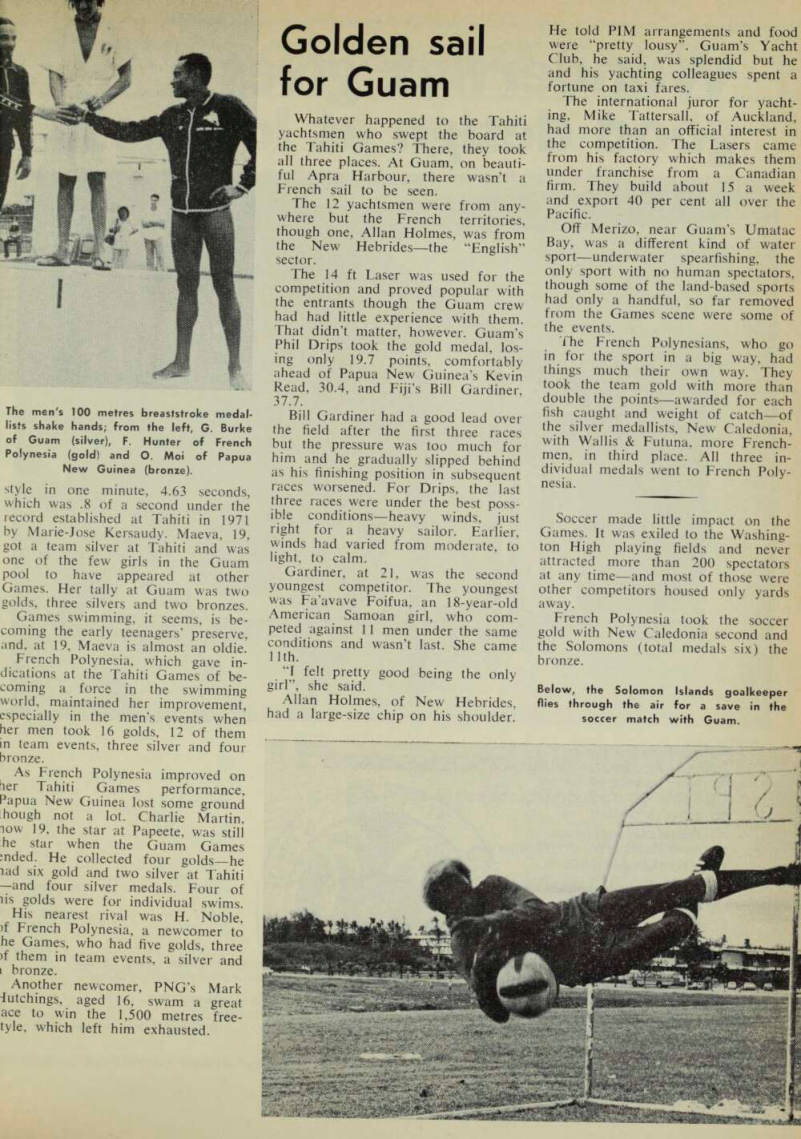
The men's 100 metres breaststroke medal lists shake hands; from the left, G. Burke of Guam (silver), F. Hunter of French Polynesia (gold) and O. Moi of Papua New Guinea (bronze).