How They Did At The Games
pp. 12-13 · Read in the full issue
Even the rain couldn't dilute the athletes' spirit!
Sixteen records were broken in 35 events which comprised the athletics, four less than at the Tahiti Games.
Four less! The wonder is that any records were broken, considering the conditions encountered on what passed for a sports ampitheatre on Guam.
If anything at Guam reached dis aster’s brink it was the athletics. The heroes, and heroines, were the ath letes and Papua New Guinea’s officials. Three months ago, there wasn’t a venue for athletics. A few days before the first starting pistol was fired, there wasn’t a running track. A few hours before the start, there was a track of sorts, still in complete.
There was no one to complete it until the PNG officials turned up.
Some of them had engineering ex perience. They buckled to and had the track ready. Then it rained. The track, a combination of compacted coral and clay—or so it seemed— was inches under water on that first Saturday evening and the start was postponed until the Monday.
From then on, the athletics con tinued without another hitch but under extremely difficult conditions.
The athletes were tremendous. So were the PNG officials, all experi enced in running athletics. Without them—chaos!
The international juror, Sydney based Mr Arthur Hodsdon, of the Oceania Council of the International Amateur Athletic Federation, was bitter in his criticism, not of the Guam people, but of the United States Amateur Athletic Union.
“I admire the tremendous spirit of these people on Guam who didn’t realise what they were undertaking with the Games”, Mr Hodsdon said.
“I don’t propose to blast them when I return home and make my report.
But I hope that, after I make my
complaints to the federation and to the United States AAU, it will have such a repercussion that the Ameri cans will take great care, if the Games go again to American terri tory, to play their part”.
Despite the poor facilities, despite the continuous rain and the absence of real support from spectators, the athletes staged a great show. How they were able to perform as they did, hampered by the fact that there was no shelter from the rain when they were waiting their turn to com pete, everyone wondered.
But the athletes didn’t fail. They really saved the Fifth South Pacific Games. Rain couldn’t dampen the sporting spirit, which was evident in all the teams although some of the Frenchmen, in the opinion of others, did too much grumbling.
Grousers or not, the Frenchmen, and French women, led the field, particularly the New Caledonians who took 12 gold medals. Fiji was only one gold medal behind, which restored some of the confidence which had drained from the Fijians as they viewed their lack of achievement in other sports.
From champion country at the First South Pacific Games in Fiji in 1963, Fiji dropped to second at Nou mea in 1966, third at Port Moresby in 1969, and fourth at Tahiti in
1971. They stayed fourth at Guam.
Happily for them, they still have good support for athletics at home and had no reason to be ashamed of their performance at Guam. In fact, with just a little luck, they would have come out in front on the athletics field.
The country which can keep its head very high is Tonga. Its full team at the Games numbered three com petitors, the brother Saniseti and Alipeti Latu and woman athlete
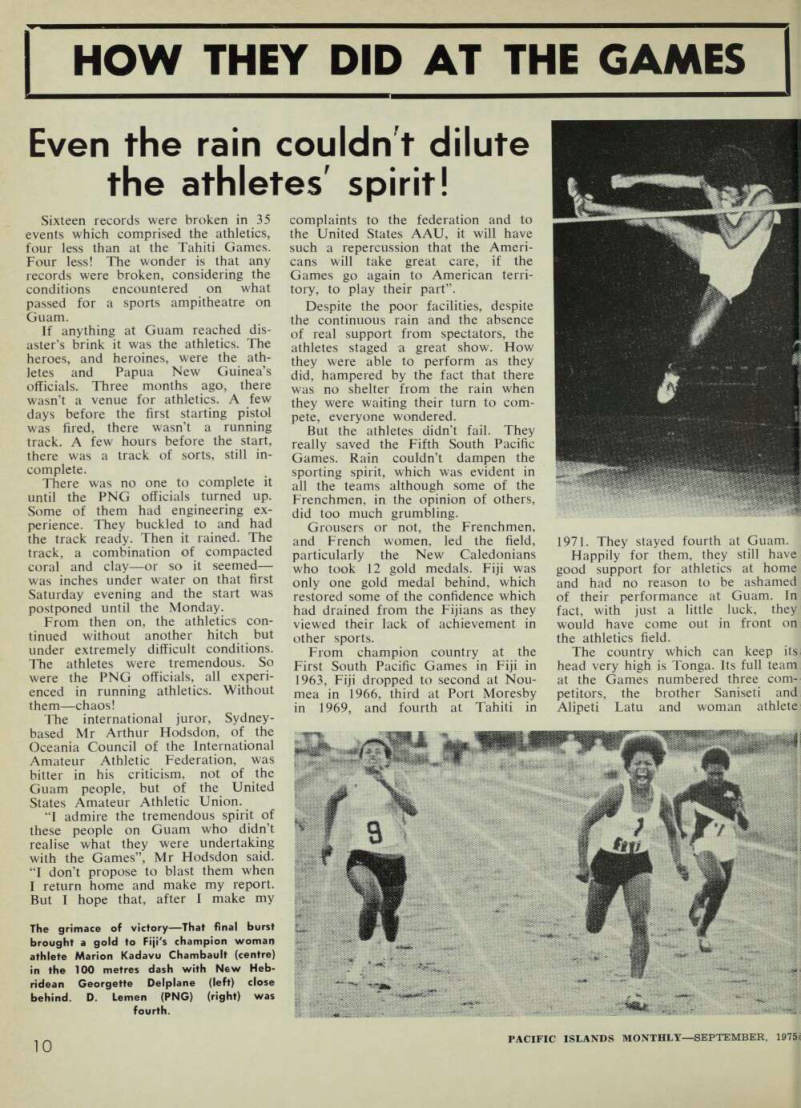
The grimace of victory—That final burst brought a gold to Fiji's champion woman athlete Marion Kadavu Chambault (centre) in the 100 metres dash with New Heb ridean Georgette Delplane (left) close behind. D. Lemen (PNG) (right) was fourth.
Losaline Faka’ata, with team man iger Siaosi Palelei.
They went home with two gold nedals, a silver and a bronze, more nedals per head than any other team.
Winner of the two golds was Saniseti aged 22, who’s now studying n Melbourne. He won the 110 netres hurdles and the decathlon— he hardest test for an athlete—and iis brother, two years older, won a ilver in the decathlon and a bronze n the pole vault.
There were several outstanding thletes—John Kokinai, of PNG, a Dng-distance runner who took three old medals and a silver; A. Lazare, 'ho won the marathon and took a ilver and bronze in other long istance events; hefty Amljot Beer, f New Caledonia, first in the discus nd shot put and second in the ham ler and the Poaniewa brothers, of few Caledonia, who staged a thrill ig display of high jumping and )ortsmanship rarely equalled in the ames.
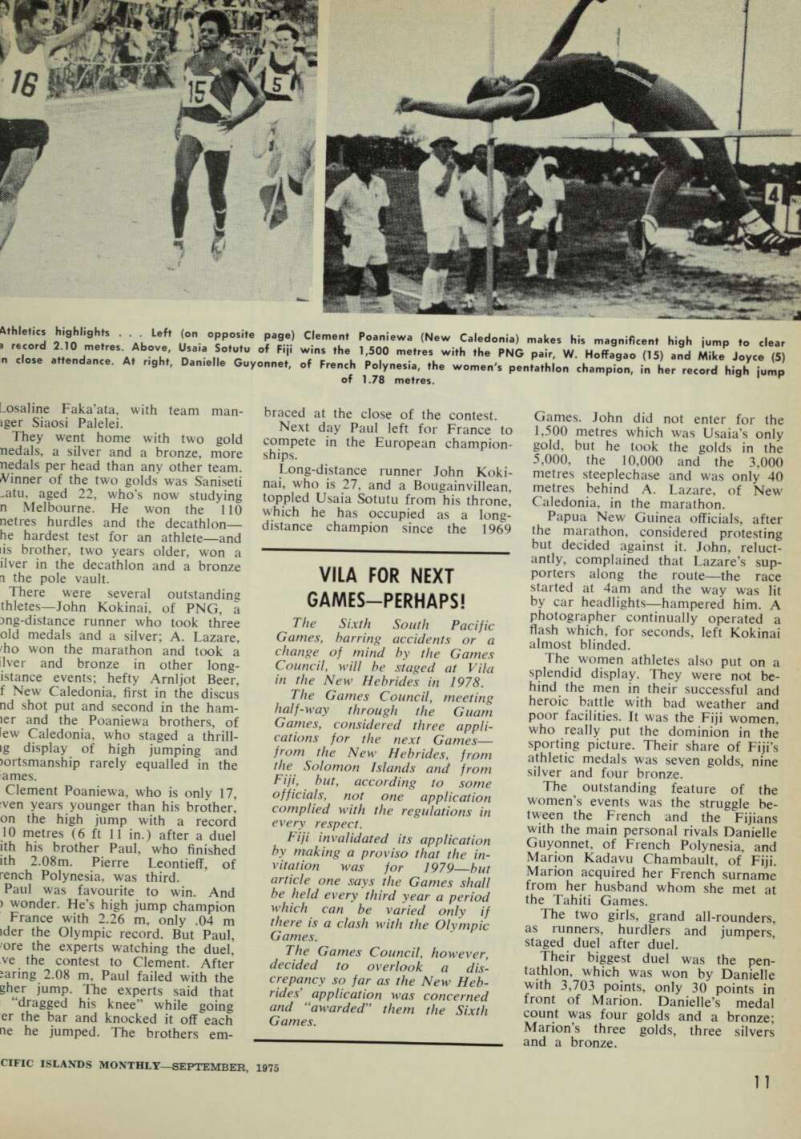
Clement Poaniewa, who is only 17, ven years younger than his brother, on the high jump with a record 10 metres (6 ft 11 in.) after a duel ith his brother Paul, who finished ith 2.08 m. Pierre Leontieff, of rench Polynesia, was third.
Paul was favourite to win. And ) wonder. He’s high jump champion France with 2.26 m, only .04 m ider the Olympic record. But Paul, 'ore the experts watching the duel, ve the contest to Clement. After taring 2.08 m, Paul failed with the gher jump. ’Hie experts said that dragged his knee” while going er the bar and knocked it off each tie he jumped. The brothers em
br?fd t , 2 ‘ he D cl ? S t ?f ‘he contest.
ar* ««*asw
Usaia Sotutu from his throne, a
Games, John did not enter for the 1,500 metres which was Usaia’s only gold, but he took the golds in the 5,000, the 10,000 and the 3,000 metres steeplechase and was only 40 metres behind A. Lazare, of New Caledonia, in the marathon.
Papua New Guinea officials, after the marathon, considered protesting but decided against it. John, reluct antly, complained that Lazare’s sup porters along the route—the race started at 4am and the way was lit by car headlights—hampered him. A photographer continually operated a flash which, for seconds, left Kokinai almost blinded.
The women athletes also put on a splendid display. They were not be hind the men in their successful and heroic battle with bad weather and poor facilities. It was the Fiji women, who really put the dominion in the sporting picture. Their share of Fiji’s athletic medals was seven golds, nine silver and four bronze.
The outstanding feature of the women’s events was the struggle be tween the French and the Fijians with the main personal rivals Danielle Guyonnet, of French Polynesia, and Marion Kadavu Chambault, of Fiji.
Marion acquired her French surname from her husband whom she met at the Tahiti Games.
The two girls, grand all-rounders, as runners, hurdlers and jumpers, staged duel after duel.
Their biggest duel was the pen tathlon, which was won by Danielle with 3,703 points, only 30 points in front of Marion. Danielle’s medal count was four golds and a bronze; Marion’s three golds, three silvers and a bronze.
2 m melL Vl, U * !?" P‘9‘) dement Poaniewa (New Caledonia) makes his magnificent high jump to cleat record 2 10 metres Above, Usa.a Sotelo of Ftp wins the 1,500 metres with the PNG pair, W. Hoffagao (15) and Mik e P Joyce (5) n close attendance. A, right, Danielle Geyonnet, of French Polynesia, the women's pentathlon in Lrrec„d high i„mp of 1.78 metres. 1 r