The Games—Biggest Rain-Soaked
pp. 6-7 · Read in the full issue
Near-Disaster In Island History
By JOHN CARTER, who was in Guam for the Games
The Fifth South Pacific Games was the biggest near-disaster in the sporting history of the Islands.
Thankfully, the ordeal is over, but the lesson learned by the South Pacific Games Council is that never again will it allow itself to put such an important inter-island event in such jeopardy.
The council courted disaster when its members agreed four years ago to accept Guam’s invitation to stage the Games. Rumours persisted all those four years that Guam couldn’t do it; that this small, unincorporated terri tory of the United States hadn’t the will, or the wherewithal, to do a good job.
But the council believed the small coterie of Guam officials that every thing would be all right, and, in the face of advice from informed ad visers who had been to Guam, seen the confusion and inertia existing there, and begged the Games coun cil to take the Games elsewhere, de cided to stick to their original de cision to come to Guam.
The council members came a few days before the start in August, and they were appalled.
Hardly one of them then believed the Games would get off the ground!
With only a few days to go, there were too many things wrong.
Hardly anything was ready. The main arena, the venue for athletics at the J. F. Kennedy High School field, was a shambles. It would still be a shambles now had not some of the Papua New Guinea officials weighed in with technical know-how and helped to complete the work only hours before the first event.
Then it rained—and rained. That wasn’t Guam’s fault. But, who agreed to the Games being staged in the middle of Guam’s wet season? A record amount of rain fell on all 10 days of the Games. Only one day was almost fine.
The public relations effort on Games publicity was a failure.
Almost nobody on the island 30 miles by eight miles knew anything about the Games. They’d been told
almost nothing about them. A taxi driver knew nothing about them when I told him what I was doing on the island and Joe Murphy, editor of the island’s morning news paper, the Pacific Daily News, wore sack cloth and ashes when he con fessed in his column that the Press hadn’t given much publicity to them.
Not that it would have mattered much.
One Guamanian told me that locals were not interested in watching a sporting event unless a relative was in the team —and there weren’t many Guamanians in the Games. Apart from that, the favourite sport on Guam is cockfighting—every Friday, Saturday and Sunday, when thou sands of dollars change hands.
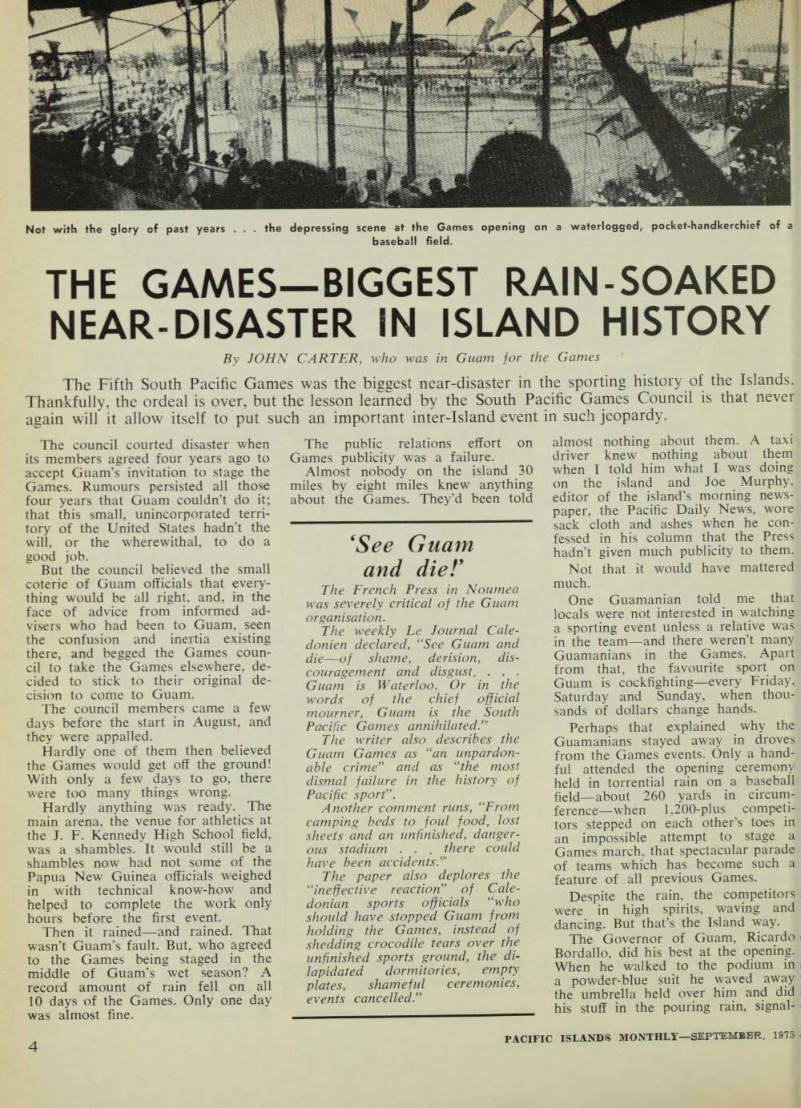
Perhaps that explained why the Guamanians stayed away in droves from the Games events. Only a hand ful attended the opening ceremony held in torrential rain on a baseball field—about 260 yards in circum ference—when 1,200-plus competi tors stepped on each other’s toes in an impossible attempt to stage a Games march, that spectacular parade of teams which has become such a feature of all previous Games.
Despite the rain, the competitors were in high spirits, waving and dancing. But that’s the Island way.
The Governor of Guam, Ricardo Bordallo, did his best at the opening.
When he walked to the podium in a powder-blue suit he waved away the umbrella held over him and did his stuff in the pouring rain, signal
Not with the glory of past years ... the depressing scene at the Games opening on a waterlogged, pocket-handkerchief of a baseball field.
ling that he was one with the few hundred people, mainly Games officials and supporters, plus the Press, who had had to endure two hours of ceremonial exposed to the weather while the favoured few local VIPs (who for some reason included young children) had sheltered in the inadequate covered grandstand.
That was another fault connected with the organisation. Nowhere, apart from the venues for the usual indoor games like basketball played in the fine gymnasium at the George Washington High School, was there cover for the spectators. The result was that only the hardy souls, and Pressmen doing their job, watched the Games.
The only suitable facilities on Guam are those operating for the schools, which are well equipped for gymnastics, basketball, softball, vol leyball and other games not requiring large fields. Agana, the capital (pro nounced Aganya) has a swimming pool, which turned out to be a fine one, liked by all the swimmers. The swimming events were the best (and the only) organised of the sports.
As the schools are scattered over the island, so were the Games venues, which meant that they were many miles apart. No wonder, with every thing scattered so far afield, the Games made an impact on the Guamanians like a snowflake hitting a hot tin roof.
Many venues—the soccer field was a case in point—were not even
fenced, so that it was hopeless to expect an income from spectators although competitors wanting to watch other sports had to pay for the privilege. That was rough, but so were most aspects of whole affair, although I heard few com plaints about the food, and, once the Guam people knew what all the strangers were doing on the island, they helped all they could. They could not have been more friendly and hospitable. The voluntary com mittees also did a good job.
There were frustrations galore.
Most of the Games equipment was ordered at the last minute (it was last minute in everything!) and wasn’t there when it was needed.
The weightlifters hadn’t any weights for pre-Games training. The poles for the pole vault are still in Japan.
And most of the equipment and the uniforms that were in the hands of the local organisers were not handed out until the last minute.
There were bottlenecks created by disputes between politicians and com merce over the supply of equipment from Japan, and many people blamed most of the Games mess on inter ference by politicians, from the ex- Governor downwards. The ex- Governor, Carlos Camacho, was opposed to the Games from the start, because, I was told, he wasn’t in formed Guam was going to invite the Games to come there. He, in 1972, opposed spending any money on the Games.
(Camacho was beaten in the elec tion for governor and he now faces, along with former Lieutenant- Governor Kurt S. Moylan and nine other ex-government officials, indict ment on charges of felonies ranging from embezzlement and falsification of accounts to presenting false claims for government funds involving about SUS3.2B million).
But most people blame, not the politicians for the mess, but self seeking Games officials, headed by Guam Games Council President Theodore Nelson. They accuse him of empire building, of self-glorifica tion, of using the Games for poli tical advancement and of being so dictatorial that many refused to work with him.
Mr Nelson was certainly blamed by some for the very embarrassing situation which arose at the start through the presence of a soccer team from Australia’s northern Queensland, which clamoured for a place in the Games despite the fact that the Games Charter says that only Island government members of the South Pacific Commission, which fathered the Games, can be repre sented. The Queenslanders actually arrived on Guam at a cost to them selves of $15,000 expecting to play in the official competition, only to be told they had no business there.
Their officials said Mr Nelson had told them they could come. Mr Nel son, in my presence, said he had learned in time that they wouldn’t be welcomed and his last message to them a few days before their de parture from Cairns was to stay at home. They denied receiving any message but two junior staff assured me they had seen the cable.
In cash and kind, it has been esti mated that the Games will cost Guam around SUSI.O million. But some officials think that costs spiralled in the last few weeks and that there will be some more bills presented, payment for which has not been authorised. As at the time of writing, there were fears that the Guam Government coffers won’t con tain enough to pay next month’s wages, anyhow, the Guam Games won’t leave a nice taste in the mouths of Guam or the rest of the Pacific.
In fact, so far as the Seiko people were concerned, it was a distinctly sour taste. Seiko, the watch manufac turers in Japan, had sent a full team of technicians to Guam to operate the sophisticated electronic timing equipment which, costing around $30,000, they had loaned to the
Spg.
But there’s no money in the Games kitty, and Seiko may have to pay its own bills. ' '