Budgeting For Sunshine In Samoa
p. 80 · Read in the full issue
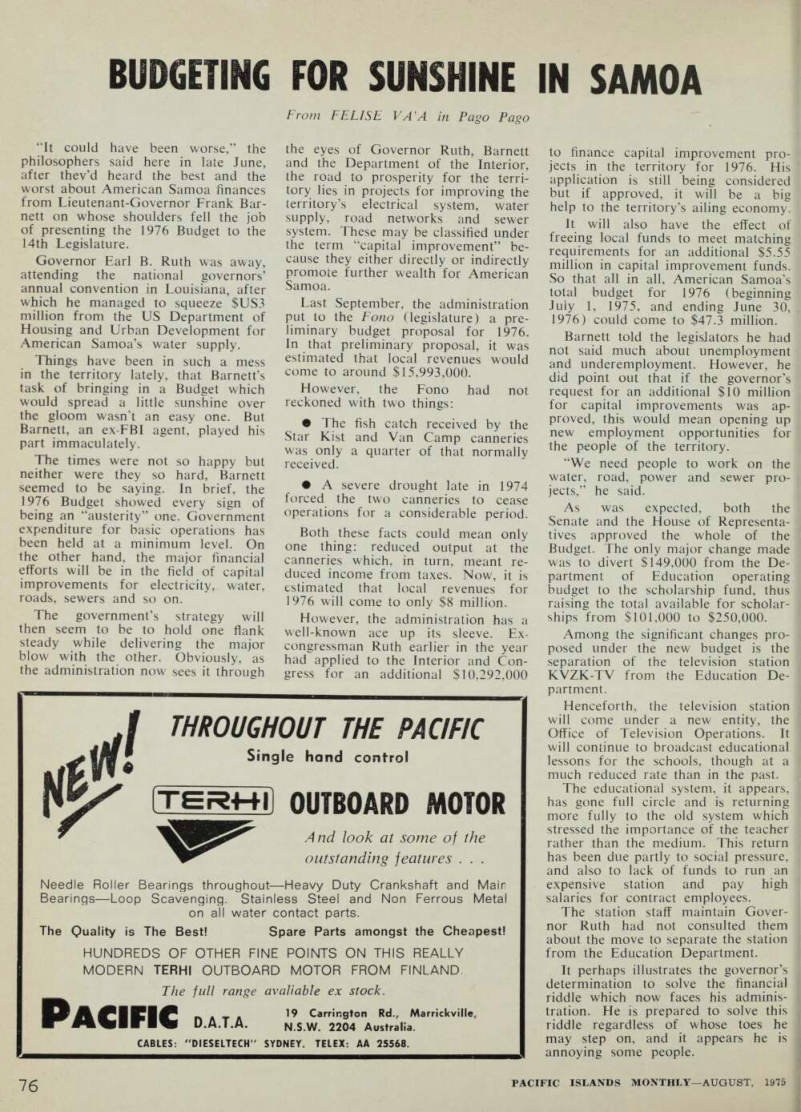
From FEL/SE VA’A in Pago Pago
“It could have been worse,” the philosophers said here in late June, after they’d heard the best and the worst about American Samoa finances from Lieutenant-Governor Frank Bar nett on whose shoulders fell the job of presenting the 1976 Budget to the 14th Legislature.
Governor Earl B. Ruth was away, attending the national governors’ annual convention in Louisiana, after which he managed to squeeze SUS 3 million from the US Department of Housing and Urban Development for American Samoa’s water supply.
Things have been in such a mess in the territory lately, that Barnett’s task of bringing in a Budget which would spread a little sunshine over the gloom wasn't an easy one. But Barnett, an ex-FBI agent, played his
part immaculately.
The times were not so happy but neither were they so hard, Barnett seemed to be saying. In brief, the 1976 Budget showed every sign of being an “austerity” one. Government expenditure for basic operations has been held at a minimum level. On the other hand, the major financial efforts will be in the field of capital improvements for electricity, water, roads, sewers and so on.
The government’s strategy will then seem to be to hold one flank steady while delivering the major blow with the other. Obviously, as the administration now sees it through
the eyes of Governor Ruth, Barnett and the Department of the Interior, the road to prosperity for the terri tory lies in projects for improving the territory’s electrical system, water supply, road networks and sewer system. These may be classified under the term “capital improvement” be cause they either directly or indirectly promote further wealth for American Samoa.
Last September, the administration put to the Fono (legislature) a pre liminary budget proposal for 1976.
In that preliminary proposal, it was estimated that local revenues would come to around $15,993,000.
However, the Fono had not reckoned with two things: © The fish catch received by the Star Kist and Van Camp canneries was only a quarter of that normally received. • A severe drought late in 1974 forced the two canneries to cease operations for a considerable period.
Both these facts could mean only one thing: reduced output at the canneries which, in turn, meant re duced income from taxes. Now, it is estimated that local revenues for 1976 will come to only $8 million.
However, the administration has a well-known ace up its sleeve. Ex congressman Ruth earlier in the year had applied to the Interior and Con gress for an additional $10,292,000
to finance capital improvement pro jects in the territory for 1976. His application is still being considered but if approved, it will be a big help to the territory’s ailing economy.
It will also have the effect of freeing local funds to meet matching requirements for an additional $5.55 million in capital improvement funds.
So that all in all, American Samoa’s total budget for 1976 (beginning July 1, 1975, and ending June 30, 1976) could come to $47.3 million.
Barnett told the legislators he had not said much about unemployment and underemployment. However, he did point out that if the governor’s request for an additional $lO million for capital improvements was ap proved, this would mean opening up new employment opportunities for the people of the territory.
“We need people to work on the water, road, power and sewer pro jects,” he said.
As was expected, both the Senate and the House of Representa tives approved the whole of the Budget. The only major change made was to divert $149,000 from the De partment of Education operating budget to the scholarship fund, thus raising the total available for scholar ships from $lOl,OOO to $250,000.
Among the significant changes pro posed under the new budget is the separation of the television station KVZK-TV from the Education De partment.
Henceforth, the television station will come under a new entity, the Office of Television Operations. It will continue to broadcast educational lessons for the schools, though at a much reduced rate than in the past.
The educational system, it appears, has gone full circle and is returning more fully to the old system which stressed the importance of the teacher rather than the medium. This return has been due partly to social pressure, and also to lack of funds to run an expensive station and pay high salaries for contract employees.
The station staff maintain Gover nor Ruth had not consulted them about the move to separate the station from the Education Department.
It perhaps illustrates the governor’s determination to solve the financial riddle which now faces his adminis tration. He is prepared to solve this riddle regardless of whose toes he may step on, and it appears he is annoying some people.