In From Ocean Island
pp. 15-16 · Read in the full issue
. . . AND A WIND BLOWS
From a special correspondent
Some chilly political winds sent shivers down quite a few spines at the South Pacific Forum meeting in Nukualofa in July.
They blew into the Tongan capital with representatives of the Banaban community on Rabi who were launching their latest campaign for self-determination of Ocean Island, their ancestral homeland.
The Banabans were seeking Forum support for their cause, and, as they expected, the mission members found themselves at the centre of a delicate web of diplomatic and protocol related manoeuvring.
“We’re not used to this sort of thing”, said a senior Tongan official.
“Why did the Banabans have to choose our Forum to bring this issue up?”
The Tongans, as hosts, were cautious in the extreme. The Bana bans, they said, were not affiliated to the Forum and could not, there fore, be accorded official status.
Would they be prepared to be part of the GEIC delegation?
“Not on your life”, said the Bana bans. Perhaps they could join the Fiji team? The Banabans dismissed this idea too. Fiji was in a delicate position. The Banabans’ current home, Rabi, is part of that country and the Prime Minister, Ratu Sir Kamisese Mara, while sympathising with them, did not wish to appear too partisan.
So the Banabans were on their own. They quickly became aware of some subtle undercurrents designed presumably to throw them off balance. A British official had allegedly told a senior Forum figure that Ratu Sir Kamisese was angry about their presence in Nukualofa.
If they lost his sympathy, they were told, then they had lost a strong ally.
The Banabans were concerned at first. Then they became sceptical.
The Fiji Prime Minister had been informed that they were Nukualofa bound and had not indicated annoy ance.
The report, decided the Banabans, was a British scare tactic.
One non-island observer suggested that the Banabans had come to Nukualofa to cause trouble. Didn’t they realise they were faced with an uphill task and didn’t they know that
the British were trying hard to keep the question out of the Forum? ‘'Well,” said the Banabans, “how do you define trouble?”
Certainly, they were faced with an uphill task—but over the years they had become used to fighting against big odds. And it wasn’t really surpris ing that the British were unhappy about their presence in Nukualofa.
After all, the United Kingdom was their chief opponent.
One of the first delegates the Bana bans made contact with was Mr Naboua Ratieta, GEIC’s Chief Minister.
Mr Tekoti Rotan, the Banaban mission leader, felt Mr Ratieta, as a matter of courtesy, should be told why the Banabans were at the Forum. He listened, and reaffirmed his position.
The Banabans approached other leaders, provoking responses ranging from caution to outright sympathy and support. But would the Forum debate the issue? It was not on the prepared agenda and it appeared that the only part of the forum session offering scope for its introduction was “other business”.
One of the Island leaders, after a full briefing, indicated willingness to make the first move. Then there was a new development.
Reports reached the Banabans’ camp that the Fiji Prime Minister might be prepared to act as an inter mediary in a get-together outside the Forum.
Mr Ratieta, apparently, was aware of this fresh proposal and had indi cated his willingness to keep the mat ter out of the Forum.
In the meantime, the Banabans distributed a document to each dele gation outlining their case and appeal ing for support. (The distribution of this submission was a separate exercise in itself. It involved a carefully-timed plan to hand the document to the leaders personally as they left an official luncheon).
The ball was back in Mr Ratieta’s court. It was time for him to make his maiden speech.
Reading from a prepared address, Mr Ratieta described some of his country’s problems and its consti tutional progress. He spoke of the need for Pacific nations to respect territorial sovereignty and refrain
from any action which might ‘threaten the sovereignty of another territory’.
Then he added, “I say this because at this very moment we have a very serious issue at home where the Banabans have demanded indepen dence for Ocean Island in Association with Fiji.”.
Mr Ratieta repeated his Govern ment’s objection to the Banaban de mand.
Ratu Sir Kamisese said later that he was ‘stunned’ that Mr Ratieta should have broached the topic in view of the unofficial agreement be tween them to keep it outside the Forum.
The Prime Minister told the dele gates in session that he was dis appointed that the Banaban question had been raised in the absence of one of the parties. The introduction of the controversy would have left people wondering about the other side of the story.
Discussion outside the Forum would have given all those involved an opportunity to resolve the prob lem by consensus—the Pacific way.
The Banabans were quick to com ment on Mr Ratieta’s speech. In a Press statement they said the Chief Minister continued to trot out the “same tired, tattered, British-inspired propaganda”.
Mr Ratieta’s reference to territorial problems of other countries was a red herring, an attempt to blur the issues. Each move or separation and self-determination must be judged on its own merits.
They posed a question that had possibly not crossed Mr Ratieta’s mind. If he continued to insist that Ocean Island belonged to his country they assumed that his government was making provision for the rehabi litation of the island. The Banabans calculated that this would cost about $B4 million.
For the Banabans their journey to Nukualofa was another step forward on a long journey. It resulted in a new development which could bring independence that much closer.
The Banaban issue did not “fizzle out” as implied by one journalist.
The same reporter suggested that Forum leaders reacted against ‘inten sive lobbying’ by the Banaban repre sentatives.
This diagnosis illustrates an in adequate grasp of a complex situation and a sad lack of understanding of the Banaban attitude. Most delegates would agree that although the Bana ban dispute did not occupy much agenda time, it was one of the hot test questions at the Nukualofa Forum.
Said one delegation member, “There was a feeling of suspense—almost tension—and everyone was wonder ing what the outcome of the Banaban mission would be”.
The Banabans’ representatives, above all else, were conscious of the need to tread quietly and with care.
They did not go to Nukualofa to brashly blare out their message. The ‘intensive lobbying’ was conducted quietly—and with respect. For that is the way of the Pacific.
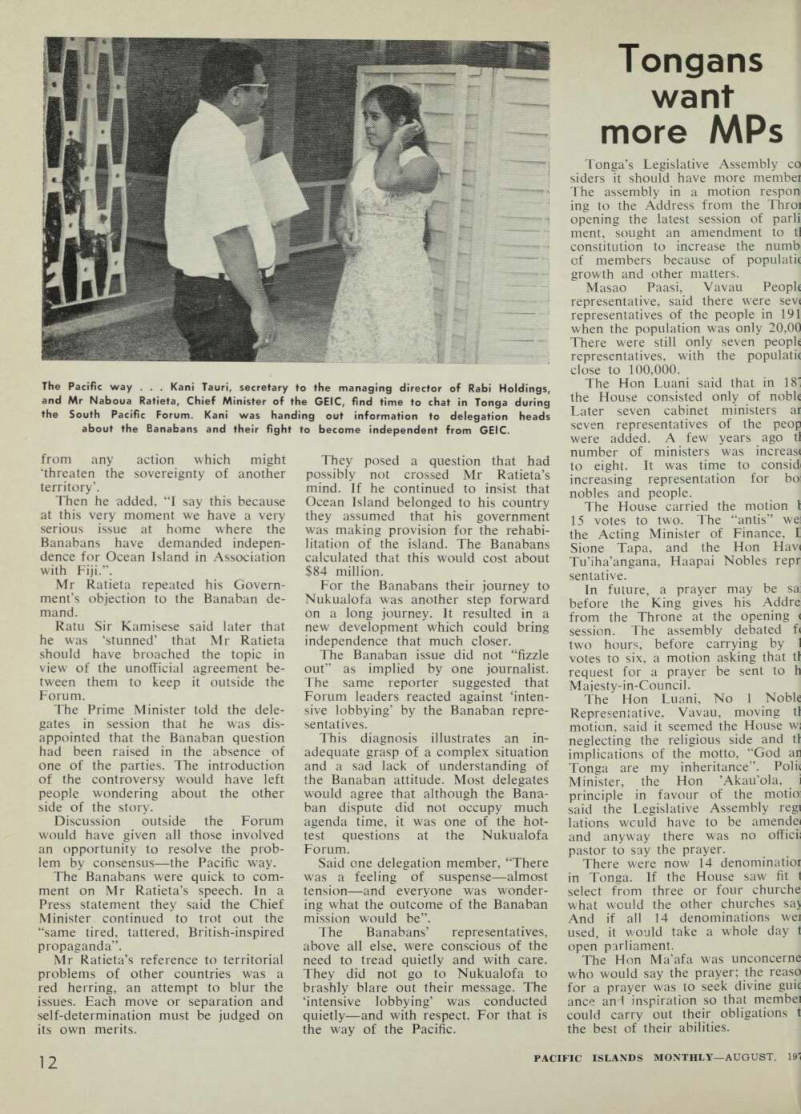
The Pacific way . . . Kani Tauri, secretary to the managing director of Rabi Holdings, and Mr Naboua Ratieta, Chief Minister of the GEIC, find time to chat in Tonga during the South Pacific Forum. Kani was handing out information to delegation heads about the Banabans and their fight to become independent from GEIC.