Islands People
pp. 78-80 · Read in the full issue
Deaths of Islands People
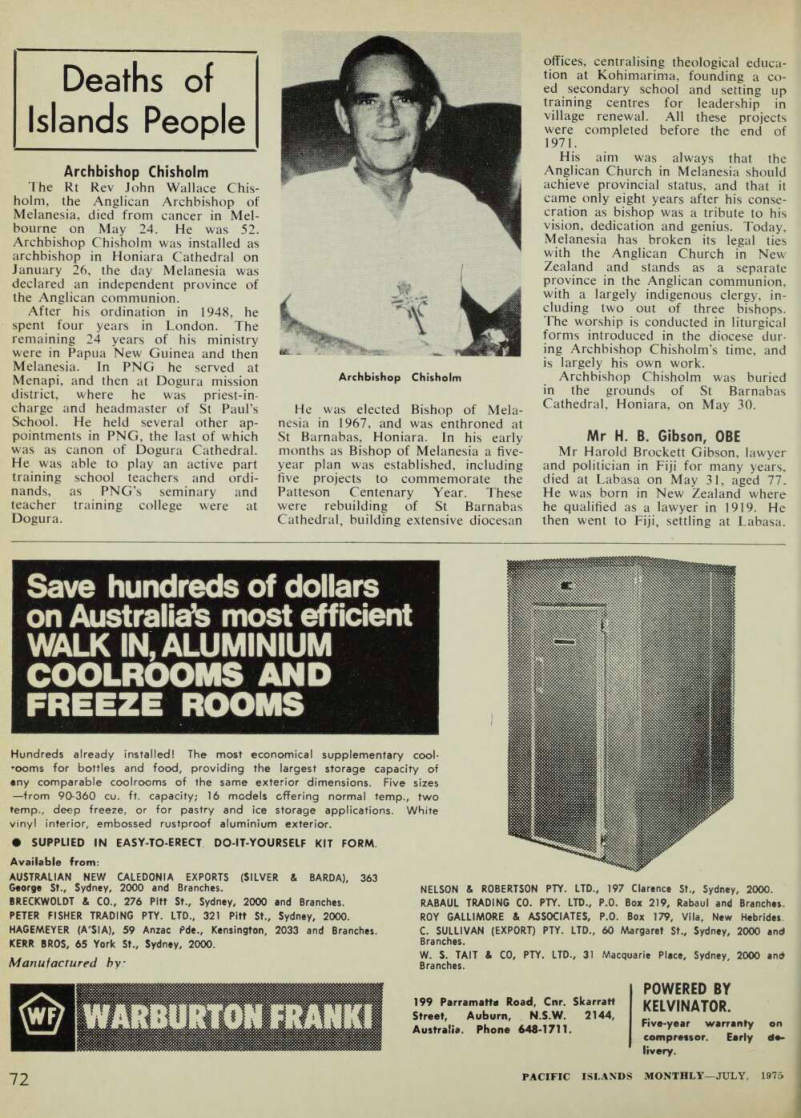
Archbishop Chisholm
The Rt Rev John Wallace Chis holm, the Anglican Archbishop of Melanesia, died from cancer in Mel bourne on May 24. He was 52.
Archbishop Chisholm was installed as archbishop in Honiara Cathedral on January 26, the day Melanesia was declared an independent province of the Anglican communion.
After his ordination in 1948, he spent four years in London. The remaining 24 years of his ministry were in Papua New Guinea and then Melanesia. In PNG he served at Menapi, and then at Dogura mission district, where he was priest-in charge and headmaster of St Paul’s School. He held several other ap pointments in PNG, the last of which was as canon of Dogura Cathedral.
He was able to play an active part training school teachers and ordi nands, as PNG’s seminary and teacher training college were at Dogura.
He was elected Bishop of Mela nesia in 1967, and was enthroned at St Barnabas, Honiara. In his early months as Bishop of Melanesia a five year plan was established, including five projects to commemorate the Patteson Centenary Year. These were rebuilding of St Barnabas Cathedral, building extensive diocesan
offices, centralising theological educa
tion at Kohimarima, founding a co ed secondary school and setting up training centres for leadership in village renewal. All these projects were completed before the end of 1971.
His aim was always that the Anglican Church in Melanesia should achieve provincial status, and that it came only eight years after his conse cration as bishop was a tribute to his vision, dedication and genius. Today, Melanesia has broken its legal ties with the Anglican Church in New Zealand and stands as a separate province in the Anglican communion, with a largely indigenous clergy, in cluding two out of three bishops.
The worship is conducted in liturgical forms introduced in the diocese dur ing Archbishop Chisholm's time, and is largely his own work.
Archbishop Chisholm was buried in the grounds of St Barnabas Cathedral, Honiara, on May 30.
Mr H. B. Gibson, QBE Mr Harold Brockett Gibson, lawyer and politician in Fiji for many years, died at Labasa on May 31, aged 77.
He was born in New Zealand where he qualified as a lawyer in 1919. He then went to Fiji, settling at Labasa.
Archbishop Chisholm
He was admitted to practice as a barrister and solicitor in Fiji in 1927.
He developed an interest in politics, ind in 1937 was elected to the Fiji legislative Council, holding the seat ill his retirement in 1972, except for wo terms, when he was beaten at he elections by Mr F. G. Archibald.
Mr Gibson was a member of the Id Labasa Township Board, serving term as chairman. He was also a lember of the Fiji Visitors Bureau, nd several other organisations. In 950 he represented Fiji as a bowler t the Commonwealth Games in Auckland. In business, he was a irector of Eastern Hotels Ltd and le Labasa Electricity Co Ltd.
He leaves a daughter, Fay (Mrs foel Wareham), and a widow, Mrs era Gibson.
Vakatini Ariki Makea - Te - Pou - o - te - Rangi akatini Ariki, a Cook Islands heredi ty high chief, died at his home in laraerenga, Rarotonga, on May 21. ext day he was buried at the tra tional burial place of high chiefs Rarotonga, the ancient marae of aputapuatea.
Among those who attended the meral were Cooks Premier, Sir Ibert Henry, the Canadian High qmmissioner to New Zealand, Mr live Glover, and his wife, Makea ui Ariki, CBE, Kariki Ariki, women liefs of Rarotonga and Rongoma ne Ariki of Atiu Island.
Vakatini Ariki had held his title r 30 years, was a staunch supporter the Cook Islands Christian Church d, in his earlier years, was a keen anter and sportsman. He married ain after his first wife died and has e children in the Cook Islands and hers in New Zealand.
Mr N. E. Nilsen Mr Nils Emil Nilsen, who was )sely linked with the goldmining lustry at Vatukoula in Fiji for my years, died on April 17, aged . He helped to develop two mines, nperor and Dolphin, and the com inities at Vatukoula. He was a quent visitor to the mine from dbourne till some years age, when and other members of the nperor Gold Mining Co Ltd re ned after what amounted to a take tr by a number of shareholders.
In Australia, he held senior execu e positions in a number of mining ripanies. In 1970, he was awarded Australasian Institute of Mining i Metallurgy medal for outstanding vices to Australian exploration, aing and metallurgical operations, e award mentioned his work at Emperor mine.
Vlr Nilsen leaves a widow, a son 1 daughter.
Mr S. D. Marshall, MBE Mr Sidney David Marshall, who died in Sydney on May 7 aged 72, was the first airman to fly solo from Papua to the Australian mainland.
Mr Marshall was an engineer in Guinea Airways, at Lae, from 1930 to 1936.
In 1934, when he went on leave, rather than follow the conventional method of a sea passage, he decided to fly. His route took him from Lae to Port Moresby, then across the Coral Sea to Cooktown, and down the coast to Mascot airport in Sydney.
The flight, in a Westland Widgeon monoplane, took 3± days. Later that year he flew back to Lae.
When he left Lae in 1936 to re turn to Australia he left the aircraft behind, but went back in 1937 to pick it up and fly it back to Australia.
In 1937 he flew Daily Telegraph reporters to Rabaul to cover the volcano eruption which devastated the town.
Back in Australia, with three small aircraft, Mr Marshall set up an aerial ambulance service, operating from Mascot. Later he transferred to Bankstown airport. His business also included charter flights and aircraft maintenance. He was active in busi ness up till his death.
Maj-Gen B. M. Morris Major-General Basil Moorhouse Morris, CBE, DSO, who was re sponsible for the civil government of Papua New Guinea during and after World War II as Commander of the Australian New Guinea Ad ministrative Unit (ANGAU), died at Beaconsfield, Victoria, in April. He was 87.
The third son of a Hertfortshire (England) solicitor, who became Registrar of the Diocese of Mel bourne, he was born in Melbourne in 1888. After education at Mel bourne Grammar School and Trinity College in the University of Mel bourne, and a short spell as a jackeroo, he joined the Royal Aus tralian Garrison Artillery Regiment.
He was a Lieutenant when World War I broke out in 1914 and an original officer of the Siege Artillery Brigade. He was three times men tioned in despatches and was awarded the DSO in 1917.
A soldier by temperament and pro fession, he rose in rank until at the outbreak of war in 1939 he was Director of Supplies, Transport, Movements and Quartering at Aus tralian Army Headquarters. In 1940, as Brigadier, he was appointed Commandant of the Australian Over seas Base and posted to Delhi as Liaison Officer.
Morris went to Papua in 1941 as
Officer Commanding the Bth Military District. His was a daunting task.
The Australian soldiers in Port Moresby, though they later proved themselves in battle, were untrained and disorderly. An uneasy partner ship began with a confused civil government under H. Leonard Murray, the Administrator of Papua.
After receiving news of the Japa nese advance from Rabaul, and be lieving government control over Papua to be worsening, Morris de cided to cut the Gordian knot in February, 1942. He drafted a plan for the transfer of Papuan affairs to himself and requested Murray’s de parture within three days. The plan was backed by Lieutenant-General Sydney Rowell, Morris’ immediate superior in Australia.
Unhappily, Murray at first refused to leave without confirmation and told Canberra that in these circum stances he would not go unless placed under arrest and deported.
Thus, at one stroke Morris ended almost 40 years of Murray tradition and acquired the reputation of a soldier who rode roughshod over civilian feelings. Undoubtedly the looting of stores by soldiers in Port Moresby did not enhance his reputa tion in early 1942; but he claimed the exigencies of war had diverted his attention. Though most of the blame for the looting lay with Aus tralian Army headquarters, for a time Morris attracted a shower of abuse in Australia and was roundly criti cised by PIM.
Morris’ plans for Papuan adminis tration were innovative. He was more avuncular in his approach to Papuans than some of his ex-New Guinea ANGAU officers who gave the Papuans a rough handling. He argued that while he was in absolute control, and money was available, there should be rapid expenditure on schools to overcome the pre-war stag nation in Papuan education. Such a chance, he said, might never happen again.
When the Japanese threat receded, Morris turned his energy to the establishment of secondary education, starting with an army base at Sogeri which he turned into the Papuan Central Training School. His main interest was in the training of Papuan medical practitioners.
It was fitting that one of his con tributions was in the field of educa tion, since he came from a noted family of educationists. His sisters had begun the Melbourne Church of England Grammar School for Girls (Merton Hall) and his brother.
Canon W. P. F. Morris, was the founder of the Church of England
Grammar School (Churchie) in Brisbane.
In some European quarters Morris did not regain popularity, because ANGAU was believed to have been tardy in handing over control to civilians.
An example of his bluff solutions to complex problems was the matter of military chaplaincies. When there were church protests about Morris’s plan to use a consecrated Anglican field chapel for ecumenical services, Morris snapped, “None of that here, this is the Parish Church, I am head of it, and it is for everybody”. Here on Sundays, Morris read the lessons and Merari Dickson from Kwato (later the first Papuan MLC) con ducted the church choir. Music was another of Morris’ interests. He established the Pacific Islands Regi ment band and organised a post-war tour of Australia.
Although Morris had a reputation for bluntness, it should be put on record that the leader of one organi sation in Papua asked Canberra to have him appointed Administrator of the combined territories after the war.
It was argued that his progressive policies, personal integrity and strong humanitarian sympathies fitted him for the post. But he was recalled.
His final wartime broadcast to Papuans i : July, 1945, ended with the words, “You are Papuans. You are men. You, too, need to do every thing you can to keep your country”.
On leaving Papua New Guinea in
June, 1946, he retired from the Army.
At the funeral service in St John’s, Beaconsfield, the panegyric was de livered by Archbishop Strong. Major- General Morris leaves a widow and
five daughters.-
D.F.W.
Tamasese Meatuai Solialofi Tamasese Meatuai Solialofi, a daughter of the late Tupua Tamasese Lealofi I, of Western Samoa, died in hospital in Auckland in April, aged 77. She was an aunt of the Prime Minister of Western Samoa Tupua Tamasese Lealofi VI. She went to New Zealand in 1972.
Mr A. Tupouniua Mr ’Alipate Tupouniua, who gave a lifetime of service in a number of areas in Tonga, died recently. He was once a Member of Parliament, and served on the Produce and Copra Boards till those boards became part of the Tonga Commodities Board in 1974. He also served the community as an inspector of schools for the Free Church of Tonga, in which he was a lay preacher.
He leaves seven sons and two daughters. One of his sons is Mr Mahe Tupouniua, director of the South Pacific Bureau of Economic Co-operation. Two other sons are well known in education fields— Penisimani, as principal of Tonga High School, and Sione as a lecturer at the University of the South Pacific.