To market—
p. 75 · Read in the full issue
by the seat of your pants
From Capt Noel Bellamy
in Port Moresby
To the north-east of Port Moresby, 35 air miles (or two days walk), nestling in the valleys under the shadows of the Owen Stanley Range and just below “The Gap” are five of the most unlikely airstrips served by regular public transport aircraft.
These strips range from 1,700 ft above sea level to 3,900 ft and vary in length from 1,300 ft to 1,900 ft.
Each of these strips can only be approached from one direction and once an approach to land has been started there is no alternative.
Usually, the cloud coverage is extensive with a base of some 2,500 ft and as often as not ground fog blankets the valleys. The strips, named Naoro, Manari, Efogi, Kagi and Munumu, have fairly irregular surfaces and Manari, Efogi and Kagi are steeply sloped. Efogi rises rapidly up to a ridge and then flattens out at the top. It also has a bend in it.
Why a regularly-scheduled service into those strips? I took Bruce Adams, a well-known aviation photo grapher, into Efogi and he goggled at the thought of operating in the narrow valleys let alone landing.
The Seventh-day Adventists have most mission centres in the area and, with the aid of the locals, the Koiaris, who are bushmen and hill people, and the Department of Agri culture, have developed a cash crop programme, specialising in citrus fruits, especially mandarins.
Citrus is perishable and wouldn’t survive the long haul down the Ko koda Track to Owers Corner and Port Moresby. That’s where aircraft come in.
Aerial Tours of Papua New Guinea took a look at the scene and, with the help of the very versatile Britten Norman Islander—one of the
most popular flying work horses in the South Pacific—set up a regular flight to market service.
The Islander can lift off the strips with around 726 kg (1,600 lb) but the actual load is dependent on the surface conditions prevailing at the time. Only specially-selected pilots, who’ve been given extensive training, are allowed on the market flights.
The BN2A takes 15 minutes flying time between Port Moresby and the “jungle” strips, but those 15 minutes are not without interest. To get into the main valley, a ridge of about 3,600 ft needs to be crossed and the cloud base invariably nestles on this ridge, so a “no see—no go” situation develops.
At Efogi the aircraft passes over the strip at 4,800 ft and begins a left turn on to a “down wind”, passing over Kagi only three miles away. Then, takes a further left turn to parallel the mountains to the west and descends towards the valley floor. The strip is on the edge of a cliff and runs into a dead-end where there is no chance of carrying out a missed approach—irrespective of the reason for wanting to do so.
With Bruce as passenger I came over the top at 80 knots, set the aircraft for landing, assessed the wind effect on the approach path and settled into a steady approach at 75 knots with sufficient power to allow for an adjustment to the flight path.
A glide approach is out of the question. Over the end, power was closed and the aircraft touched down at 55 knots, then power on again to get up the hill to the end of the strip.
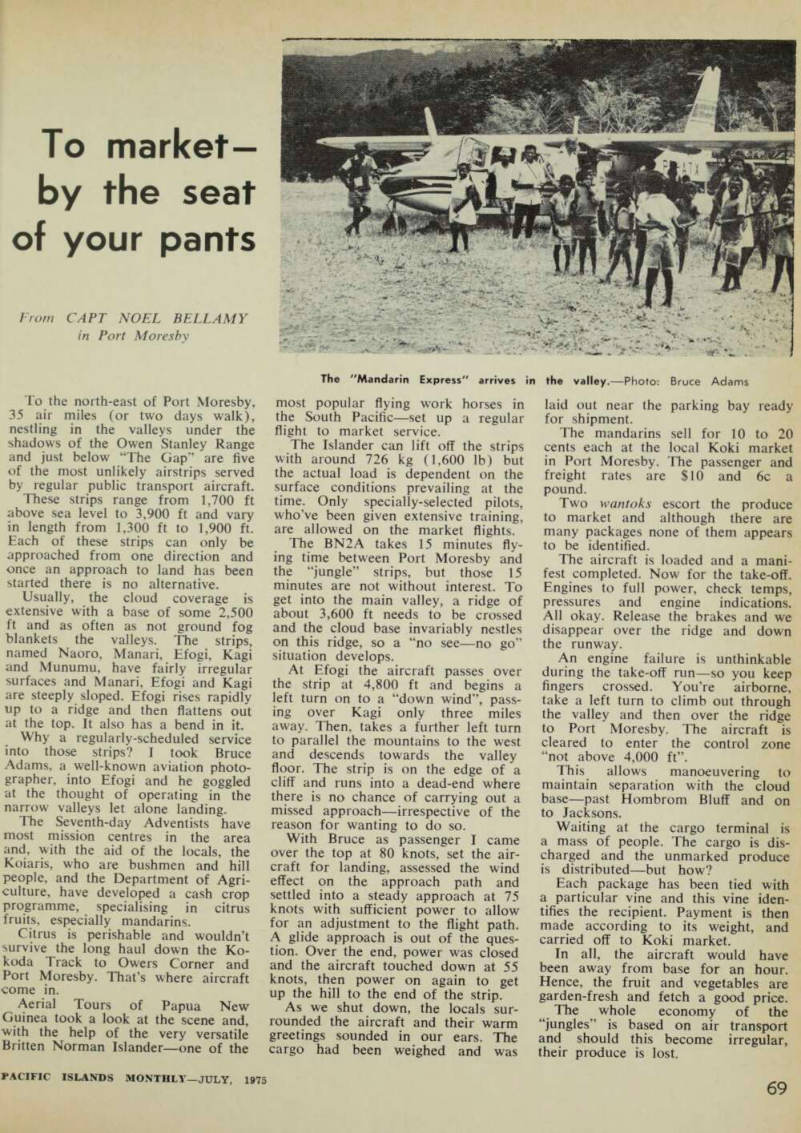
As we shut down, the locals surrounded the aircraft and their warm greetings sounded in our ears. The cargo had been weighed and was
laid out near the parking bay ready for shipment.
The mandarins sell for 10 to 20 cents each at the local Koki market in Port Moresby. The passenger and freight rates are $lO and 6c a pound.
Two wantoks escort the produce to market and although there are many packages none of them appears to be identified, The aircraft is loaded and a mani fest completed. Now for the take-off.
Engines to full power, check temps, pressures and engine indications, All okay. Release the brakes and we disappear over the ridge and down the runway.
An engine failure is unthinkable during the take-off run—so you keep fingers crossed. You’re airborne, take a left turn to climb out through the valley and then over the ridge to Port Moresby. The aircraft is cleared to enter the control zone “not above 4,000 ft”, This allows manoeuvering to maintain separation with the cloud base—past Hombrom Bluff and on to Jacksons.
Waiting at the cargo terminal is a mass of people. The cargo is dis charged and the unmarked produce is distributed—but how?
Each package has been tied with a particular vine and this vine iden tifies the recipient. Payment is then made according to its weight, and carried off to Koki market, In all, the aircraft would have been away from base for an hour, Hence, the fruit and vegetables are garden-fresh and fetch a good price.
The whole economy of the “jungles” is based on air transport and should this become irregular, their produce is lost.
The "Mandarin Express" arrives in the valley.— Photo: Bruce Adams