Pacific Transport
pp. 65-67 · Read in the full issue
Japanese In The Competition
For Png's Aviation Plums
By Ken Mcgregor
Overseas aviation links in the ature are up for grabs in Papua lew Guinea and it appears the race between Qantas and Japanese in vests.
The competitive situation follows ic release, in recent weeks, of a :nder by the PNG Government for peration of the territory’s overseas ffieduled air services in the im lediate period following indepen mce.
Nature of the tender—and its nplications—have excited consider ate interest throughout the regional /iation scene. It is but the latest in South Seas air mtings, which have stayed most ilatile and uncertain during the ast 10 years.
The question mark on PNG air rvices externally comes on the eve several significant events effecting e area, the most important of which elude: • Introduction by Fiji-based Air icific of its first “fast” route to ustralia, Nadi to Brisbane, via ily one stop, Noumea. • The arrival, in July, of a 100issenger capacity Boeing 737 jet— th final seat configuration unknown -for Noumea, which will tempo rily at least expand its all-jet fleet three. • Advanced examinations by ihiti-based Air Polynesie, of its lall-jet requirements, with forays :o the Cooks and Fiji most likely. • Increased pressure by Asian rriers, Thai International and igapore Airlines, for traffic rights
:o American Samoa/Tahiti, and
ji, respectively.
• Reports that Apia-based Poly sian Airlines may go into jets, at Air Pacific may recall its leased lll jet from Africa for an tended Nauru run into Majuro and awaii, plus word of an aviation reement close between Tonga and mru.
PNG, however, is the biggest
aviation story around, in view of what equipment it may use, who it will use for expertise as its initial contractor and whence it will fly.
Obviously, first priority is to maintain links with Australia. Then there are other probables, such as Fiji, via the Solomons, New Cale donia and possibly New Zealand.
To the north, the possibilities are more interesting. Jakarta, West Irian, Singapore, Hong Kong, Manila, Japan and even Hawaii are all there.
Traffic rights and scheduled passenger
seat capacities have yet to be deter mined.
Then who will operate the service as the territory is apparently in capable of doing this at first?
Japan is reported to be lobbying strongly, both with a view to selling YS-11 aircraft to internal carrier, Air Niugini, and selling Boeing 727 (from All Nippon Airlines) jets to operate the actual external services.
Boeing 727 sales to PNG would be a massive success for the Japanese, should they pull it off. It would eclipse other sales of Boeing 7275, model 100, that the domestic carriers in Australia, TAA and Ansett, are also trying to flog to the territory.
Acquisition of jet aircraft could well mean PNG might drop the idea of using outsiders to manage the ex ternal service.
One report has it Air Niugini would go the PNG-Australia service alone, with behind-the-scenes Japanese help. And that’s after buying out Qantas, Ansett and TAA sharehold ings in Air Niugini.
If this happens, it would mean a loss in influence for Australia’s De partment of Transport, the unwieldy dispersed mass of Minister Charlie Jones, which would have had a say in PNG’s civil aviation had Qantas won the external deal.
Qantas could well do this, of course. It has confirmed that the Australian international carrier is, indeed, tendering, to PNG, to carry the independent country’s first over seas air services under contract.
Here, it goes in with previous ex perience and a proven record in aiding carriers of developing countries find their feet—there are a couple of south-east Asian examples, plus, of course. Air Pacific, which still has a Qantas chairman.
Qantas’ reputation in PNG is understood to be much better than when it left operating both the terri tory’s domestic and external air services several years ago. It has
since returned, as an overseas carrier only, and promotes PNG as part of its services into south-east Asia.
Both Ansett and TAA are under stood to be other tenderers to Port Moresby, and at least one other is having a go. One report claims the hopeful here is the American, Conti nental Airlines, another says a Japanese operator, probably All- Nippon Airlines itself.
The tender taps a period when Air Niugini has delayed a decision on acquiring additional non-jet equip ment for domestic work. Contenders here were the Japanese, with the 60passenger YS-lls, and several second hand Fokker F27s from Ansett.
Air Niugini was supposed to be making its mind up on this one on May 6, but did not do so and it continues to lease four Ansett Friend ships.
A YS-11 decision would be a brave one and would be the first scheduled Japanese aircraft route operation in the South Pacific. This aircraft is out of production, while Fokker has recently increased pro duction of its F27s.
Ha'apai Gets
Its Airstrip
Ha’apai Island in May made a great leap into the 20th century when a 2,300 ft coral airstrip was opened.
There was a wild welcome for the 10-seater Britten-Norman Islander which made the flight from Nuku alofa to mark the occasion. It was all done in typical Tongan fashion.
The welcome ceremony (haunga)
was followed by a feast, speech making and dancing.
The dancers were keen and pre pared to go on all afternoon; it was only when they were told that the aircraft had to return to Nukualofa that they reluctantly gave up.
The aircraft was piloted by Ray Robertson. VIP passengers for the flight were Princess Pilolevu, the Acting Prime Minister, Tuita, Prin cess ’Ofeina, Mrs Kalo Kakafanua and the Director of Works, Mr Chris Welford.
The distance between Nukualofa and Ha’apai has now shrunk to a mere 50 minutes. It used to take half-a-day by sea.
The airfield has been named Salote Pilolevu Airfield. The runway, fenc ing of safety surrounds, terminal and landing aids cost $54,000. Internal Air Service will make a weekly flight to Ha’apai, on Saturdays.
More Services
For Air Pacific
Air Pacific is extending its regional services. A new overseas service is a weekly flight from Nadi to Bris bane, via Noumea. The frequency of the Fiji-Auckland services, via Tonga, has been stepped up from two to three a week. Most of the traffic on this route is between Tonga and Auckland and return.
However, the airline will lose one service to Air Niugini—the Honiara- Port Moresby “leg” of the Nadi-Port Moresby service. The Nadi-Brisbane service, via Vila and Honara, has been rescheduled so that it can con nect with Air Niugini services at Honiara.
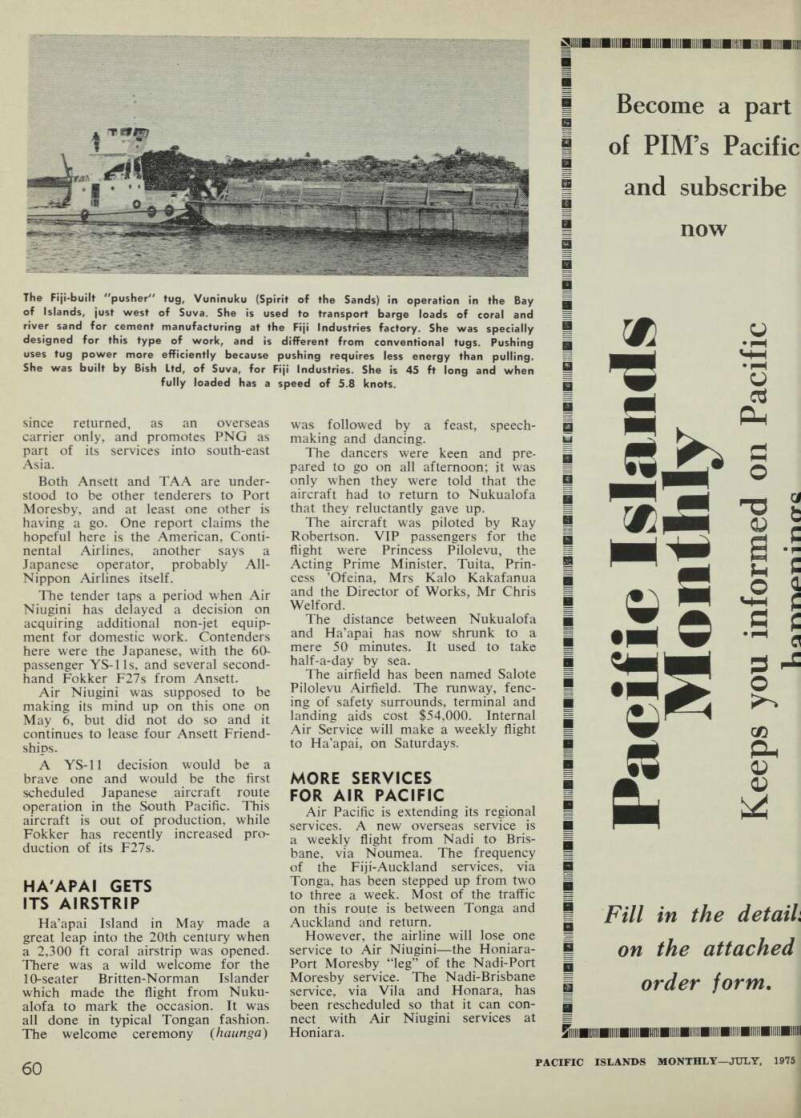
The Fiji-built "pusher" tug, Vuninuku (Spirit of the Sands) in operation in the Bay of Islands, just west of Suva. She is used to transport barge loads of coral and river sand for cement manufacturing at the Fiji Industries factory. She was specially designed for this type of work, and is different from conventional tugs. Pushing uses tug power more efficiently because pushing requires less energy than pulling.
She was built by Bish Ltd, of Suva, for Fiji Industries. She is 45 ft long and when fully loaded has a speed of 5.8 knots.
Kava, Not Champagne
For Tui Cakau
The Tui Cakau, the shipping company-union owned ship operating between New Zealand, Fiji and Western Samoa since May, went into service after a launching, which in cluded Fijian ceremonies.
Formerly the Capitaine La Perouse, operated by Sofrana-Unilines, she is now owned by that company, the Carpenter group in Fiji and the Fiji Waterside Workers and Seamen’s Union.
The ship was built in Norway in 1951, and has been in the Pacific for about two years. She can carry 2,800 tons of cargo and has accommodation for 12 passengers.
The ship was officially renamed by Adi Salote Lalabalavu, daughter of the Tui Cakau, Ratu Ratavo Lala balavu, who was guest of honour.
Shaw Savill Sails Out
Of Cruise Market
Economics are forcing Shaw Savill 0 quit the cruise market. The ship ping line’s last cruiser, the Northern star, 24,000 tons, will be withdrawn Tom service in October. Shaw Savill operated three passenger cruisers, the Northern Star, the Southern Cross md the Ocean Monarch. The kmthern Cross was sold in 1971 and he Ocean Monarch will be scrapped.
Shaw Savill cruised in the Pacific rom Australia from December to \pril. Island groups visited were the 4ew Hebrides, New Caledonia, Fiji, Ponga, American Samoa, Western ►amoa and Tahiti. A spokesman for he line said it had become un economic to run one passenger ship, mel costs alone had risen by more han 300 per cent in 18 months. • Air Melanesiae has been advised •y the Civil Aviation Department in he New Hebrides that it may resume wice-daily flights to Norsup. The trip was closed in mid-December, .ater, daily services were allowed. • Twenty-three politicians and usinessmen of Koror have launched campaign to have a port developed 1 Palau for a super tanker. They ave started a “joint planning effort”, t was reported recently in Micro lesia that more than SUSSOO,OOO ad already been spent on a study explore a plan to bring together JS, Japanese and Iranian financial nterests for the project, the first base of which will cost more than 600 million. • Air Pacific Inc, of Guam, re ently added a DC3 aircraft to ouble its one-plan effect. The air raft will be used on a service be ween Guam and the Marianas.