Books, Reviews, writers
pp. 58-59 · Read in the full issue
Did early Spanish forebears help develop Polynesian skills?
A remarkable tribute to Polynesia’s ancient culture is that, a century and more after it disintegrated, Europeans are still arguing about its origins and development.
New theories abound. Some claim these remote, subsistence-living islanders could only have achieved a high civilisation with outside influence; Americo-Indians, Peru vians, even ancient Egyptians; anyone but the Polynesians themselves. Now comes Robert Langdon to trail his scholarship among the ethno-historians with The Lost Caravel.
Not for him the romantic notions of von Daniken, a product of the flying saucer age, convincing himself that Toltecs, Incas, Egyptians had the help of space ships and extra terrestial intelligence. Langdon’s superior beings were earthlings, land ing from a wrecked 16th century ship from Spain.
He begins with four coral encrusted iron cannon found in re cent times on the Tuamotuan atoll of Amanu. Research has convinced him they could only have come from a Spanish expedition to the Moluccas in 1526. One caravel, San Lesmes, was separated from the others some where between the Strait of Magellan and the Tuamotus, long known as the Dangerous Archipelago, and could well have piled un on one of those reef-encircled atolls.
Since no wreckage was found— Amanu, near the French naval air station on Hao, serving the atomic bomb site, had been examined by divers—Langdon assumes the vessel
was floated off again, that some of its 50 to 70 crew survived, landed somewhere, inter-married and pro duced fair-skinned descendants whose influence spread through the region.
He cites a folk legend of one light skinned castaway on Hao, another of a large sailing craft built and launched there, and reports by early Central Pacific voyagers of seeing people of vaguely European character istics on several islands, including the richly-endowed high island of Raiatea, which was by tradition the birthplace of a new religion that conquered Tahiti long before Wallis, Bougainville and Cook made it known to the outside world.
Impossible in a few hundred words to relate the complex, detailed argu ment Langdon elaborates in a very long book, often most persuasively.
He seems to have read almost every thing ever published on the Poly nesians, as befits the executive officer of tb#» National Univer sity’s Pacific Manuscripts Bureau, and
nonchalantly challenges the accepted wisdom of past experts. Some of his questions are shrewd ones, and are difficult to answer.
Why, he asks, did the Society Islands evolve an advanced, Euro pean-style sailing craft such as the Samoans and Tongans never knew: how did they come by European methods of measuring the horizon, even though they had no compass ; or use needles and knots to make their long fishing nets; where did the radically new Oro-worship come from, with its concept of an eternal father; and what about all those re ports of individuals among a pre dominantly dark population with fail skins, blue eyes and reddish hair?
How was it again that the new religion, spreading from the most famous of all marae (temnles) al Opoa, Raiatea, was irresistibly estab lished throughout the Society Islands by powerful chiefly families noted for their light skins?
To base any argument on skin
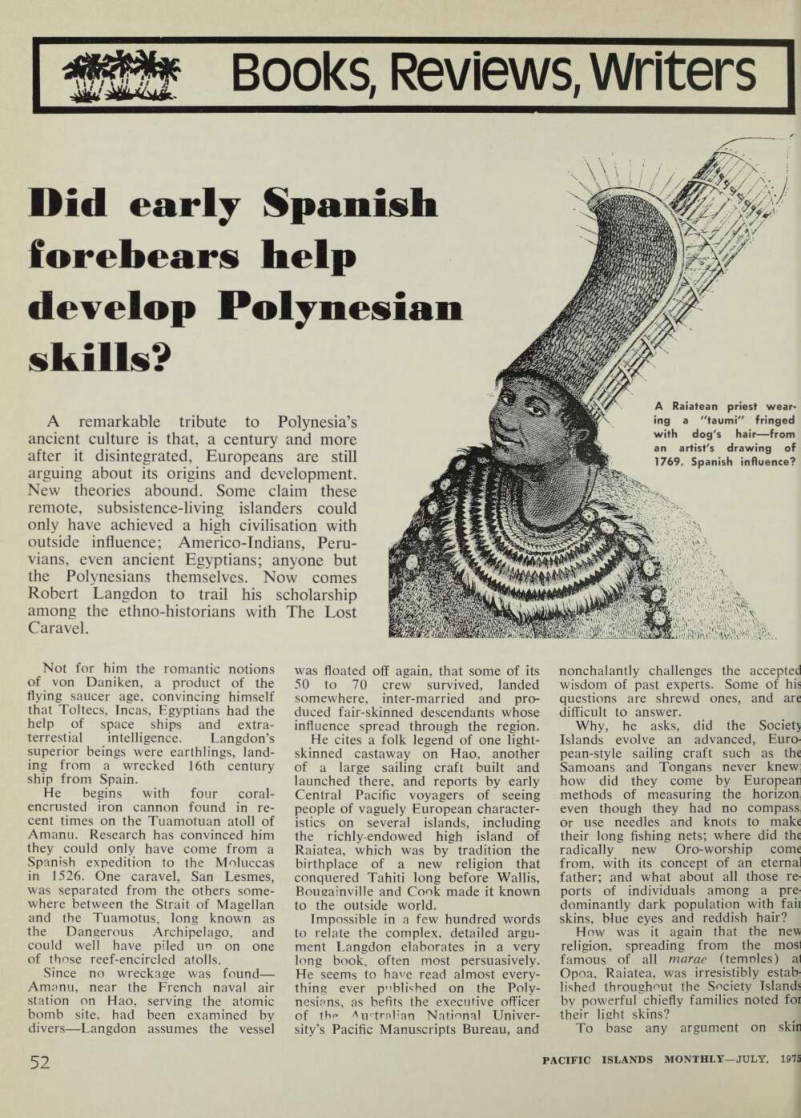
A Raiatean priest wear ing a "taumi" fringed with dog's hair—from an artist's drawing of 1769. Spanish influence?
colour is notably insecure. Especially, when we have only the ad hoc im pressions of 17th and 18th century visitors to rely on, plus a few artists who tended to idealise the Noble Savage.
Most ethnologists accept that the mi rahi, the high chiefs, were not jnly a separate caste, but belonged to a later wave of migration than the peasant cultivators they were assumed ;o have conquered. The chiefly families never exposed themselves to the sun, so that their lighter com plexions were as much a class dis tinction as a racial one (and still ire). Besides, Polynesians are not Negroid, and who is to say that hrow-backs cannot happen.
A scientific expedition I accom panied to the Papua New Guinea Highlands back in 1955 was similarly puzzled by light skins and hair, hough these people had been sealed pff from the outside world—or stray Spaniards—for millennia. As for the >ro cult, there are certain problems n trying to relate the inflexible logmas of Spanish Catholicism to parbaric human sacrifices and the exual permissiveness of its prosely isers, the Arioi Society, whose belief n incessant fun and feasting outraged ater Christians of all denominations.
The main burden of his argument s carried by the great folk hero, Hiro, said to have been a brilliant lavigator who led his followers far >eyond the Society group, colonising he Cook Islands and later New Zealand. Was he, too, a Spaniard mder his light Polynesian skin?
Bob Langdon’s claim here seems o run into a problem of mathe natics. Most authorities—including he great Maori anthropologist, Sir
Peter Buck—insist that the great double-canoe migrations from Raiatea to Tahiti, then from the Central Pacific to New Zealand, occurred between the 12th and 14th centuries.
As Langdon rightly states, these are vague calculations based on oral geneologies, estimating say 25 years to each generation. Supposing the space between generations was re duced to 20 years or less, he suggests, wouldn’t this place Hiro within the 16th century;, after the San Lesmes’ arrival?
Yet it doesn’t need a computer to
work out the number of possible Spaniards within that time-frame. He assumes that 30 out of a probable 50 to 70 seamen might have survived the caravel’s wreck. Even if they worked hard at fatherhood within the next generation or so, it was a mere handful of men to establish a new regime on neighbouring islands, overthrow the hereditary chieftains of Raiatea and Tahiti, create a strong new religion and make the first epic voyage to the Land of the Long White Cloud, which Langdon postulates might have been an attempt to get back to Spain by way of the Magellan Strait.
But where do we stand if the San Lesmes simply went down in those treacherous Tuamotuan seas, or if what survivors there were simply got eaten by the atoll-dwellers, as often happened in those times of acute
protein scarcity?
From my own experience of land ing through surf on one of those savage coral reefs, and in a modern iron-shod whaleboat, those Spaniards would have been lucky to get ashore at all.
Then we are left with no alterna tive than to believe that the Poly nesians were, after all, a creative and resourceful people, gifted in navigation, capable of evolving their own social and religious traditions, as much at home in a vast ocean as their forebears who crossed some two millennia earlier?
Well, that’s only my humble view.
—George Farwell.
THE LOST CARAVEL, by Robert Langdon. Published by Pacific Publications (Aust) Pty Ltd, Box 3408 GPO, Sydney, 2001. Price $14.50.)
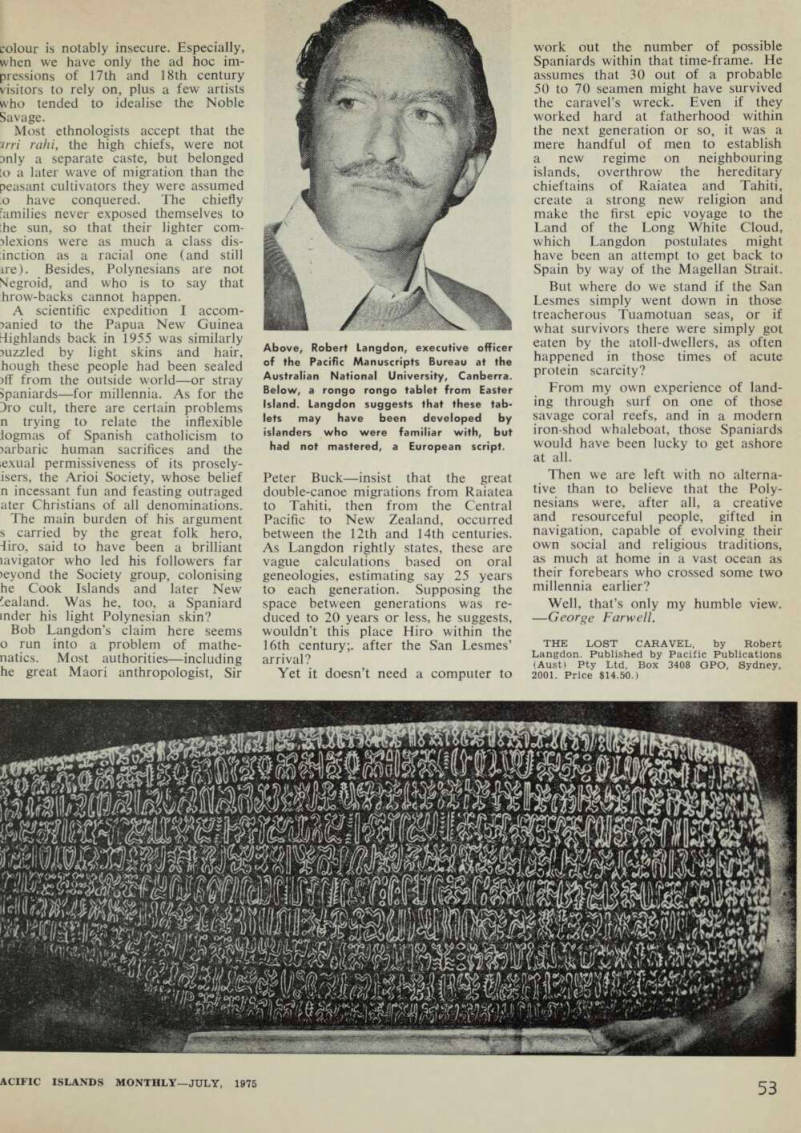
Above, Robert Langdon, executive officer of the Pacific Manuscripts Bureau at the Australian National University, Canberra.
Below, a rongo rongo tablet from Easter Island. Langdon suggests that these tab lets may have been developed by islanders who were familiar with, but had not mastered, a European script.