Yesterday
p. 42 · Read in the full issue
PIM was 25 years old in July, 1955, and to mark the occasion brought out a special issue with several quarter-century features, as well as the general coverage of Pacific news for which it had become so well known. Here are extracts from that silver jubilee issue: The five "top" advertisers who appeared in every issue from No 1 were Burns Philp and Co and subsidiaries, Brunton's Flour, W. R. Carpenter and Co, W. Kopsen and Co Pty Ltd, and Sil Rohu.
Dr K. W. Todd, of the Department of Health, Port Moresby, won the quarter-century colour photo competition, and a prize of $5O for a picture of a Mt Hagen huntsman.
A profusely-illustrated issue captured typical Islands' scenes, some recalling important events, such as the Royal visit to Fiji of 1953, war in the Pacific, the development of civil aviation, from Smithy's Southern Cross to Super Constellations, hurricane damage, and how the Pacific was affected by the world-wide depression of the early thirties.
An inquest was expected to throw some light on the deaths of five Bainings natives who were killed when attacking a patrol in New Britain in mid June.
A wounded native, taken to Rabaul, told of an outbreak of cargo cult in his village. The leader of the cult killed one man who refused to accept his ideas and badly wounded another.
Murder was so uncommon in Tonga that the kingdom suddenly had to look for a hangman. The government was looking into the possibility of appointing an official executioner, but with the hanging of two convicted murderers approaching, Nukualofa had inquired about the feasibility of sending a hangman from Suva to Tonga by plane.
The last execution in Tonga was in 1927. Fiji's hangman, incidentally, was a somewhat inaccessible person who lived away from Suva and journeyed into the capital when required— which was seldom.
The Commonwealth Government refused to have anything to do with changing the title of the head of administration in Papua New Guinea from Administrator to High Commissioner. An official statement to that effect was issued in response to a motion carried at the March session of the PNG Legislative Council, which sought the change.
The change was sought because Administrator was away down the list of precedence in a line-up of heads of other Pacific Islands territories, which boasted governors and high commissioners.
The linking of the Tamasese and Malietoa families of Samoa by wedding on August 6, would be one of Western Samoa's biggest occasions of recent years, PIM reported in July, 1955. More than 1,500 guests from all parts of Samoa were invited. The nine-tiered wedding cake was to come from New Zealand. In accordance with Samoa custom, the honour of supplying the cake fell to Mr P. Tufuga, of Wellington, paramount chief of one of the six ruling houses of Savaii. Because there were nine sections in the family of Malietoa, a nine-tiered cake was required. The bride-to-be, Emi Papalii, was the daughter of Papalii Poumau, and heir of Malietoa Taimalelagi, the groom-to-be
was Tamasese Moegagogo, third son of the late Tamasese Leolofi and brother of the then Fautua.
The first wave of a planned migration of 120 Gilbertese from their overcrowded home islands to Gizo, in the Solomons, was scheduled for around the end of 1955. The first wave, of 30 adults, would establish gardens and temporary houses.
Wreckage of an American plane, lost near Cape Cumberland, at the northern tip of Espiritu Santo, in the New Hebrides in 1943, was found by Wong Bouko villagers. In the wreckage were the remains of the pilot and a gold identity plate and chain. In 1943, a US Army listening post at Santo made contact with two American planes which were running out of fuel and asked about the possibilities of landing near Cape Cumberland. It was night; there were no landing grounds in the area, and the mountain-and-jungle country made landing impossible.
One plane went down in the sea and disappeared without trace, and the second crashed into a mountain. One airman survived. After wandering for two days he was found by New Hebrideans. But all attempts then to find the aircraft failed.
New Caledonia's all-embracing system of "credit" provided one of the most interesting passages in a report on the territory. Credit was offered for everything from postcards to cars. The main objective of credit accounts was to make sure of the client's "commercial property". When articles were scarce, the cash customer was often rebuffed, as the goods were reserved for credit clients. Young government employees arriving from France were offered all house furnishings on credit, as well as cars, and a government servant without a car was likely to be "deconsidered". When he returned to France, the government servant could not take his possessions with him because of excessive freight charges, and so he sold the goods— often to the original vendors at a heavy loss. Usually the articles were refurbished and resold to start a new profitable cycle. The Assembly, after the report was made public, moved to curb the credit system as far as
possible.
Off on her second voyage following extensive and expensive repairs, the Papeete vessel, Hiro, 183 tons, crashed on to a reef as it approached Taunoa Pass. Fortunately it was in shallow water. She was able to get clear and make her way to Papeete after passengers and cargo were unloaded.
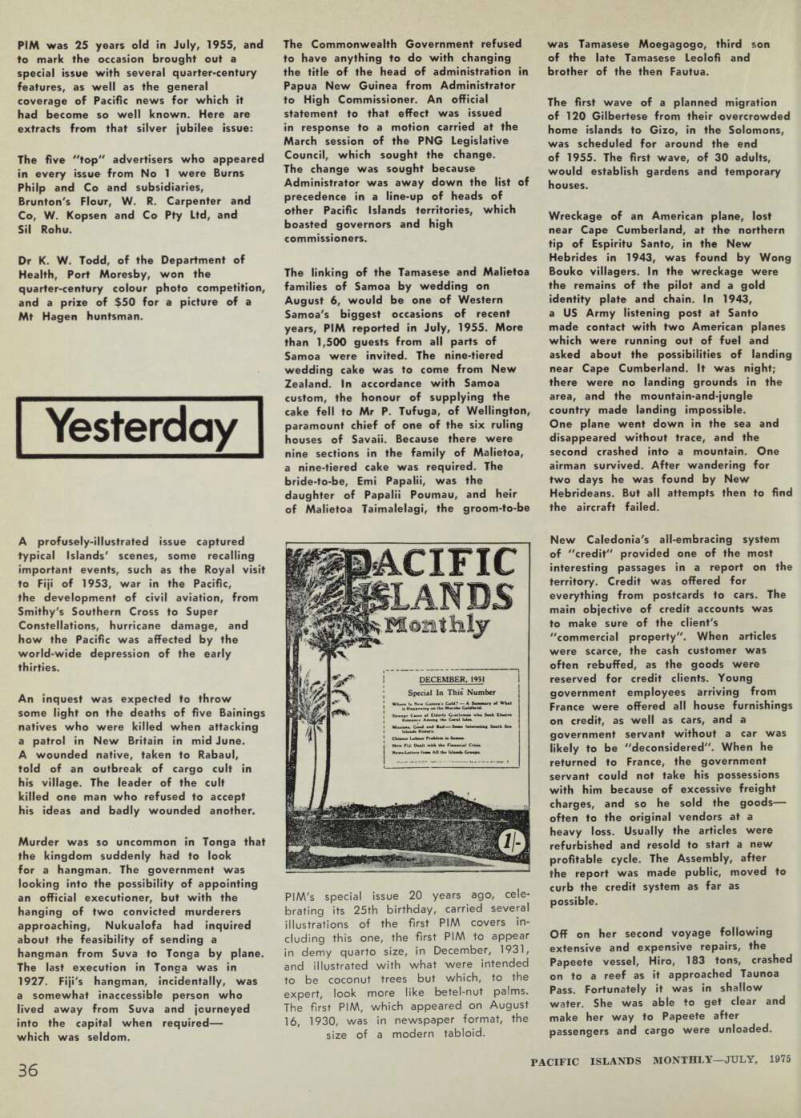
PIM's special issue 20 years ago, cele brating its 25th birthday, carried several illustrations of the first PIM covers in cluding this one, the first PIM to appear in demy quarto size, in December, 1931, and illustrated with what were intended to be coconut trees but which, to the expert, look more like betel-nut palms.
The first PIM, which appeared on August 16, 1930, was in newspaper format, the size of a modern tabloid.