extracts colonial glue'
p. 26 · Read in the full issue
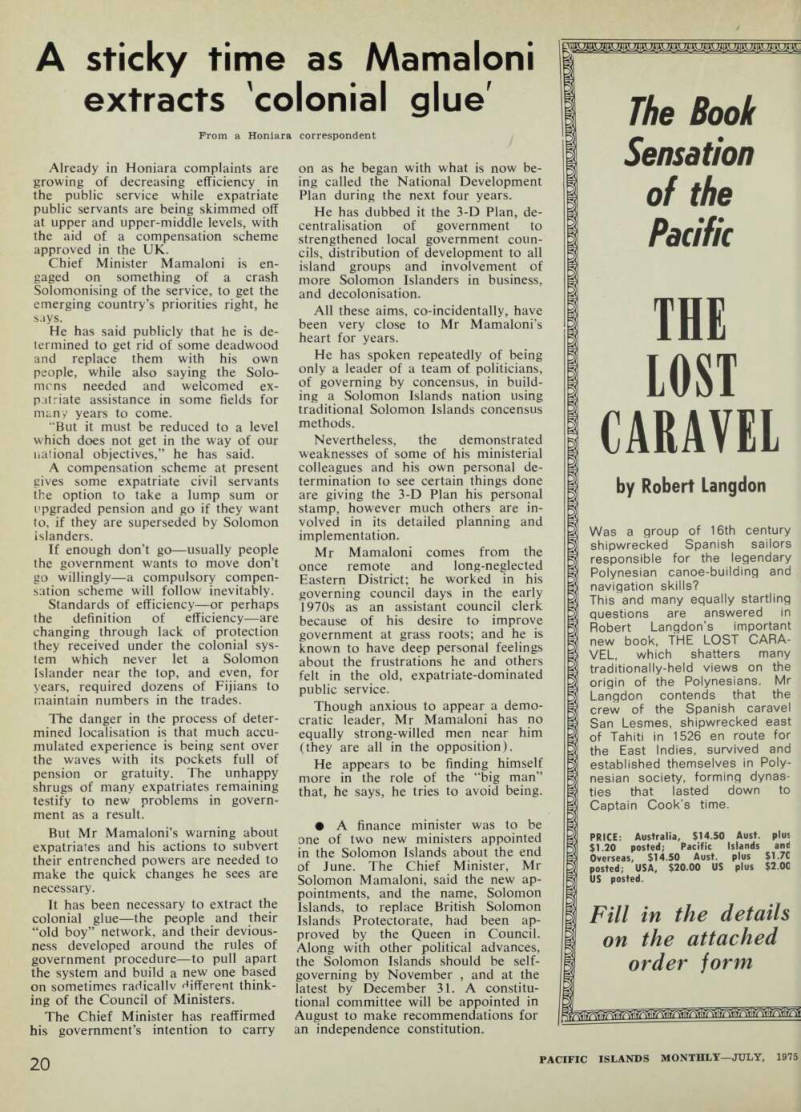
A sticky time as Mamaloni extracts colonial glue'
From a Honiara correspondent
Already in Honiara complaints are growing of decreasing efficiency in the public service while expatriate public servants are being skimmed off at upper and upper-middle levels, with the aid of a compensation scheme approved in the UK.
Chief Minister Mamaloni is en gaged on something of a crash Solomonising of the service, to get the emerging country’s priorities right, he says.
He has said publicly that he is de termined to get rid of some deadwood and replace them with his own people, while also saying the Solo mens needed and welcomed ex patriate assistance in some fields for many years to come. ‘But it must be reduced to a level which does not get in the way of our national objectives,” he has said.
A compensation scheme at present gives some expatriate civil servants the option to take a lump sum or upgraded pension and go if they want to, if they are superseded by Solomon Islanders.
If enough don’t go—usually people the government wants to move don’t go willingly—a compulsory compen sation scheme will follow inevitably.
Standards of efficiency—or perhaps the definition of efficiency—are changing through lack of protection they received under the colonial sys tem which never let a Solomon Islander near the top, and even, for years, required dozens of Fijians to maintain numbers in the trades.
The danger in the process of deter mined localisation is that much accu mulated experience is being sent over the waves with its pockets full of pension or gratuity. The unhappy shrugs of many expatriates remaining testify to new problems in govern ment as a result.
But Mr Mamaloni’s warning about expatriates and his actions to subvert their entrenched powers are needed to make the quick changes he sees are necessary.
It has been necessary to extract the colonial glue—the people and their “old boy” network, and their devious ness developed around the rules of government procedure—to pull apart the system and build a new one based on sometimes radicallv riifferent think ing of the Council of Ministers.
The Chief Minister has reaffirmed his government’s intention to carry
on as he began with what is now be ing called the National Development Plan during the next four years.
He has dubbed it the 3-D Plan, de centralisation of government to strengthened local government coun cils, distribution of development to all island groups and involvement of more Solomon Islanders in business, and decolonisation.
All these aims, co-incidentally, have been very close to Mr Mamaloni’s heart for years.
He has spoken repeatedly of being only a leader of a team of politicians, of governing by concensus, in build ing a Solomon Islands nation using traditional Solomon Islands concensus methods.
Nevertheless, the demonstrated weaknesses of some of his ministerial colleagues and his own personal de termination to see certain things done are giving the 3-D Plan his personal stamp, however much others are in volved in its detailed planning and implementation.
Mr Mamaloni comes from the once remote and long-neglected Eastern District; he worked in his governing council days in the early 1970 s as an assistant council clerk because of his desire to improve government at grass roots; and he is known to have deep personal feelings about the frustrations he and others felt in the old, expatriate-dominated public service.
Though anxious to appear a demo cratic leader, Mr Mamaloni has no equally strong-willed men near him (they are all in the opposition).
He appears to be finding himself more in the role of the “big man” that, he says, he tries to avoid being. • A finance minister was to be one of two new ministers appointed in the Solomon Islands about the end of June. The Chief Minister, Mr Solomon Mamaloni, said the new ap pointments, and the name, Solomon Islands, to replace British Solomon Islands Protectorate, had been ap proved by the Queen in Council.
Along with other political advances, the Solomon Islands should be self governing by November , and at the latest by December 31. A constitu tional committee will be appointed in August to make recommendations for an independence constitution.