melting pot
pp. 23-25 · Read in the full issue
A real stew in PNG's melting pot
From a Port Moresby correspondent
Not since the Japanese invasion lave so many things been together in the melting pot in Papua New Guinea —Independence is coming, at ast, on September 16; Papua Besena, dthough not now as aggressive, is dill hankering for secession; there’s ?een a row over who should be Head )f State and, finally, some Bougain fille leaders have sworn to wrest in lependence for their copper island fom PNG’s central government.
The House of Assembly, bearing he label—for constitutional purposes —of the National Constituent Assem >ly, wrestled and wrangled over Minister Michael Somare’s pro tosal that the Queen should be in ited to become Head of State of ndependent PNG and also bogged lown several times over the few re naming clauses in the constitution.
Opposition members said they /anted more time to consider the lauses and Mr Somare, still hoping a get his heart’s desire of indepen ence in September, and believing here was a plot to hold it up, asked ae House, “Can’t we trust each ther any more?”
He was fighting against proposals d adjourn the constitution debate 11 later in June. He managed to lake some progress. The Constituent Lssembly approved the preamble and Production early in June but didn’t et much further.
There were many angry exchanges nd a few choice phrases such as the utburst from Nationalist Pressure Iroup leader John Kaputin, who filed against delays in deciding con itutional issues with, “Why this de iy? Just because someone did not iclude some stupid bloody point in le motion”.
Mr Somare wasn’t far behind. In reference to Opposition leader Tei bal’s complaints that they weren’t sing given enough time to consider le constitutional proposals, the hief Minister accused “half-baked lack politicians, who lived like white lillionaires” of trying to delay in spendence and destroy the govern ient. It was obvious, he said, that
the Opposition United Party and the Nationalist Pressure Group were just plain power hungry.
But he made little progress and, eventually, the House decided to ad journ until June 23.
But, as events turned out, Mr So mare wasn’t beaten, and his heart must have sung with satisfaction on June 18 when he surprised everyone with his coup and named The Day in the House which had reverted to a House of Assembly. The roars of approval from members and the pub lic gallery told him he had timed it well. The suggested date of Septem ber 15 was changed because National Day had colonial ties.
The ease with which it went through on the voices was almost an anti-climax.
He also got undoubted satisfaction out of his victory over his proposal to invite the Queen to become Head of State. There was some loud op position to this at first. University students demonstrated against it and Mr Somare was accused of wanting to retain the trappings of colonialism.
Much of the opposition was engen dered through a mistaken idea of the Queen’s functions as Head of State, and once it was explained that it wasn’t something new; that she was Head of State at present and that someone PNG-born would be in the
position of honour as Governor- General, the fire went out of the opposition.
The National Constituent Assembly gave its approval on June 5, despite opposition from the Nationalist Pressure Group and the Country Party which saw their motion to de lete all reference to the Queen from the current draft of the constitution defeated by 57 votes to 26.
Soon afterwards, the Assembly passed on the voices its endorsement of that section of the constitution recognising the Queen as Head of State. All that remains to be done
in that respect is to choose the Governor-General.
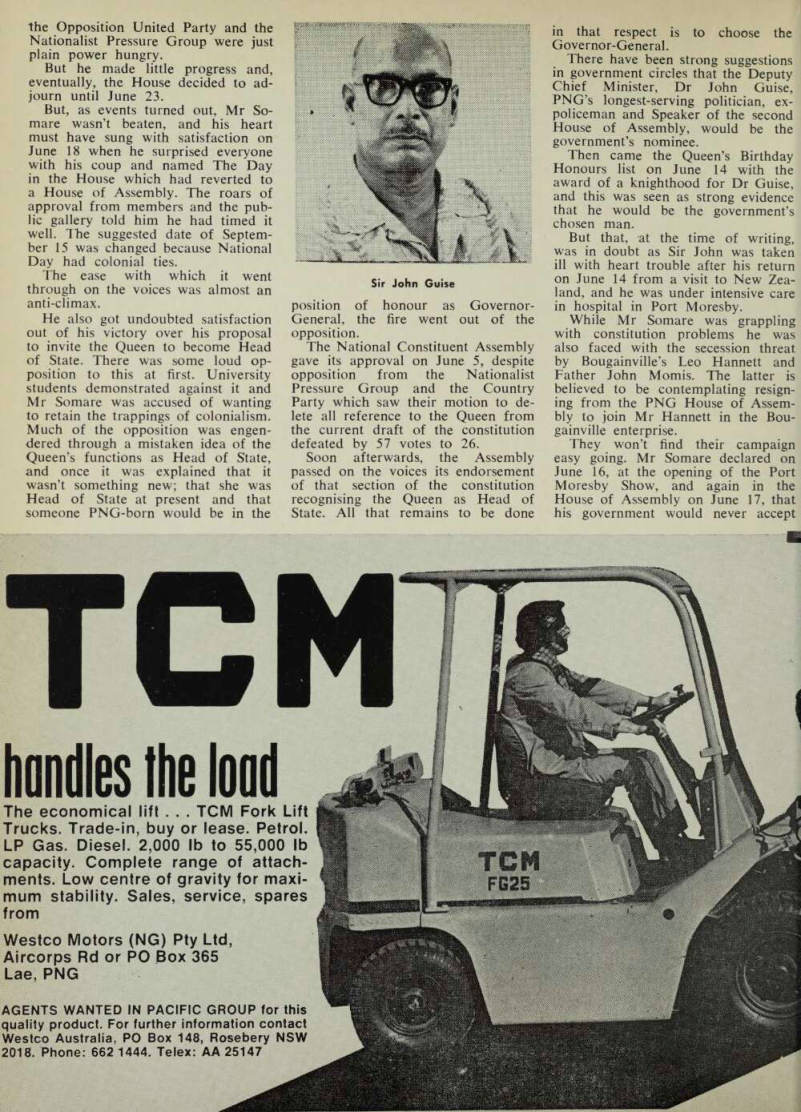
There have been strong suggestions in government circles that the Deputy Chief Minister, Dr John Guise, PNG’s longest-serving politician, ex policeman and Speaker of the second House of Assembly, would be the government’s nominee.
Then came the Queen’s Birthday Honours list on June 14 with the award of a knighthood for Dr Guise, and this was seen as strong evidence that he would be the government’s chosen man.
But that, at the time of writing, was in doubt as Sir John was taken ill with heart trouble after his return on June 14 from a visit to New Zea land, and he was under intensive care in hospital in Port Moresby.
While Mr Somare was grappling with constitution problems he was also faced with the secession threat by Bougainville’s Leo Hannett and Father John Momis. The latter is believed to be contemplating resign ing from the PNG House of Assem bly to join Mr Hannett in the Bou gainville enterprise.
They won’t find their campaign easy going. Mr Somare declared on June 16, at the opening of the Port Moresby Show, and again in the House of Assembly on June 17, that his government would never accept
Sir John Guise
the Bougainville secession threat seriously because it was a threat to the peace, stability and well-being of the whole country. It was essential, he said, that all the people of PNG should stand together.
About the same time, there were signs of increasing opposition to the secession threat from Bougainvilleans themselves who have accused the secessionists of being power-hungry.
Mr Simon Kariup, president of the Buka Local Government Council, who was a member of the Bougain ville negotiating team in abortive talks in Port Moresby about the island’s future, wrote to the Chief Minister on behalf of the people of north Bougainville saying the island should remain part of PNG.
Mr Somare made a further state ment in the House of Assembly when ne told members there had been a breakdown in communications be ween his department and Bougain ville Provincial Government execu tes. He had not been aware that heir representatives wanted to talk ibout secession rather than about a vorks programme when they met in 3 ort Moresby.
The Bougainville representatives lad said that secession was a non legotiable issue, but there had been io direct communication with him.
“National unity is also non
negotiable”, Mr Somare told the House. “National unity is something no individual or group can violate or be allowed to discard or destroy just because it suits an unprincipled, unselfish political desire”.
Mr Somare also explained that it had been decided that all royalties on copper from Bougainville would go, after June 30, to the Bougainville Provincial Government for it to spend according to its own priorities, although it could still negotiate an annual capital works programme with the central government.
Mr Somare added that he had in vited Bougainville regional member Mr Hannett to a meeting after the central government’s offer of a K 1.3 million programme for Bougainville had been rejected. Bougainville Pro vincial Government had asked for K 5.3 million. Mr Hannett did not attend the meeting.
Meanwhile, land is also coming back into the news. Plans to develop Wuvulu Island off the New Guinea north coast appear to have faded with a decision announced in the middle of June by the PNG Govern ment to resume land on the island, which had been bought by a group of developers, and hand it back to the islanders, who are Micronesians.
The proposal to develop the island and sell off half-acre blocks at $5,000
to $B,OOO was extensively promoted.
Film actor William Holden, who was one of 40 who had bought blocks, was in Papua New Guinea in June to try to salvage something from a plan to set up a sanctuary for wild life. With him was Sydney solicitor, Mr Colin Helliar, a director of Wuvulu Holdings, of Sydney, who was a driving force in the develop ment scheme.
They flew to Wuvulu to inspect improvements. Mr Helliar said he would ask the PNG Government for $1.5 million compensation.