aftermath
pp. 19-20 · Read in the full issue
When war’s aftermath came to Guam
M Frank J. Cunningham
on Guam a day-to-day activities on Guam, t to the Fifth South Pacific nes, residents hardly know that e than 106,000 South Vietnamese gees had found a temporary ;n on the island, heir presence has, however, stirred :ontinuing debate among island dators over executive authority, ied a minor shortage of water, ised some concern over the spread lengue fever and put nearly $3.5 ion into the local economy in a veek period. uam was used as a “staging ”, a place where refugees could placed for several days before ement to the mainland US. Its ive proximity to SE Asia allowed es to drop off refuges and return aigon for more. nee Saigon fell, the influx slowed iderably, but the lull only lasted May 7 when the first of a n or more cargo liners, freighters former South Vietnamese Navy i arrived at Guam carrying any e from several hundred to 4,000 ?ees in each ship, jspite the influx, people in the less, residential and recreational ; of the island saw little or no of the refugees. Feared food ages never developed. The only i hard to find were paint and igated sheet metal, and some bing supplies. ansportation and housing of the ;ees were completely the respon ty of the US military, with the n Government having almost no msibility. Abandoned or unused ary barracks, as well as empty icks for alien construction ers with private firms, were used ause nearly 20,000 people. But reat mass of refugees was housed ;nt City on Orote Peninsula.
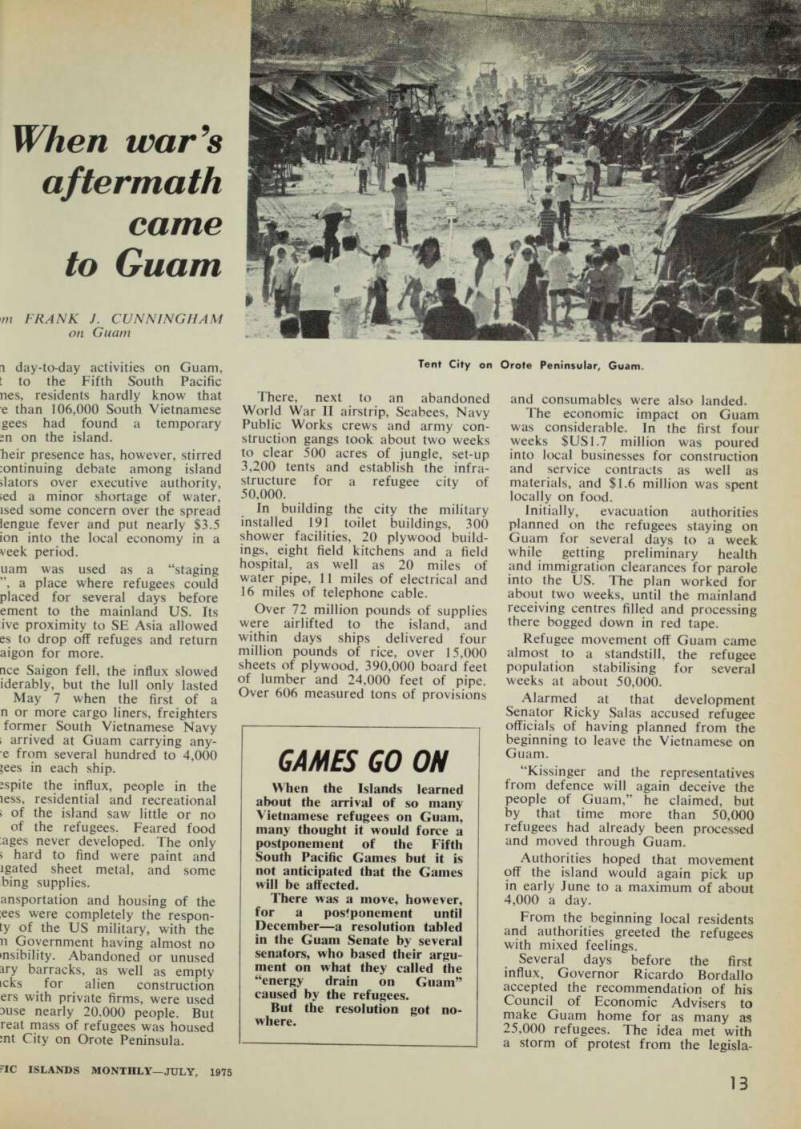
There, next to an abandoned World War II airstrip, Seabees, Navy Public Works crews and army con struction gangs took about two weeks to clear 500 acres of jungle, set-up 3,200 tents and establish the infra structure for a refugee city of 50,000.
In building the city the military installed 191 toilet buildings, 300 shower facilities, 20 plywood build ings, eight field kitchens and a field hospital, as well as 20 miles of water pipe, 11 miles of electrical and 16 miles of telephone cable.
Over 72 million pounds of supplies were airlifted to the island, and within days ships delivered four million pounds of rice, over 15,000 sheets of plywood, 390,000 board feet of lumber and 24,000 feet of pipe.
Over 606 measured tons of provisions
and consumables were also landed.
The economic impact on Guam was considerable. In the first four
weeks SUSI. 7 million was poured
into local businesses for construction and service contracts as well as materials, and $1.6 million was spent locally on food.
Initially, evacuation authorities planned on the refugees staying on Guam for several days to a week while getting preliminary health and immigration clearances for parole into the US. The plan worked for about two weeks, until the mainland receiving centres filled and processing there bogged down in red tape.
Refugee movement off Guam came almost to a standstill, the refugee population stabilising for several weeks at about 50,000.
Alarmed at that development Senator Ricky Salas accused refugee officials of having planned from the beginning to leave the Vietnamese on Guam.
“Kissinger and the representatives from defence will again deceive the people of Guam,” he claimed, but by that time more than 50,000 refugees had already been processed and moved through Guam.
Authorities hoped that movement off the island would again pick up in early June to a maximum of about 4.000 a day.
From the beginning local residents and authorities greeted the refugees with mixed feelings.
Several days before the first influx. Governor Ricardo Bordallo accepted the recommendation of his Council of Economic Advisers to make Guam home for as many as 25.000 refugees. The idea met with a storm of protest from the legisla
Tent City on Orote Peninsular, Guam.
ture and residents and was soon abandoned.
By the time the first refugees arrived, the legislature was bogged down in debate over giving the gov ernor authority to spend any money or use government resources to assist the programme.
In long, tedious hearings, legisla tors refused to approve any expendi tures without guarantees of federal reimbursal. When it became ap parent these guarantees had been made, the legislators started arguing that nothing should be spent until they had guarantees from immigra tion officials that the refugees would not be allowed to remain indefinitely on Guam.
Senator Joseph Ada, Speaker of the legislature, expressed concern that Guam would become “another Miami with Cuban refugees staying for life”.
On May 8, 15 days after the air lift began, the legislature approved $250,000 in federally reimbursable funds to be spent to assist Operation New Life. On-island transportation presented logistical difficulties since refugees had to be ferried back and forth among 11 different camp sites and Andersen Air Force Base and Naval Air Station, the main arrival and departure areas.
The problem was further compli cated with the arrival of the ships with thousands of refugees on board, who had to be transferred en masse from the dock area to the camps.
To help solve the problem, Governor Bordallo declared a State of Emergency, closed the elementary schools for three days and turned over the extensive fleet of school buses for use by Operation New Life.
He announced the state of emergency on May 6, saying that, in fact, it had been in effect since April 26, but had not been announced because of some “bureaucratic hang-up”. The ensuing storm of legislative protest lasted for days.
On May 3 a federal official in the
US announced that the government would “indefinitely detain bar girls, prostitutes and others of questionable background” in the refugee camps on Guam.
Senator Ada, in a letter to Presi dent Ford and Secretary of State Kissinger, strongly protested, saying that the action “could only result in a major increase in crime, the destruc tion of moral attitudes and values and would totally destroy the reputa tion and image of Guam.”
He added that “the people of Guam are warm and hospitable people, but by turning Guam into a sort of Devil’s Island, Guam’s image would be permanently and irrepar ably damaged”.
No mention was made of the fact that there was very little contact be tween residents and people in the camps, and that refugees were not allowed out of the camps.
Senator Roy Duenas urged a survey of the refugees to find those who might want to stay and the possible contribution they could make to the island, and Senator Alan Sekt noted that “there is a strong Asiatic strain running through the population of Guam, which would make it easy for the Vietnamese to blend into our culture than if they were shipped off to Arkansas”.
As the dust began to settle towards May’s end, the legislature’s finance and taxation advisory board proposed a programme to help 5,000 refugees to resettle on Guam.
With $2O million supposedly to come from the federal government, the committee proposed a new 1,100 acre community of 1,000 houses and the necessary roads and utilities for 5,000 Vietnamese. Their principal occupations would be fishing, farm ing, animal husbandry and construc tion trades, and related commercial and administrative activities.
Under the guidance of a non profit sponsor co-ordinating their economic activities, the refugees would be set up in a co-operative
association for five years. After th period the refugees would be free remain with the co-operative or lea it.
Despite the presence of so mai people, surprisingly few probler arose. May, usually a transition month into the wet season was n usually dry. Less than an inch rain was recorded. The influx refugees taxed the water system, b water conservation urged by milita and civilian authorities, eased t problem.
Two cases of dengue fever we reported, but representatives of t US Communicable Disease Cent said that it posed little danger the local population even thouj Guam had the fever-carrying me quite. To be safe however, moderate aerial spraying campai was undertaken by the Air Force.
More indicative of local reactic however, was the tremendo volunteer effort. Thousands Guam residents, particularly milita dependants, turned out to work whe needed and to donate thousands pounds of clothes and toys.
Admiral Steve Morrison, Coi mander Naval Force Marianas aj Co-ordinator of Operation New Lil consistently praised the voluntee pointing out that the operation won not have succeeded without them.
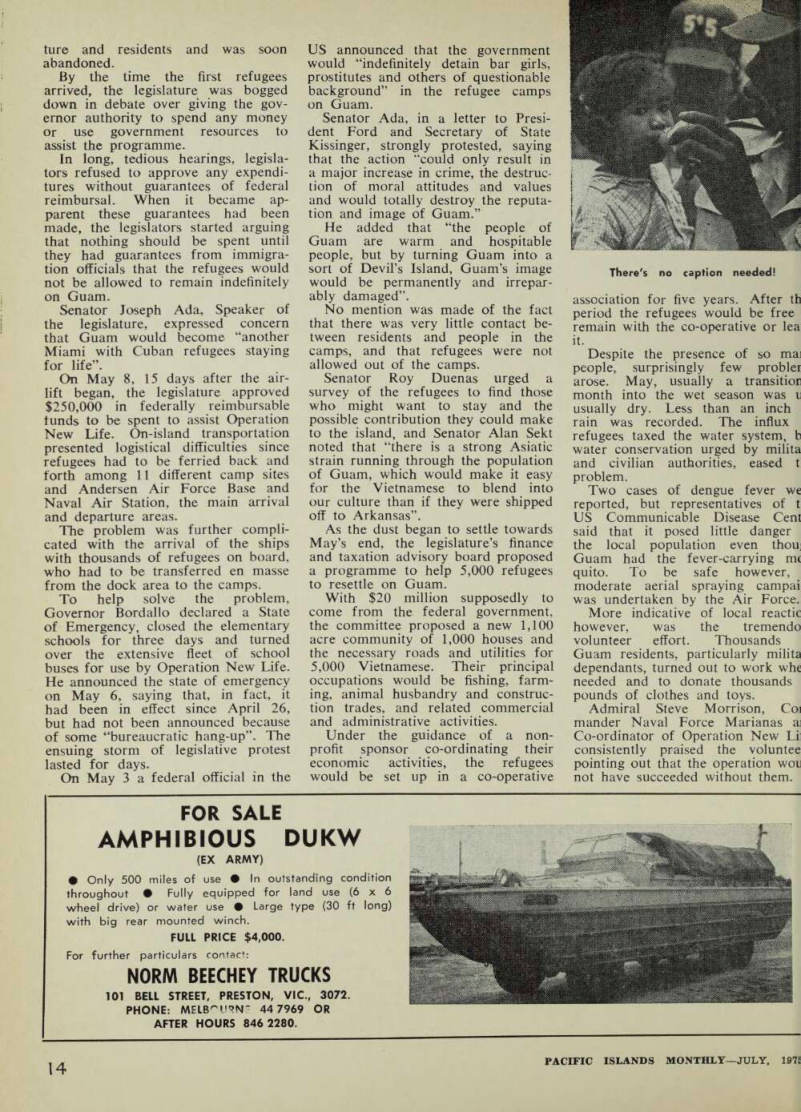
There's no caption needed!