Pacific Islands Monthly
pp. 7-8 · Read in the full issue
Wooing The Church In The New
Hebrides With Elections In Mind
By John Garrett
When New Hebrides French Resi- Commissioner Robert Gauger and British Resident Commissioner Roger du Boulay turned up in May an the same boat to attend a morning session of the Assembly of the Presbyenan Church of the New Hebrides ® ?V ter 18 a P[J of Emae, some i’ k?°u a P ts johshed their spectacles.
>an£d Uni “ahST
an President of' the National' pfrtv
Dokesman for and
TANK ("he French-kanine coalition
,f interests) and Mr David Curbs n Australian workfwith he Honolulu-based Peacock land deelopment concern, who explained hat he was along to fill the assembly i on the recent land deals in South anto between his clients, Jimmy tephens of Nagriamel, and a local anto chief, Puluk.
Mr Gauger, a French Reformed rotestant with family connections mong well-known Madagascar rench missionaries, spoke in French. le was interpreted throughout by lr du Boulay, who explained that s was a Roman Catholic, but wel- )med the muting of old animosities id the recognition that “we are all hristians”.
Both commissioners as good as said ey had come to build bridges into e Presbyterian Church in view of e coming elections in September r the country’s first representative sembly. Most observers expect the ational Party to poll well. Cynics ive even begun to regard the ajonty Presbyterian Church as the ational Party at prayer—an impliurrh P "T P u tly dlsowned hy the * lcn stresses h is not S !ii tt, a ( ny xrr party ' • , . *ll a F au £? r ’ J n bls pf liTf add . ress ’ Pomted out nani 3 n ?f haS , pre P ared wal mnrllil^l,'1 a l a . bOUtt, . I ? e
enctTsnplwnt the
,n°t f lu® COD ’
miniums population and the pas-
tors and elders who are nominating for the elections. j n the out-of-session activities of the delegates at Emae it was a toss- U p whether theology was as much discussed as politics. Walter Lini’s presence underlined the parallel activity on behalf of the National Party within the Anglican Church, which is stronger in the north. His speech .characteristically alluded to 3 mornll ’S bible study preceding the Presentation of the visiting celebrities, P ° mt ' nB ‘? a ,t ‘ he obscure biblical |? r ?P het , Habbakuk was a peaceful fig !! er tt This is hardly likely to send New Hebndes planters scurrying to get them selves a copy of Habbakuk, but serves notice that Father Lini, like hls vi ce-president Pastor Fred Karlo- ?? ua P a (Assembly Clerk of the Presbyterian Church) is determined fo think theologically about nationbui ldmg- Both men will attend the World Council of Churches Fifth Assembly at Nairobi next December. Tanzanian thinking about rural development is already reflected in the National Party’s platform as expounded by Walter Lini—though with little trace of the Marxist ideology that peppers theory and practice in the African country.
At question time Mr Gauger went out of his way to stress the need for changes in education that will speed up French in English schools, and vice-versa. In conversation in his office I found his own English is improving all the time, though we spoke French. He keeps constructively in touch in Vila with Pastor Karlomuana, who welcomes the thaw between the church and the French administration.
What did the two commissioners have m mind in the long-term in vls J t ; n B the a?sembly?
Its a question that invites shrewd s P e c c . ula,lon - . .
Since the election of Giscard
d’Fstaing as French President there are many signs of a streamlined approach in the UN and on the inter national diplomatic front. The im mobile France d’outre-mer policies of Pompidou and Messmer are up for a second look, no doubt in the light of de Gaulle’s initial explosive in sistence, in the late 19505, that Algeria would decide its own future.
The London negotiations about the future of the New Hebrides, fol lowed by the affable visit of France’s Olivier Stim and Britain’s Joan Lestor to the territory, seem to herald the possibility of a phased withdrawal of France’s political presence and a simultaneous attempt to maintain moral and economic influence after independence arrives.
This is not to say that the same thing is afoot in New Caledonia and Tahiti; indications are contrary. But a successfully adroit extraction of France from the condominium could be a feather in the cap of France while she takes time to consider how she is going to deal with the calamitous divisions plaguing her other Pacific territories.
If France adopts this course, Britain is likely to follow at the same speed. Despite recession and inflation, the French are in a rosier economic condition than the British, with prospects of good grants and loans towards a viable autonomous New Hebrides. Mr du Boulay can hardly feel consoled by current dire forebodings of bankruptcy in the UK.
He couldn’t be blamed for biting a midnight fingernail over the Common Market referendum in his homeland.
Question time at the assembly session saw some polite needling over the land question. The New Hebrides Presbyterians are on record about the need to return church and other alienated land to the rightful original owners when these are con clusively traced. Mr Curtis claimed in his speech that a recent acquisition of South Santo land by his clients
had been a model of legal and finan cial propriety.
Under the deal, areas made over for development in Nagriamel terri tory were ceded by Chief Puluk and will yield handsome returns for com munity betterment. Mr Curtis ap pealed to the two resident commis sioners to confirm that this was the sort of legal-financial quid pro quo they would like to see encouraged.
After a certain amount of sotto voce conference between, they replied that it was indeed a legally and financially sound affair in principle, but that they wouldn’t wish to com mit themselves on the details.
Some laughter greeted the reply, since many people are asking how much of the money will flow on to the individual family proprietors and how much will remain in the hands of a few at the top who sealed the deal.
Presbyterian consistency was put to the test later in the assembly when the church faced up to a request from influential leaders of the Kalsakau family of Vila for the return of the church-owned island of Iririki in Vila Harbour. The British have a virtual thousand-year tenure on the site of their commissioner’s residence there. The Presbyterian Paton Memorial Hospital former buildings are on the island, unused since the hospital went to government control and a mainland site.
After much debate on and off the floor, the assembly decided to offer to return the bulk of the island to the people of nearby Fila Island, who evidently owned it before the missionaries acquired it in 1870 for six bits of cloth, two handkerchiefs, some beads, and 11 knives.
No conditions were set about use
of the land, which is rumoured to be up for discussion as a hotel or casino. This rather surprised those who give the Presbyterians a blue nose reputation. However, the assembly stipulated that the church must be satisfied under the terms of the deal that funds derived from future use will be applied for the
long-term benefit of all the Fila island people. They also asked for compensation on buildings of around $120,000, payable at long term, on generous interest terms.
It’s obvious, as Mr Gauger sug gested in his speech, that the Presby terians are going to have to watch out in the next few years to give Caesar and God their rightful dues of obedience, or they are likely to run into some trouble with Caesar and even a little with God.
Mr Kalkot-Matas Kele of the National Party wound up the morn ing’s proceedings on the occasion of the commissioners’ visit with a burst of acclamation, when he pointed out to his fellow-Presbyterians that the church is as inevitably involved in New Hebrides politics, as the Christians were at the time of Christ’s crucifixion.
So, at the same time Mr Gauger, as a spiritual descendant of John Calvin, is likely to have to discuss with his Melanesian fellow Protes tants the consequences of a con clusion universally drawn by theo logians of the Reformed tradition— as distinct from the Lutheran—that when the chips are down, and people feel they must choose between Caesar and God on issues of justice and freedom, God should get the nod.
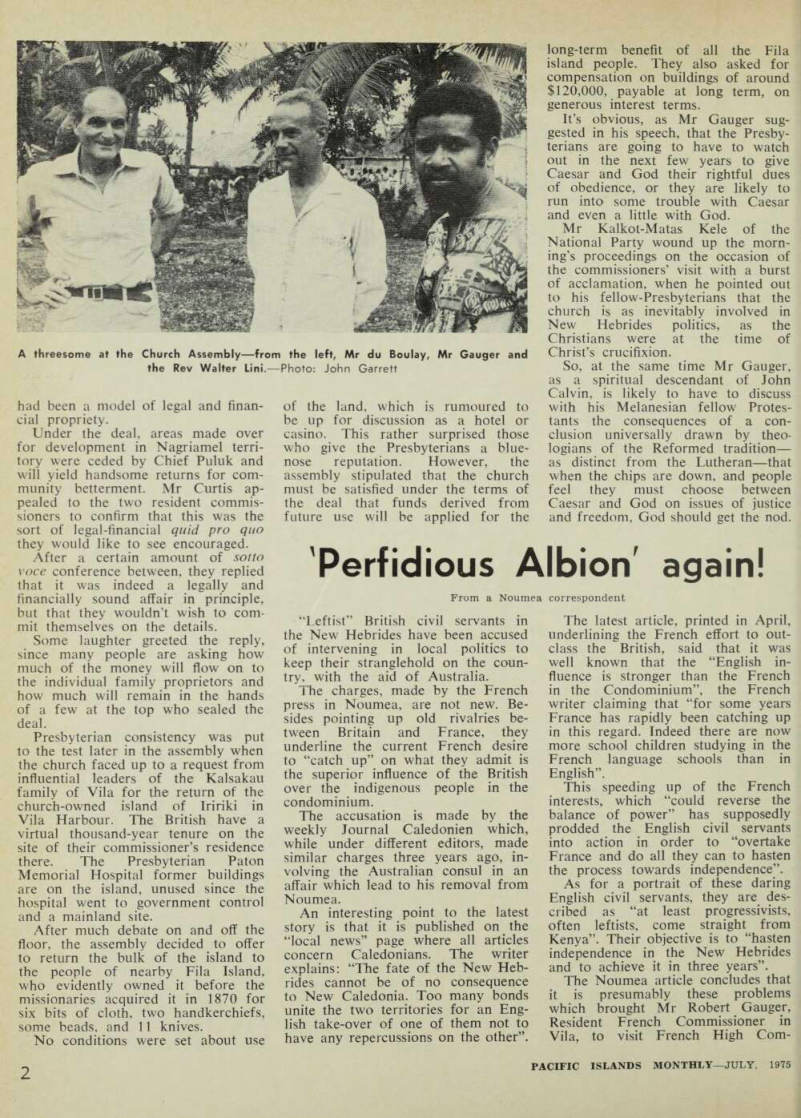
A threesome at the Church Assembly—from the left, Mr du Boulay, Mr Gauger and the Rev Walter Uni.— Photo: John Garrett