Tastes are changing in Fiji
p. 83 · Read in the full issue
Fiji, with a population approaching 600,000, is one of the best markets in the South Pacific, even though in numbers it cannot compare with South-East Asia. The rate of natural increase for the country is more than 20 a thousand, although not quite as high as the 10-year average of 26.46 for the 10 years, 1964-73.
The estimated population at the end of 1973, the last full year for which statistics are available, was 545,205. Indigenous Fijian and Indians make up the bulk of the population —233,694 Fijians and 277 248 Indians. ’ . . , Outside major corporations, much of the business is in the hands of Indians and Chinese. The Chinese population is very small, 4,263 at the end of 1973, but, pro-rata, there are probably more of them in business than any other race. Many of me Indian shopkeepers are Gujratis.
They are sound businessmen. The number of Fijians in business on their own account is very small, but this position is changing slowly.
With the passage of time, and under the influence of European requirements, the tastes of the Fijians and Indians are changing. Whereas once they were quite happy to eat what the land and sea offered them, more or less in its natural state, their demands are now more sophisticated,
They want processed imported food, and are getting it, even though the government repeatedly says the food and drink import bill must be cut.
Once, the Fijians were quite happy with a bowl of yaqona (kava) as a social beverage, as well as a cere monial drink. Now, he wants tea, coffee, soft drinks, and of course, i( I uor - W ine sales have been , creep in 8 U P * or some years, not because of demand by Europeans, who are awa V ™ numbers, but from Fl h^ s anc * Bea arou , n d Fl P is said to teem with fish, although the Prime Minister, Ratu Sir Kamisese Mara do es no t agree, basing his opinion on b j s own personal experience, yet the import bill for frozen and canned fi sb j s growing steadily. The meat import bill is also growing, even though the Fiji beef industry is being bui i t up . So is the bin for pig meats , y e t Fiji slaughters a lot of pigs each year.
Projections are for continued popu iation gr owth and thus a growing market. In the mid-19505, when an official census showed a population of 345,737 (on September 26, 1956), it was freely forecast that Fiji would have a population of two million by 2000. This, no doubt, has been noted by marketing managers who have to look ahead, although not as far as that.
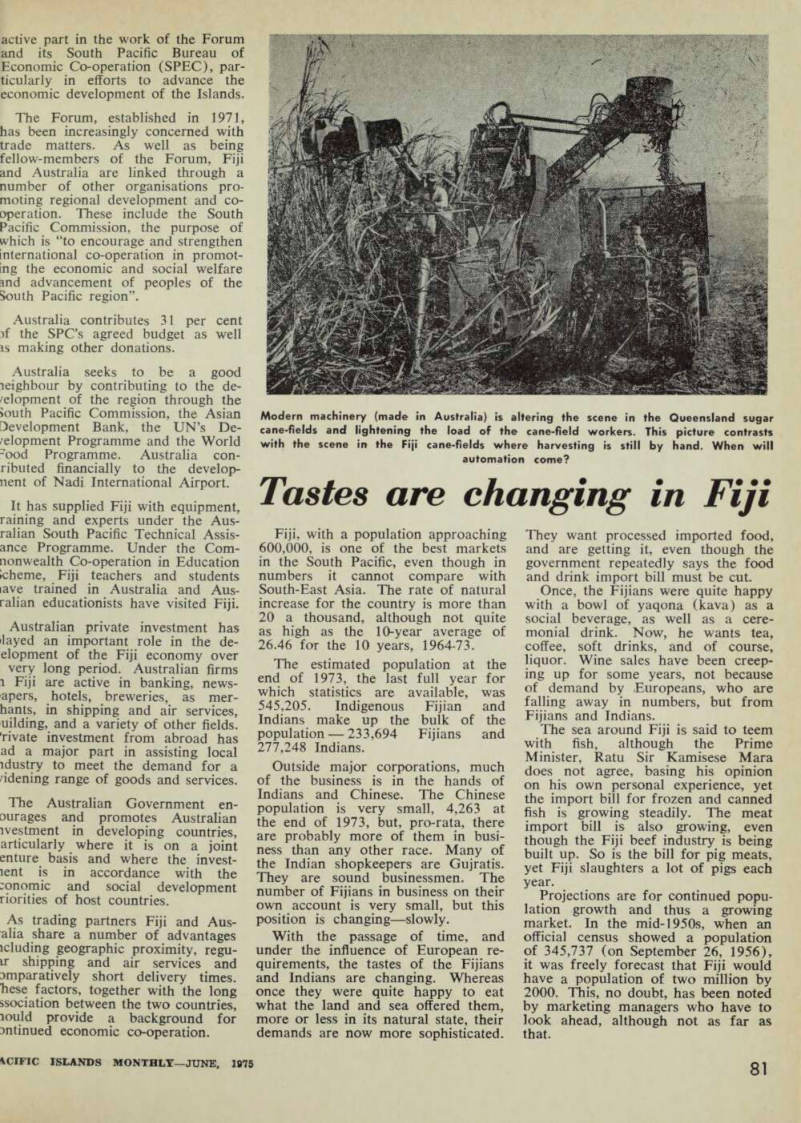
Modern machinery (made in Australia) is altering the scene in the Queensland sugar cane-fields and lightening the load of the cane-field workers. This picture contrasts with the scene in the Fiji cane-fields where harvesting is still by hand. When will automation come?