Pacific Transport
pp. 65-69 · Read in the full issue
Fiji's Travellers Wait For The
Honest Tick Of The Taximeter
From ROBERT KEITH-REID in Suva
June 1, 1975, may go down in Fiji history as a minor, or perhaps major, D-day of sorts: a day of de livery from endless arguments with taxi drivers about fares. It’s the day by which most of Fiji’s 1,000 or so taxis are supposed to be sporting fare meters.
But, while the government is de claring, firmly, that meters shall be compulsory for taxis based in the main towns of Viti Levu, the chief island, there’s still a certain amount of scoffing and disbelief.
It’s a story that has been heard once too often. Because the shilly shallying, back-tracking, side-stepping and double-talk that has been going on about getting meters into taxis is so long a story that to tell it all would be boring.
To say that June 1 may be D-day, "ather than will be, is merely a pre :autionary qualification. Be that as it iiay, there will certainly be a huge sigh of relief from the Fiji public, and tourists of course, when the aonest tick of those meters at last s heard intermingled with wailing rom Radio Fiji’s Hindi programmes.
Everyone in Fiji is used to being ipped off by taximen, tourists more han most. Over the years it has been me of the Fiji Visitors Bureau’s most Vequent tasks to pacify Aussies and Kiwis who had discovered that they aave been taken for a ride in more vavs than one.
Charges of S 5 and $lO for a five )r 10 minute trip are a bit stiff, specially when the real rate, accord ng to the Transport Department’s described fare table, should be no nore than a dollar.
And kills of $l5 or $2O is an all oo-often sad, sad, sad, repeated tale.
Among the most bitter complaints ire those of fares paid for the long, lusty, and sometimes perilous, trip dong the Queens Road between Nadi md Suva. What should have been >erhaps a $2O fare has scored $3O >r $4O or much, much more. Locals
have had a long running feud with taximen too. The usual whine from them, when faced with a demand for, say a dollar, is: “Hey man: So-and so’s cab charged only 80c for this trip.”
The FVB has been pressing for fare meters from about the grounding of the Ark, and 1968 seems to have been the year that the government got the message—a Transport Depart ment official then said, possibly with out thinking, that meters might arrive “sometime in 1969”.
Naturally, taxi owners didn’t take to the idea. They were used to getting away with almost anything. It would be hard to argue against a meter.
So, mutters that “the industry can’t afford meters yet” began to rise.
Also the tale that: “If we get meters the public will suffer”, just why wasn’t really made clear. The theme seemed to be: “We won’t be able to charge locals lower prices if we have meters.”
Taximen never did get around to explaining why they could not charge
some destitute local something less than what the meter displayed which would simply be the maximum they could legally charge.
Meters didn’t arrive in 1969, or 1970, or 1971. The government line was that the matter was so highly technical that it needed deep con sideration. It appears to have got that all right—at a length that got lengthier.
D-Day was set for a day some where in 1973, but that somehow slithered off the calendar. More prevaricating, and then July 1, 1974, was prescribed.
Then another complication arose. It was about fares and so the Prices and Incomes Board was brought into the act, although not very willingly.
Taximen, with much justification it must be said, were lamenting that, in this era of hyper-inflation, none of them could seriously be expected to honestly and profitably run a taxi business on fare rates set 22 years before and not adjusted by a cent
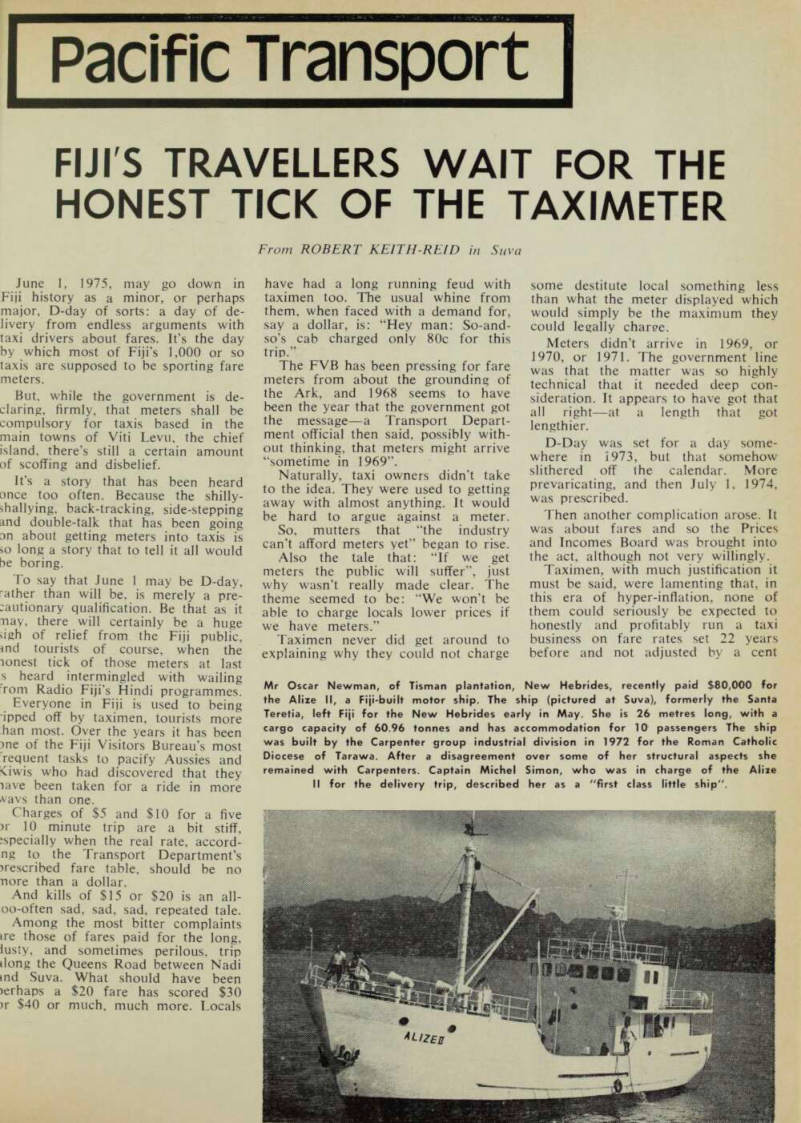
Mr Oscar Newman, of Tisman plantation, New Hebrides, recently paid $BO,OOO for the Alize 11, a Fiji-built motor ship. The ship (pictured at Suva), formerly the Santa Teretia, left Fiji for the New Hebrides early in May. She is 26 metres long, with a cargo capacity of 60.96 tonnes and has accommodation for 10 passengers The ship was built by the Carpenter group industrial division in 1972 for the Roman Catholic Diocese of Tarawa. After a disagreement over some of her structural aspects she remained with Carpenters. Captain Michel Simon, who was in charge of the Alize II for the delivery trip, described her as a "first class little ship".
since—3oc for the first mile and 20c for each successive one.
Why, even a former Finance Minis ter, Mr Wesley Barrett, boss of the Cathay Hotel chain, had gone on record in parliament as saying he couldn’t understand how any taximan could make a living. He had tried running a few cabs and found they just didn’t pay.
The government agreed that an in crease was needed but added that proposals it had been mulling over needed to be okayed by the PIB.
“Okay,” said the PIB. but not with out a technical study that was beyond its means to carry out.
So D-day was postponed until November, and then months of De cember and January were bandied about.
By January, the taximen were get ting really fed up about fares and in several towns declared that the gov ernment and PIB could go to hell.
They would charge what they thought was a reasonable rate —60c to 70c for the first mile and 40c to 50c after.
The mutiny brought warnings of dire consequences from the board and Transport Department. It lasted a few days but seemed to spur the Ministry for Communications and Works to a declaration of an upward revised table —20c at flagfall, 10c for each quarter of a mile; a 5c surcharge in country areas reckoned to be extra rough on vehicles and a 25c surcharge for trips made between midnight and 6 am.
There were some moans, but, sur prisingly, the majority of taximen accepted this formula without pro test.
June 1 was then hailed as the for real, genuine thing for all 815 taxis based in Suva, Lautoka, Nadi, Nau sori and Sigatoka. Taxis elsewhere were to equip with meters at a date to be decided later.
Several companies began advertis ing the gadgets at around $4OO and caused more screams.
“Meters in Australia cost only $7O —they shouldn’t cost more than $lOO here —we’re being done,” Or just simply: “Boss, we can’t afford.”
As this article was being written, it was D-day minus 30 and Secre tary for Communications, Works and Tourism, Mr Bob Dods, had issued a warning. Hardly any taxis, he said, seemed to be getting fitted with meters —there’s only a month to go— you’d better get a move on because from June 1 it will be illegal to run without one.
There seemed to be little response to his edict; taximen were too busy holding meetings to condemn another date. , r .
Along with meters the use of seat
belts is to become compulsory for the driver as well as for, at least, one of his front-seat passengers.
Being belted to their seats, the taxi men were proclaiming, would be like being trussed to them, helpless and at the whim of any backseat basher.
Some taxi-owner associations were envisaging unused front seat belts being utilised from the back to throttle a driver over his wheel. The vision of this was so horrific that they were threatening to demonstrate their displeasure with a strike.
A strike against whom? The travel ling public seemed unperturbed by thought of this retaliation; it could always revert to a much cheaper form of transport—the bus.
Captain Milder
Goes To Sea Again
Captain Brett Hilder, a Burns Philp mariner for 42 years, returned to sea from semi-retirement late in April. He flew to Madagascar to pick up a ship for delivery to Java and Singapore, for Guan Guan, of Singapore.
After the Burns Philp fleet was run down, Captain Hilder spent several years with Karlander and Swiss Aluminium. He now spends his time between Castlecrag, Sydney, and his wife’s home at Currumbin, on the Queensland south coast, and is available for odd jobs, such as re ieving master, and delivering ships.
Recently he and his wife spent a jusman’s holiday at sea in the Enna 3, sailing to Nauru and back to Melbourne. ‘‘lt hurt me to pay the fare,” Cap ain Hilder jokingly told PIM. He vrote many items and drew sketches or PIM over the years.
►Hip Saved By
Her Radio Beacon
The Paerimu, 216 tons, is the atest addition to the Fiji inter-island leet. She arrived in Suva late in on her delivery voyage, which /as not without incident. The Suva ug, Wallacia, was sent out to her /ith a supply of lubricating oil after radio message was received that she /as in difficulties in bad weather.
The Paerimu carried an automatic adio rescue beacon, which helped RNZAF search aircraft to find her fter she sent out a distress call.
The Fiji Marine Board took ad antage of this to urge owners of ammercial and private vessels to quip them with the beacons. The quipment it recommended trans uded automatically on civil and lilitary distress frequencies, and juld be picked up more than 200 files away by an aircraft flying at 0,000 ft.
Navy Sweeps The
Bottom Of Bootless Bay
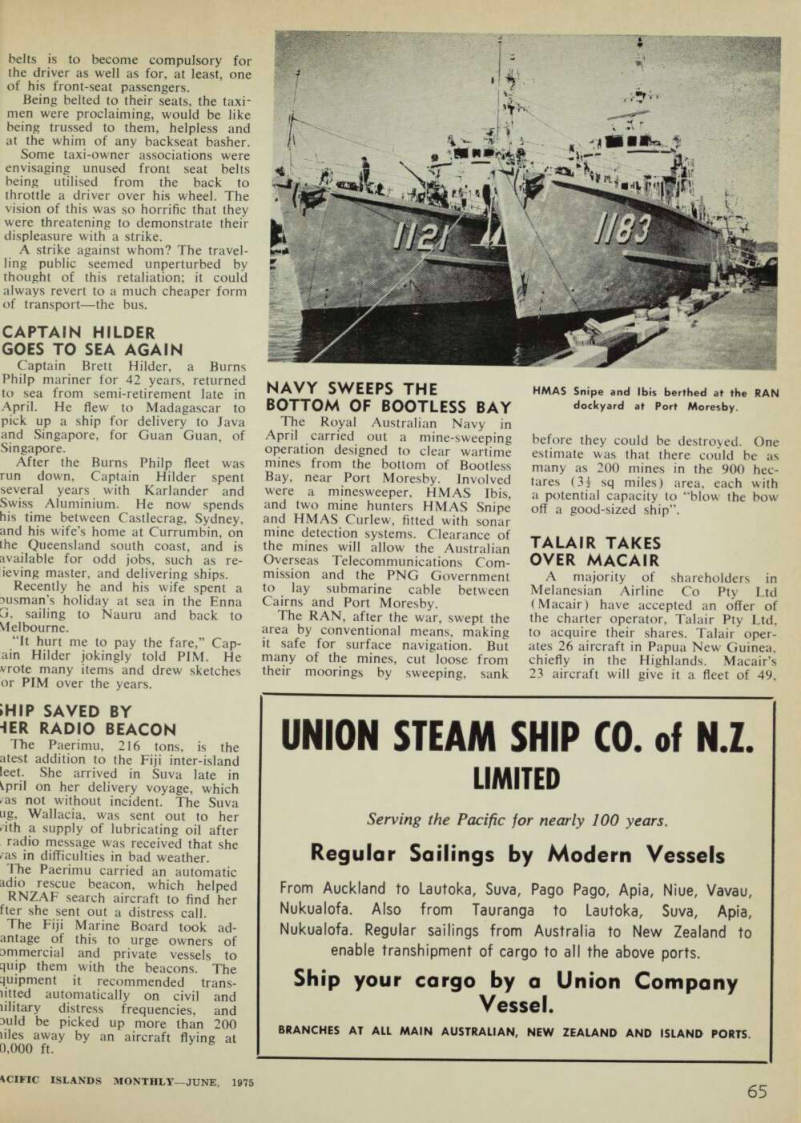
The Royal Australian Navy in April carried out a mine-sweeping operation designed to clear wartime mines from the bottom of Bootless Bay, near Port Moresby. Involved were a minesweeper, HMAS Ibis, and two mine hunters HMAS Snipe and HMAS Curlew, fitted with sonar mine detection systems. Clearance of the mines will allow the Australian Overseas Telecommunications Com mission and the PNG Government to lay submarine cable between Cairns and Port Moresby.
The RAN, after the war, swept the area by conventional means, making it safe for surface navigation. But many of the mines, cut loose from their moorings by sweeping, sank
before they could be destroyed. One estimate was that there could be as many as 200 mines in the 900 hec tares (3i sq miles) area, each with a potential capacity to “blow the bow off a good-sized ship”.
Talair Takes
Over Macair
A majority of shareholders in Melanesian Airline Co Pty Ltd (Macair) have accepted an offer of the charter operator, Talair Pty Ltd, to acquire their shares. Talair oper ates 26 aircraft in Papua New Guinea, chiefly in the Highlands. Macair’s 23 aircraft will give it a fleet of 49,
HMAS Snipe and Ibis berthed at the RAN dockyard at Port Moresby.
and will enable it to extend opera tions to eastern Papua and the Morobe area.
The airline will service, on a regular timetable, 92 PNG and Solo mon Islands airports, as well as undertaking charters in PNG. In cluded in the takeover will be the Solomon Islands Airways Ltd (Solair), which recently acquired rights to operate between Honiara and Kieta.
Geic Hit By
Shipping Shortage
A sudden shortage of shipping has hit the Gilbert and Ellice Islands.
The Teraka, after a recent trip to Christmas Island, was found to be in need of extensive repairs, which were expected to take about three weeks. Then she had to go for slip ping and overhaul, which would put her out of action for another three months.
This came at a time when the Moana Raoi was in Suva for annual overhaul. The demand for shipping at the time has been particularly high, with people from Nauru re turning home, and others being recruited to go to Nauru. The* re maining ships were expected to be hard pressed on internal work. These services will be disrupted for several months; it may not be possible to maintain the normal frequency of services to outer islands.
Sacked Air Pacific Men
Return To Work
A dispute between Air Pacific and the Air Pacific Transport Employees’
Association ended after arbitration proceedings, when the arbitrator, Mr R. I. Kapadia, said that about 300 employees should be reinstated with out delay.
The dispute rose when the presi dent of the association, Mr Gyanen dra Singh, refused to accept a new post, which he claimed was a down grading, and he was dismissed. A strike followed.
Air Pacific told the strikers to re turn to work, setting a deadline, and saying that those who did not return to work by then would be dismissed.
A number were dismissed on that ground, although many of them claimed they were held up getting to work through a transport delay.
The arbitrator said Mr Singh should take the new post, and if he did not, the company would be en titled to dismiss him on one month’s notice. Air Pacific flights were not affected.