Bougainville's
pp. 9-10 · Read in the full issue
"shame"
From a Port Moresby correspondent “ Disgraceful, shameful” conduct by “a mob of irresponsible and un disciplined hooligans”, said PNG Minister for Police Mr Peter Lus.
“I’m shocked by the magnitude of violence and damage ”, said Chief Minister Michael Somare.
They were referring to two days of violent rioting by more than 1,000 miners which began on May 12 at the Bougainville open-cut copper mine at Panguna, the world’s largest.
The rioting shut down the mine, caused the temporary evacuation to the coast of mine-worker families, mass arrests and gaolings, and exten sive damage to buildings and vehicles estimated at about $500,000 as the mine workers went on a wild ram page of destruction. Police moved in with tear gas.
Mr Somare said the government would act in future to prevent simi lar “industrially-inspired violence”, but he gave no details of his plans.
The Bougainville Copper Com pany, partly owned by the PNG Government, has had an excellent record of industrial relations, there being only one previous strike; for three days last December. Only a small proportion of the strikers worked directly for Bougainville
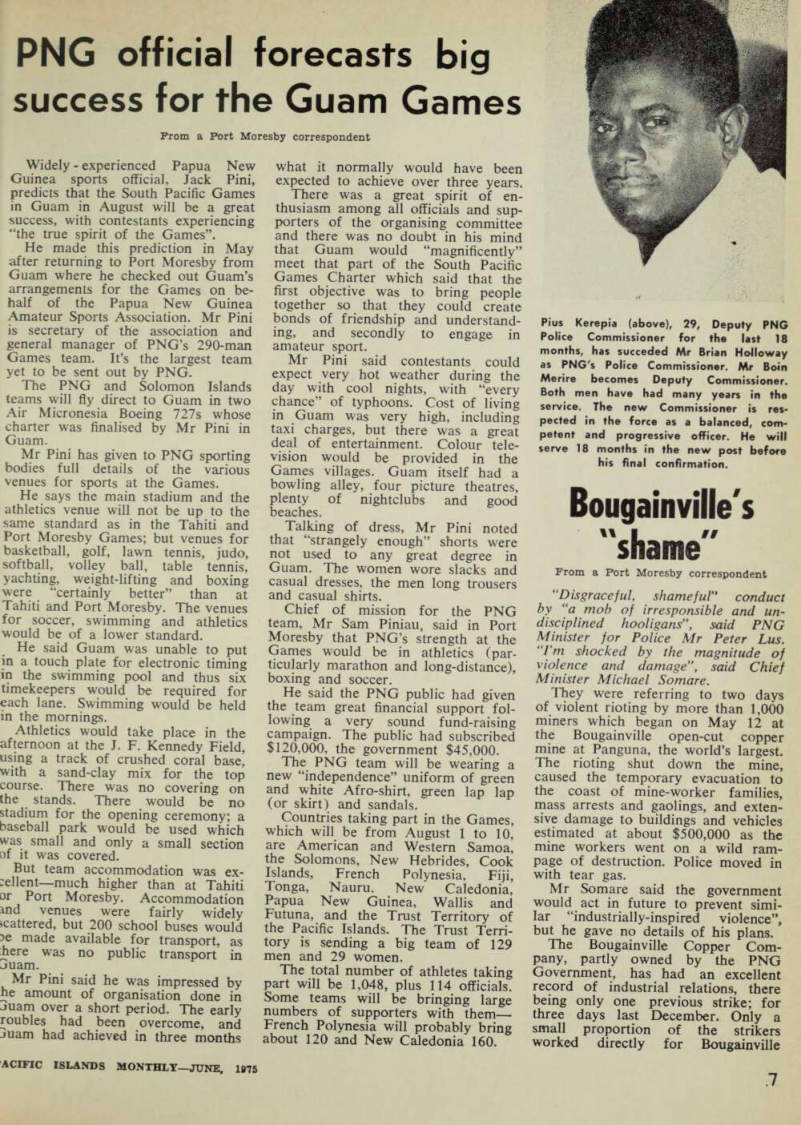
Pius Kerepia (above), 29, Deputy PNG Police Commissioner for the last 18 months, has succeded Mr Brian Holloway as PNG's Police Commissioner. Mr Boin Merire becomes Deputy Commissioner.
Both men have had many years in the service. The new Commissioner is res pected in the force as a balanced, com petent and progressive officer. He will serve 18 months in the new post before his final confirmation.
Copper Ltd—the others being em ployed by service industries and sub contractors at the mine site.
Frustrations which started the riot ing seem to rest on the difference between pay rates for the trained and skilled New Guineans at the mine and those with minor skills and in transient jobs. The unskilled have resented the growing economic gulf separating them from their country men. There is also the problem of large numbers of workers in a con fined area, despite the amenities pro vided.
Union officials encouraged the men to take action for better pay, but there are indications that the unions are now concerned over what they unleashed.
About 200 company and police vehicles were damaged, some bodily capsized or pushed into gullies. The government office and police station suffered heavily. Roads were tom up or littered with boulders, overturned vehicles and oil drums. An attempt was made to block the only road out of Panguna. The strikers holed them selves up in buildings between periodic forays of violence. Despite pillaging of food supplies, hunger and fatigue eventually drove the strikers, bearded and dirty, into the arms of the police.
Special courts sat into the night to hear charges against more than 800 defendants. Some were given gaol sentences, others were remanded.
Those arrested were penned in make shift camps on the coast, where con ditions were so sub-standard that police feared further violence and eventually released them to return to Panguna.
Convicted workers will be sacked and returned to the mainland, and the mine is already advertising for more workers to keep production up. • Meanwhile, on the political front, as PNG gets closer to indepen dence, expected later this year, the PNG Cabinet has announced the country will join the British Com monwealth and will ask Queen Eliza beth to become Head of State. The Queen has said she will decide whether to accept on independence.
If she agrees, she will be represented in PNG by a Governor-General, with no executive power, appointed on the advice of the PNG Cabinet after parliament decides nominations. Chief Minister Michael Somare will in any case become Prime Minister. • In Port Moresby on May 19 the House of Assembly turned itself into a National Constituent Assem bly, to finally approve the constitu tion, agree on an independence date, and nominate a Governor-General.
It will continue into June.