Up Front
pp. 4-5 · Read in the full issue
with the a guest
MR OLIVIER STIRN, Secretary of State in charge of French Overseas Departments and Territories, writes for RIM on certain aspects of Franco- Australian relations and France’s place in the South Pacific.
There is no doubt that 1975 marks a new phase in Franco-Australian relations. A turning point, which will probably bring about a new type of rapport between Europe itself and countries of South Pacific. A new mode of co-operation setting out new opportunities to preserve peace not only in these two regions of the world but wherever it might be threatened.
To achieve this new understanding, government leaders had, first, to meet at a personal level. This has now been done.
The visit to Paris last January of Mr Whitlam (Australian Prime Minister) has made it possible to discuss the differences which existed between our two countries regarding France’s nuclear tests in the Pacific.
A further step towards the normalisa tion of our relations was made last March when I visited Australia.
As our differences draw to an end, it has to be recalled once more, that France’s nuclear tests were in no way the expression of aggressive am bitions, but a contribution to the defence of the free world to which Australia belongs. In the light of events in Indochina and of major crises in some parts of Europe it becomes abundantly clear that the world continues to be threatened.
For the last 17 years, France has pursued an original and coherent defence policy aimed at preserving her independence vis-a-vis the major blocks while maintaining her support for countries which share her con cept of democracy.
While Australia has adopted other principles with regard to defence matters, it has for matters concerning foreign policy adopted similar views on many aspects to those of France.
Thus, the difference over nuclear testing could no longer keep our two countries apart, especially since France has now undertaken not to hold atmospheric nuclear tests for a
period of time far greater than any other nuclear power has ever ac cepted to commit itself.
Furthermore, no one can deny that France has taken every precaution to minimise any risks that may result from such tests, and that, to date, it cannot be said that these tests have proved harmful to people living on Australian territory or elsewhere.
In a somewhat curious way, these tests have led some to question France’s presence in the Pacific and in other regions of the world. Some who probably lack sufficient informa tion, depict France as a country living in the past, preoccupied with preserv ing the last remnants of her colonial empire and with constraining against their will the populations of these territories within a system of ex changes and relations directly in herited from colonialism.
What a mistaken and unfair view!
France has probably done more than any other country for the emancipa tion of peoples and to respect their dignity. Wherever there is a wish for independence, France is granting it. Not as some powers have done, abandoning everything from one da> to the next, thus exposing the newl> independent countries to a long period of anarchy, but by leading them progressively to the full exercise o! the responsibilities of national sovereignty.
This was the case for all Africa! countries many of which, today, re tain ties with France. This coulc also be the case for the territoriei which are still French; for example the Comoro Islands which have just through a referendum, opted foi their independence, while maintain ing with France ties of friendship and co-operation which will enable these four islands in the Indian Ocear to face more easily the inevitable difficulties they will face on the threshold of their new destiny.
Following a series of visits U nearly all France’s overseas depart
ments and territories, I have formed the conviction through these direct contacts, after very open and frank discussions with all political groups represented in these territories, that none of them for the moment wants to sever the links which unite them with France.
The exceptionally warm welcome which awaited the President of the Republic last December in the Antilles, the cordiality I myself have felt during my recent stays in New Caledonia and Polynesia show how these populations feel towards France.
It is only recently that these mani festations of friendship and trust have been so evident. They are probably the result of a new policy adopted in these territories as defined by Mr Giscard d’Estaing, well before his election as the President of the Re public. This policy is based on the reaffirmed principle of equality, of political, spiritual and material rights for all those living in these territories.
You probably know that with re gard to France’s Overseas Depart ments—there are four; Reunion, Mar inique, Guadalope, Guiana—their administrative and social structure is almost identical to that of metro politan France and that with regard to their political and legal rights here is complete identity and equality.
This explains why the living stan iards of the population of the French Departments, are, on average, three imes higher than those of their im nediate neighbours. This is also true >f New Caledonia and Polynesia, but he economic aspect alone is not nough to explain how attached to Yance these populations are. , There exists between them and Yance common feelings and tra litions, the experience of shared acrifices and continuous mutual ex hanges, all of which make the over eas populations really feel an inte rred part of French civilisation /hile, at the same time, they largely ontribute to enrich it. This is an ssential aspect of the question.
Does one really believe that conomic or strategic reasons or olitical opportunism can in 1975 xplain France’s continuous presence i these distant lands?
As a matter of fact, France is in o way guided by any material or port-term interest.
These territories in fact weigh eavily on the finances of the Nation nd every one knows that they are ow of very little strategic value.
France s continued presence in icse territories rests on two en irely complementary factors. Firstly,
France’s presence meets the wishes of the great majority of the popula tions concerned. Secondly, France considers it important that these populations continue to benefit from the advantages they enjoy today in the way of capital equipment, economic development, health and education services.
If, also, it is felt that these terri tories benefit France, it is because they have their own different characteristics and that through them France can project itself in regions of the globe very far apart. Our intention is not, however, to try to impose French civilisation, but to morrow’s civilisation will be a global one and there will necessarily be a process of blending the values of the French civilisation, its ways of think ing, of living, of reacting, to those of other countries.
It is our deep conviction that, if tomorrow’s civilisation is not success ful in integrating cultural differences and in assimilating the ways of life and thinking of those of the develop ing countries, this civilisation is doomed to failure. The present task is indeed to establish the base of a new solidarity founded on equality, namely, in terms of an equitable share of the wealth, of these overseas territories and that of France itself, which is made available to them to promote their development.
It is, therefore, ridiculous to think that France might wish to maintain her presence overseas in the hope of making the French territories a
“chasse gardee” (hunting preserve) from which she could profit and whose populations she would subject.
The situation is that the political status of all France’s overseas terri tories evolve towards a transfer of responsibilities to representatives they themselves elect. An example of this is the political status intended for the New Hebrides, elaborated in agree ment with Great Britain and in collaboration with the local popula tion. Elections will be held for the New Hebrideans to freely express themselves as it is done everywhere where France is involved.
Such a policy necessarily implies that the different French territories have other relations besides those with France. These relations must extend largely to neighbouring countries, in the case of this region, to countries such as Australia and New Zealand.
France has no wish to isolate her self in these territories. It is her desire to see them forge new regula tions and exchanges of all kinds, principally in the cultural and economic fields, with their neighbours.
France is a democratic and liberal country and wishes to be seen as such. There is no better way for her to project this image, than by multiplying contacts, exchanges, in vestments, on a reciprocal basis. My recent visit to Australia and New Zealand has made me feel that this is a common wish also shared by these two countries.
With this in view, the Prime Minister, Mr Jacques Chirac, intends to come to Australia to consolidate the good relations now established between our two countries and to give a new impulse to our co operation, something which, in my view, must be first achieved through all types of exchanges between Aus tralia and France’s territories in the Pacific.
For most major problems of inter national policy, especially that of the necessity for each country to pre serve its independence, France and Australia share the same views. Such views are also becoming more and more those of the European countries which already are and will continue to be, a stabilising force between the power blocks.
France, it is known, plays an im portant role in Europe. This is one more reason why it is in the interest of countries like Australia and in the interest of peace in this region of the world to develop our friendship.
• PIM has also published Mr Stim's article in French. It's on p 15.
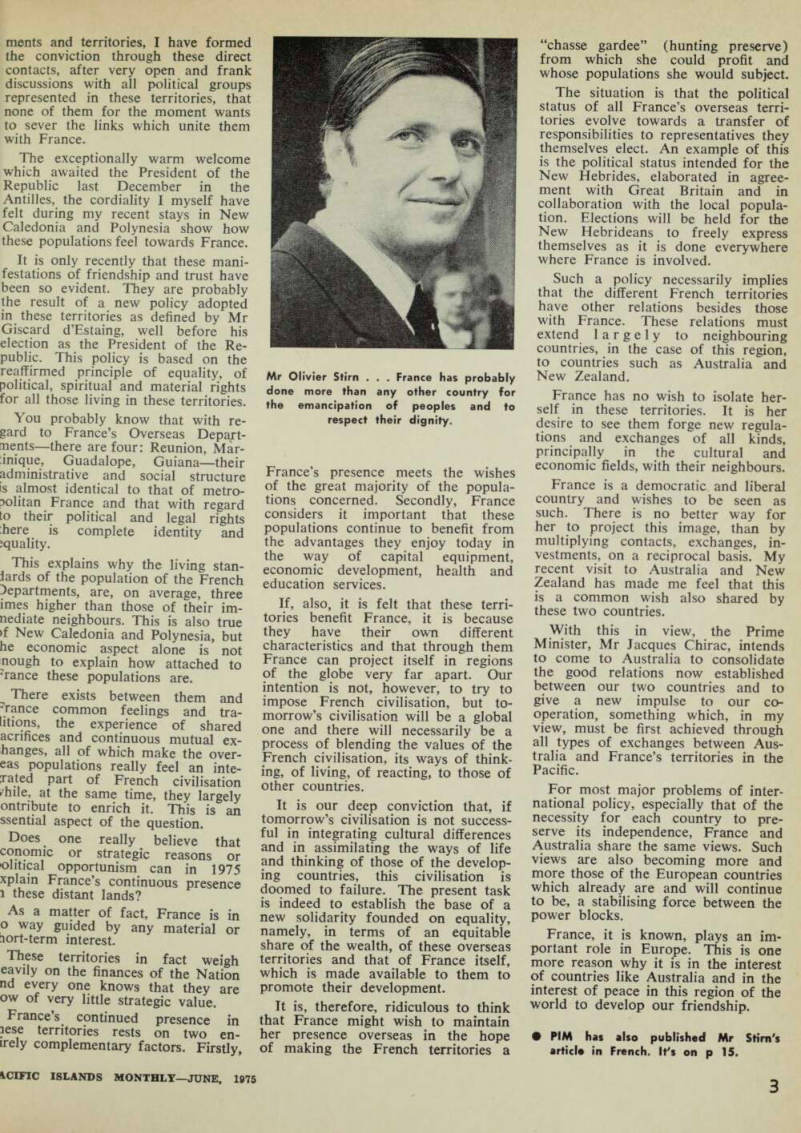
Mr Olivier Stirn . . . France has probably done more than any other country for the emancipation of peoples and to respect their dignity.