This living reef: pictures
pp. 61-63 · Read in the full issue

from a watery paradise
Douglas Faulkner agrees with those who call him the best marine life photographer in the world. He doesn’t consider the truth egotistical.
And once you’ve seen Faulkner’s colour photos of Palau, it’s not hard to be a believer.
He isn’t satisfied to document this famous fish and coral paradise, but he has to produce underwater art as well. Because of this it has taken him over eight years to shoot the 25,000 transparencies that provided the pickings for the 107 colour plates that he has selected for his latest book, This Living Reef.
Faulkner first went to the Western Carolines in 1967 on a magazine assignment to photograph dangerous tropical marine animals. There he found one of the Pacific’s legendary reefs at Palau, and he has returned frequently since then to gather material for this book and others.
He expects to spend most of 1975 in Palau photographing the life and death of a coral reef for Audubon magazine, and the life cycle of the elusive Chambered Nautilus for Natural History magazine.
While the Palau archipelago has much to offer the underwater adven turer, Faulkner has his own favour ite One of these is the Great Reef, which borders Bailechesengel Island in the Ngemelis group. It is here that a good many shots were
taken for This Living Reef and it was here in February that he cap tured the first Chambered Nautilus ever recorded in Micronesia.
The Chambered Nautilus study will be a joint effort with marine biologist Norine Haven from Hop kins Marine Station in Pacific Grove, California.
Faulkner’s Great Reef is a solid wall of growing coral that drops straight down from the surface to a depth of 800 ft. Because most reef walls of this type don’t begin to drop until the diver has gone beyond the 50 ft level, he considers this one truly unique.
I was with him during the summer of 1973 when he was almost through with This Living Reef.
“I’ve already got enough good shots to fill a half-dozen more books on these islands”, he said.
“Why are you still here then?” I asked.
“I might find something even bet ter. You never quit while you’re ahead”.
Underwater photography is hard work and Faulkner takes better pic tures because he works harder at it.
He has a habit of driving himself into healthy exhaustion day after day, showing a stamina that is quite simply amazing. To take the 25,000 transparencies from which the This Living Reef pictures were selected,
he diver-photographer had to return o the surface after every 12 shots nd change film.
He recently collected a sea fan off Tutremdiu Point, which Dr Fred layer, his scientific collaborator, has letermined is a completely new pecies and he has honoured the ihotographer by calling it Tricho oria faulkneri.
This Living Reef opens with a ’alauan Genesis myth (he uses the iative Belau for Palau throughout he book) and then a scientific xplanation of Palau’s geologic his ary. The photos themselves are in □ur sections: The Outer Reefs, The ’asses, The Lagoons, and The Coves nd Marine Lakes. A commentary □Hows with detailed specimen lentification, location, and Faulk er’s personal reactions to each of ic photographs. There is also an xccllent map of Palau, produced by :. R. Donnelley Cartographic Ser iccs.
Faulkner, 37, got into his present )b by chance. A one-time English lajor at the University of Miami, e decided to link his love for writ ig and poetry with the other great park in his life, marine biology.
Faulkner, however, didn’t have the mbition to become a full-time :icntist. He liked the feel of his ameras and decided to become a rofessional photographer. After an pprenticeship he travelled to the larquesas, the Society Islands and lew Caledonia an underwater photo rapher.
“During my first seven years as a rofessional”, he says, “things were retty rough. I financed almost all ly trips with my meagre earnings rom stock picture sales. I rarely got
an assignment—and still get very few assignments—but my picture sales have increased considerably. It’s only been in the last few years that I’ve been able to breathe easier while working on my projects”.
Project means book to Faulkner.
He no longer gets enough joy from magazines because he has little con trol over the final layout or in the quality of reproduction.
From This Living Reef, Faulkner has moved to a book on living corals that’s scheduled to be pub lished by year’s end. Another on reef nightlife is due out in 1976. Be sides these, he plans a major re vision of his 1970 book, The Hidden Sea, which is still in demand.—
Ronn Ronck,
in Guam.
(THIS LIVING REEF, by Douglas Faulk ner. Published by Quadrangle/The New York Times Book Co. $U527.50.)
Plenty Ocean,
Little Land
There is little enough available on the Micronesian Islands, so the appearance of Plenty Ocean, Little Land, by the editors of Nel-douris Pacific Publications, of California, would in any case be welcome. But as it happens, it’s a lot of fun.
Plenty Ocean, Little Land is de signed as a general guide book, and it has what you might expect of a guide book (clear maps, colour pic tures, hotel and travel information, further reading list) although the
format is rather large and the paper rather heavy for ease of handling.
But the fun is in the running com mentary, in which the writers, un named, involve us with their enthusi asm for the Trust Territory and its people, and share their observations including their personal biases.
But as the authors claim, the guide book is not biased in any particular direction. “We have no axes to grind and no favours to repay”, they say.
“We travel only as private citizens and at our own expense; we receive no preferential treatment; we do not try to palm off exotic situations and activities as ‘typical’ when they are actually very special events reserved for the favoured few. If we neglect an information source, it is in the interest of our avoiding potential obligation-inducing favours”.
Perhaps one can go too far in avoiding favours and miss out on obtaining useful information for the traveller, but since the authors quite clearly value their independence, and wear their hearts on their sleeves, they’ve produced something both use ful and refreshing. There’s the Islands flavour in it.
It’s worth owning as a traveller’s tale of the Micronesian islands as they are and probably won’t be for much longer—even if you never get to these scattered islands and have
no plans to go there.
SI.
(Plenty Ocean, Little Land. Nel-
Douris Pacific Publications, Box 376, Dept PI, Livermore, CA, 94550, USA. $U57.95.)
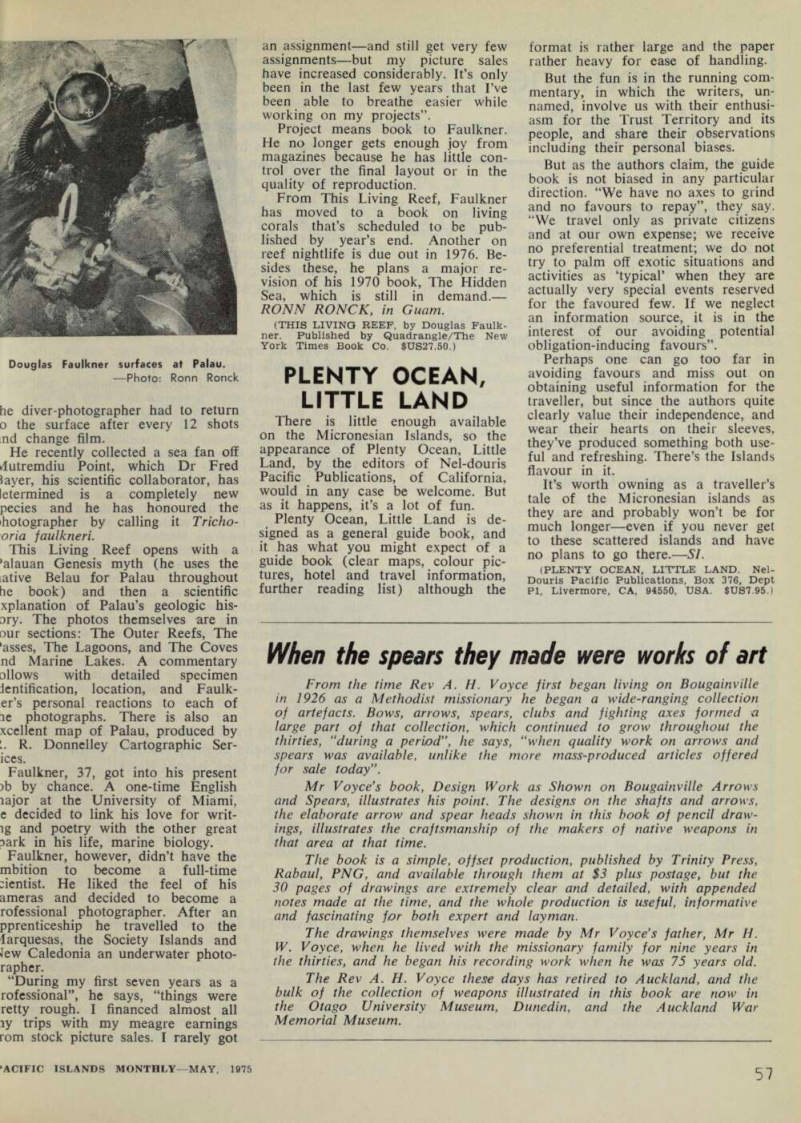
Douglas Faulkner surfaces at Palau. —Photo: Ronn Ronck