Book Reviews
pp. 59-61 · Read in the full issue
Sudden death for two 'peripatetic' missionaries
The London Missionary Society was founded in 1795 and began work in Tahiti in the following year. Its work spread rapidly westward from island group to island group across Polynesia until it established a Mela nesian beach-head in the Loyalty Islands. In 1872 it leapt across Mela nesia to establish itself in what was later to become successively British New Guinea, Australian Papua and near-independent Papua New Guinea.
Its work was propagated by two types of missionaries, the plodders and the peripatetics. The plodders were content to sit down in one place, learn the language and spend labori ous but unspectacular days preach ing, teaching and building up a Christian community. The peripate tics were consumed by a compulsive urge to spread the gospel as far as possible as fast as possible, leaving others to consolidate the work they had begun.
The subjects of these two bio graphies (Beyond the Reefs: The life of John Williams, missionary, by John Gutch, and Tamate—a King: James Chalmers in New Guinea, 1877-1901, by Diane Lang more) were of the latter type and had much in common. Both came to the Pacific as LMS missionaries; both were men of immense stamina, courage and what Diane Langmore, correctly I think, calls charisma; and both, after getting out of manv tight corners, met violent ends, Williams on the beach of Erromango in the New Hebrides and Chalmers on Goaribari Island in the Gulf of Papua.
There was another link between them too, for it was the rapid west ward progress across the Pacific spearheaded by Williams which made possible the “great leap for ward” into New Guinea in the 1870 s.
It is a happy coincidence, there fore, that these two books should have appeared almost simultaneously.
It is a further and equally happy coincidence that their authors write, as it were, from outside the mission
ary “establishment”, with sympathy but with balance, and without the nauseating adulation which mars so many books about missionaries and their work.
Sir John Gutch, who writes about Williams, spent 33 years in HM Overseas Service and was High Com missioner of the Western Pacific from 1955 to 1960. Diane Langmore currently combines research with teaching duties in the Department of History of the University of Papua New Guinea.
“For my own part”, wrote John Williams, “I cannot content myself within the limits of a single reef”, prompting an attractive title for Sir John Gutch’s book. Mrs Langmore’s choice, a quotation from one of Chalmers’ contemporary admirers, is perhaps rather less happy a choice, but if anyone finds it—as I must confess I do—a bit off-putting, he
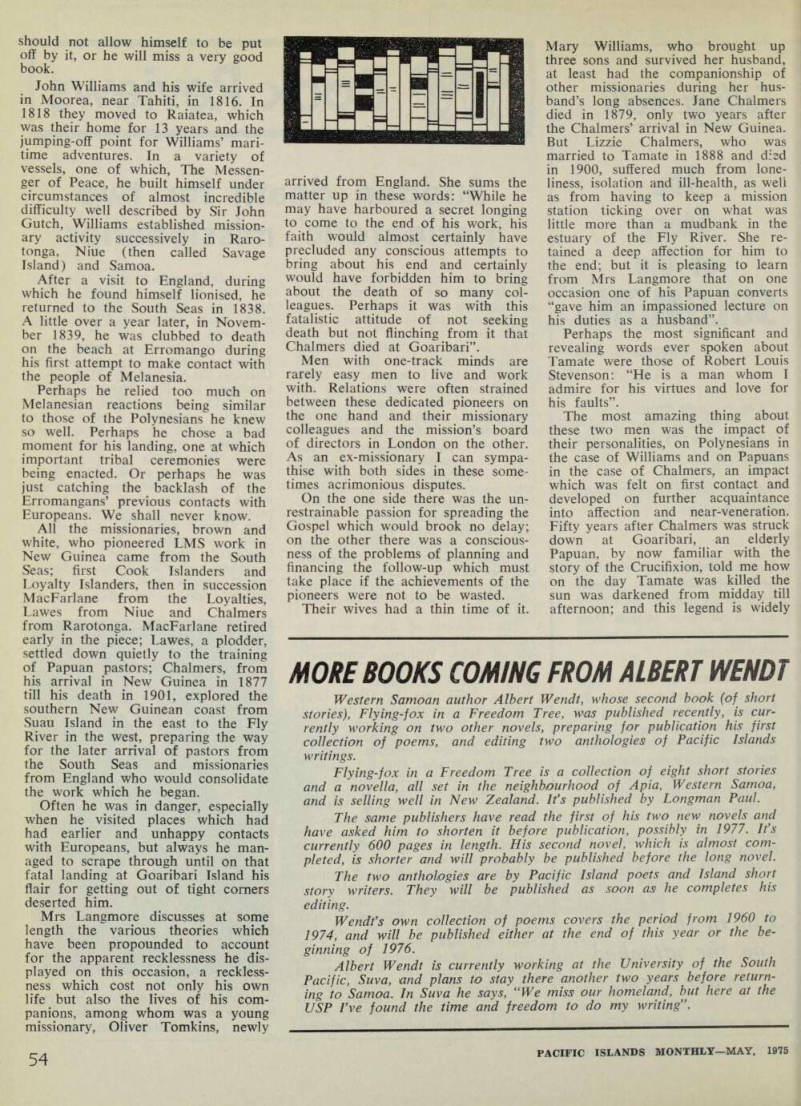
The Rev John Williams ... no reef limits to his labours. Picture taken from a portrait painting.
should not allow himself to be put off by it, or he will miss a very good book.
John Williams and his wife arrived in Moorea, near Tahiti, in 1816. In 1818 they moved to Raiatea, which was their home for 13 years and the jumping-off point for Williams’ mari time adventures. In a variety of vessels, one of which, The Messen ger of Peace, he built himself under circumstances of almost incredible difficulty well described by Sir John Gutch, Williams established mission ary activity successively in Raro tonga, Niue (then called Savage Island) and Samoa.
After a visit to England, during which he found himself lionised, he returned to the South Seas in 1838.
A little over a year later, in Novem ber 1839, he was clubbed to death on the beach at Erromango during his first attempt to make contact with the people of Melanesia.
Perhaps he relied too much on Melanesian reactions being similar to those of the Polynesians he knew so well. Perhaps he chose a bad moment for his landing, one at which important tribal ceremonies were being enacted. Or perhaps he was just catching the backlash of the Erromangans’ previous contacts with Europeans. We shall never know.
All the missionaries, brown and white, who pioneered LMS work in New Guinea came from the South Seas; first Cook Islanders and Loyalty Islanders, then in succession MacFarlane from the Loyalties, Lawes from Niue and Chalmers from Rarotonga. MacFarlane retired early in the piece; Lawes, a plodder, settled down quietly to the training of Papuan pastors; Chalmers, from his arrival in New Guinea in 1877 till his death in 1901, explored the southern New Guinean coast from Suau Island in the east to the Fly River in the west, preparing the way for the later arrival of pastors from the South Seas and missionaries from England who would consolidate the work which he began.
Often he was in danger, especially when he visited places which had had earlier and unhappy contacts with Europeans, but always he man aged to scrape through until on that fatal landing at Goaribari Island his flair for getting out of tight corners deserted him.
Mrs Langmore discusses at some length the various theories which have been propounded to account for the apparent recklessness he dis played on this occasion, a reckless ness which cost not only his own life but also the lives of his com panions, among whom was a young missionary, Oliver Tomkins, newly
arrived from England. She sums the matter up in these words: “While he may have harboured a secret longing to come to the end of his work, his faith would almost certainly have precluded any conscious attempts to bring about his end and certainly would have forbidden him to bring about the death of so many col leagues. Perhaps it was with this fatalistic attitude of not seeking death but not flinching from it that Chalmers died at Goaribari”.
Men with one-track minds are rarely easy men to live and work with. Relations were often strained between these dedicated pioneers on the one hand and their missionary colleagues and the mission’s board of directors in London on the other.
As an ex-missionary I can sympa thise with both sides in these some times acrimonious disputes.
On the one side there was the un restrainable passion for spreading the Gospel which would brook no delay; on the other there was a conscious ness of the problems of planning and financing the follow-up which must take place if the achievements of the pioneers were not to be wasted.
Their wives had a thin time of it.
Mary Williams, who brought up three sons and survived her husband, at least had the companionship of other missionaries during her hus band’s long absences. Jane Chalmers died in 1879, only two years after the Chalmers’ arrival in New Guinea, But Lizzie Chalmers, who was married to Tamate in 1888 and died in 1900, suffered much from lone liness, isolation and ill-health, as well as from having to keep a mission station ticking over on what was little more than a mudbank in the estuary of the Fly River. She re tained a deep affection for him to the end; but it is pleasing to learn from Mrs Langmore that on one occasion one of his Papuan converts “gave him an impassioned lecture on his duties as a husband”.
Perhaps the most significant and revealing words ever spoken about Tamate were those of Robert Louis Stevenson: “He is a man whom I admire for his virtues and love for his faults”.
The most amazing thing about these two men was the impact of their personalities, on Polynesians in the case of Williams and on Papuans in the case of Chalmers, an impact which was felt on first contact and developed on further acquaintance into affection and near-veneration.
Fifty years after Chalmers was struck down at Goaribari, an elderly Papuan, by now familiar with the story of the Crucifixion, told me how on the day Tamate was killed the sun was darkened from midday till afternoon; and this legend is widely
irrent all along the southern coast today’s Papua.
These two books, well-written, sll-balanced and well-documented, ould fascinate not only enthusiasts r the spread of Christianity but so all who are interested in the )ry of the impact of the West on e south Pacific.
I cannot do better than conclude is review with a quotation from John Gutch’s opening chapter. It astrates the poise and humour nch characterise both these books.
Tie missionaries”, he writes, ffered them (ie the Polynesians) new way of life in place of their m cruel practices, one which uld at the same time help them to list the vices brought by other ropeans. Sadly they would also tidemn many innocent aspects of lynesian custom and make life less -efree and uninhibited, but on lance the arrival of the missionaries the Polynesian scene was timely J the Polynesians themselves were nature well equipped to modify ! m ore rigorous restraints de
mded of them”.-
Percy Chat-
[?]Rton.
Beyond The Reefs; The Life Of
MISSIONARY, by John Published by Macdonald, London.
'at atttdo A^ TE—A kinq : JAMES
Almers In New Guinea, 1877-1901.
Ehane Langmore. Published by Mel irne University Press. $10.80.)