in the ears of Fiji’s farmers
p. 18 · Read in the full issue
Boom in sugar is sweet music in the ears of Fiji’s farmers
From VIJEN DR A KUMAR in Lautoka
THERE is a resurgence of hope among Fiji’s 16,000 cane farmers. A new sugar deal that Fiji has signed with British and Common Market countries will bring the country an estimated S7O million for this year’s crop.
It means a windfall for the far mers who stand to earn up to $35 per ton of cane—more than double the present price.
The prospects for the industry look bright. Sugar experts fore cast a continuing boom for the next five years at least. If poli ticians leave the farmers alone, they could give the national economy a jab in the arm.
Sugar and the predominantly- Indian farmers who grow the sweet reed have long been the hot-bed of political activity. It is an irony of history that such a sweet commodity has spawned bitterness from one generation to another. The sugar industry, since its inception in the latter part of the last century, has had a series of crippling strikes.
Such political luminaries as the late Mr A. D. Patel, the founder of the Opposition National Feder ation Party, the late Mr Ayodhya Prasad, the founder of the Fiji Kisan Sangh, and the bulk of the present NFP leadership, rode to power on the backs of the cane farmers. Some of them did and still do much for the farmers.
Others play on their fears and passions to keep themselves poli tically alive.
The canefarmer’s life history is one of debts passed on from one generation to another. Some years ago, the government Co operatives Department carried out a survey and was staggered to find that the overall debt of farmers in the sugar belt in Viti Levu was about $2O million.
Most of this was money they owed to their merchants in town from whom they bought all their goods and borrowed cash to tide them over until the next cane payments. Many merchants were unscrupulous thieves who preyed
on the illiterate farmers by making false entries in their charge books.
I remember my grandfather buying everything from one merchant. When he died, my father inherited his debts running into several hundred dollars. He slowly paid it off after several years.
Such is the story of many others, During the past 10 years, sugar cane production has been steadily declining. Canefarmers found that they could not support and educate their children from their farm earnings. They took outside jobs and encouraged their children to do likewise.
The prickly land problem saw thousands of acres of fertile land go into Fijian reserves. Indian canefarmers were displaced and resettled elsewhere.
Although the cane price remained virtually unchanged, land rents kept shooting up. Prices of farm machinery, fertiliser and work bullocks kept soaring, Labour costs continued rising. The farmer was being driven to the wall but the government seemed
unconcerned at his plight, Now there is a ray of light at the end of the tunnel. The govern ment and the Native Land Trust Board are opening up more land for cane farming under better lease conditions. The Prime Minister, Ratu Sir Kamisese Mara, took a personal interest in their case and was instrumental in hammering out a good deal for them after protracted negotiations with hard-driving British and European buyers, Last month, the farmers’ lead ers, headed by the saffron-robed Indian monk, Swami Rudrananda, took an independent stand and carved out a favourable deal from the Fiji Sugar Corporation for an increased share of the proceeds from the sale of sugar. As poli ticians saw their strongest plut form slip from their fingers, they made desperate attempts to get into the act.
But the talk on the farms m the countryside is different these days. The farmers are far too busy growing cane to bother about the politicians.
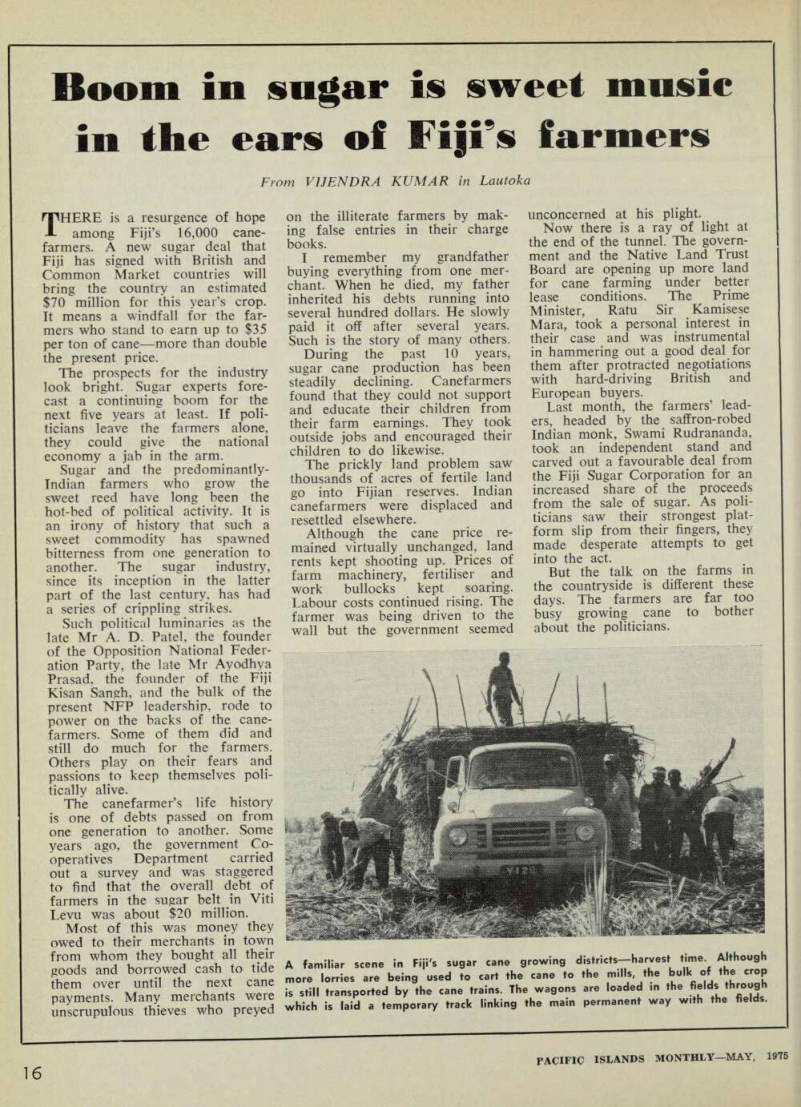
A familiar scene in Fiji's sugar cane growing districts—harvest time Although more lorries are being used to cart the cane to the mills, the bulk of the crop is still transported by the cane trains. The wagons are loaded in the fields through which is laid a temporary track linking the main permanent way with the fields.