Samoa's public service
p. 16 · Read in the full issue
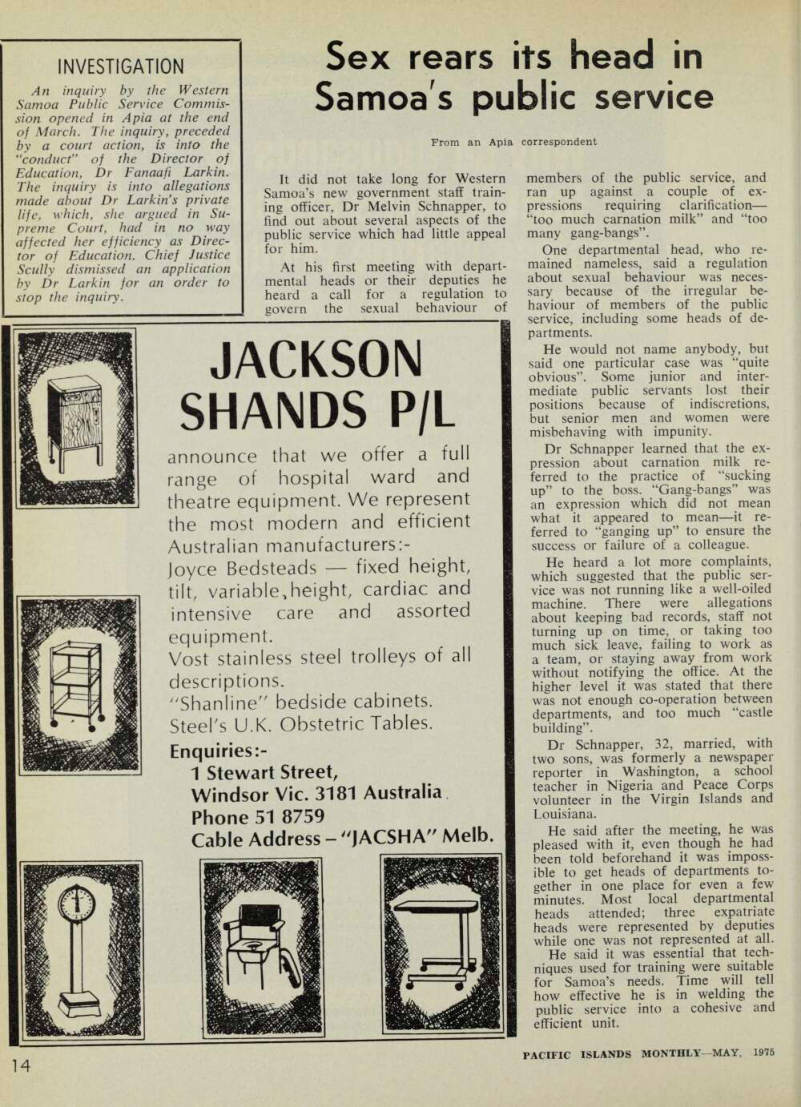
Sex rears its head in Samoa's public service
From an Apia correspondent
It did not take long for Western Samoa’s new government staff train ing officer, Dr Melvin Schnapper, to find out about several aspects of the public service which had little appeal for him.
At his first meeting with depart mental heads or their deputies he heard a call for a regulation to govern the sexual behaviour of
members of the public service, and ran up against a couple of ex pressions requiring clarification— “too much carnation milk” and “too many gang-bangs”.
One departmental head, who re mained nameless, said a regulation about sexual behaviour was neces sary because of the irregular be haviour of members of the public service, including some heads of de partments.
He would not name anybody, but said one particular case was “quite obvious”. Some junior and inter mediate public servants lost their positions because of indiscretions, but senior men and women were misbehaving with impunity.
Dr Schnapper learned that the ex pression about carnation milk re ferred to the practice of “sucking up” to the boss. “Gang-bangs” was an expression which did not mean what it appeared to mean—it re ferred to “ganging up” to ensure the success or failure of a colleague.
He heard a lot more complaints, which suggested that the public ser vice was not running like a well-oiled machine. There were allegations about keeping bad records, staff not turning up on time, or taking too much sick leave, failing to work as a team, or staying away from work without notifying the office. At the higher level it was stated that there was not enough co-operation between departments, and too much “castle building”.
Dr Schnapper, 32, married, with two sons, was formerly a newspaper reporter in Washington, a school teacher in Nigeria and Peace Corps volunteer in the Virgin Islands and Louisiana.
He said after the meeting, he was pleased with it, even though he had been told beforehand it was imposs ible to get heads of departments to gether in one place for even a few minutes. Most local departmental heads attended; three expatriate heads were represented by deputies while one was not represented at all.
He said it was essential that tech niques used for training were suitable for Samoa’s needs. Time will tell how effective he is in welding the public service into a cohesive and efficient unit.