'seclusive democrats'
pp. 11-85 · Read in the full issue
Tough times are ahead for the Solomons 'seclusive democrats'
From Warren A. Paia
It is now nine months since the Solomon Islands adopted the West minster format of government and elected to office its first Chief Minister, Mr Solomon Mamaloni. It has become clear that the new Mamaloni government means busi ness in its attempt to show that it can run its own affairs.
But the precarious nature inherent in a minority government and the unpredictability of party alignments, have created some concern for it.
Not unrelated to such concerns, moreover, has been the existence of an unshakable pillar of expertise and experience provided by the staunch, tough-minded and, very often, devious bureaucrats whose governmental skills are often quite unmatched by those of the new poli tical leaders.
Mr Mamaloni’s government, there fore, may be sympathised with, if not for anything else than for emerg ing at an important juncture of the nation’s history. To facilitate a smooth transition to nationhood at such a time is not exactly an easy task to carry out in a colonial out post where the seeds of British colonialism have sprouted rather well on the soils of a remote group of tropical islands. So the new government could perhaps be ex cused should it be over-cautious, seclusive and uneasy in its approach to shaping a new nation.
Indeed, the new regime has ap peared like a novice swimmer strugg ling desperately to keep her head above the murky waters of a deep, stagnant pool. And the fact that it has found itself in a dilemma is not surprising.
While on the one hand the Mama loni government is trying its utmost to break new ground in political respectability and innovation, on the other hand the urge to conform to the requirements of foreign concepts and institutions (which only a hand ful of people in the Solomons seem able to understand) has become somewhat irresistible.
But such obstacle aside, the new government is certainly making de termined moves toward self government. Many old policies are
now being scrutinised closely. Besides the formation of a long-overdue Lands Review Committee, designed to solve the country’s increasing land problems, the setting up of a Forestry Review Committee recently, has also shown how much the government recognises the need to nationalise its essential resources.
A further sign that self-government might only be around the corner is indicated by the proposed appoint ment of a first Solomon Islander Minister for Finance. He is expected to take his seat sometime in the middle of the year. It seems how ever, that the difficulty here will not be on whether or not to fill the post but who to man it.
Suitable candidates for this very important and demanding senior job are scarce, at least in the governing party. But it is an attractive post, and since potential candidates are almost all in the opposition party, it is conceivable that shrewd Mr Mama loni might “con” a further opposition member into joining him.
As self-government is now immi nent (some unofficial calculations
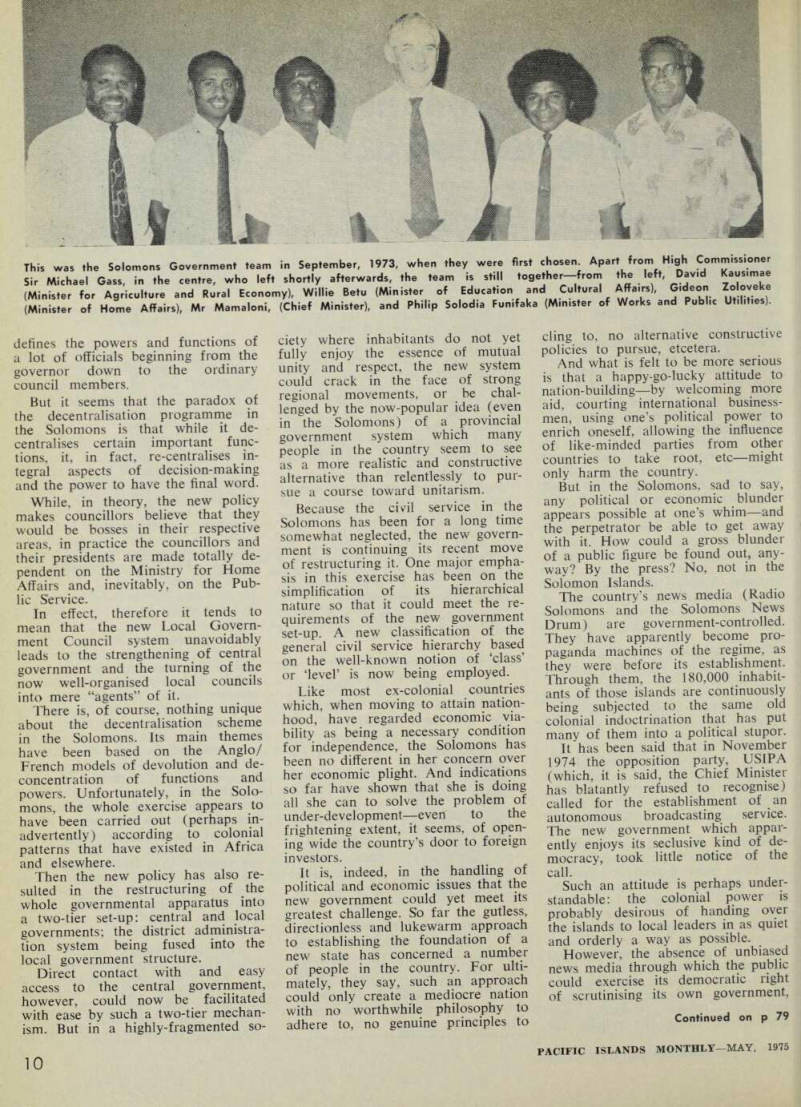
Mr Paia, a Solomon Islander from New Georgia in the Western Solomons is
a tutor in Poli t i cal Studies at the Uni versity of Papua New Guinea. Be fore taking up an aca dem i c career, he
worked as a civil servant for four years, 1966-70, with the British Solomons Government.
His article was written after he spent 12 weeks in the Solo mons “observing certain poli tical phenomena”.
have suggested end of 1975 or Janu ary 1976 as possible dates while Mr Mamaloni has said he would sur prise everybody) increasing govern mental activities in other fields have also become evident.
Mr David Kausimae, the Minister for Agriculture and Rural Economy, has been enthusiastic lately about his ministry improving agriculture gener ally and the cattle industry in parti cular. He told Western Council members in January that New Zea land was prepared to establish a meat factory in the country and to supply sea-trucks for carrying meat from different islands to the factory.
He also said that copra and charcoal factories might be set up in the near future.
The government’s Education Policy Review Committee’s report, which earlier was tossed out by the Legis lative Assembly, was reconsidered recently and has now been accepted.
This means that the Ministry of Education will now be able to put into practice most of the committee’s recommendations. Free education for children in standards one to three, the establishment of district education boards and area secondary schools have been some of the recommenda tions said to have been agreed to.
As for free education, most parents in the Solomons have probably not yet realised that free education for their children would probably mean higher prices for the sugar, meat and rice, etc , . . the prices which in the Solomons today are alarmingly exorbitant.
The government’s highly-praised Local Government Council Review is now in the process of being put into full operation. New legislation amending most provisions of the existing LGC Ordinance, 1963, has been effective since January. It re-
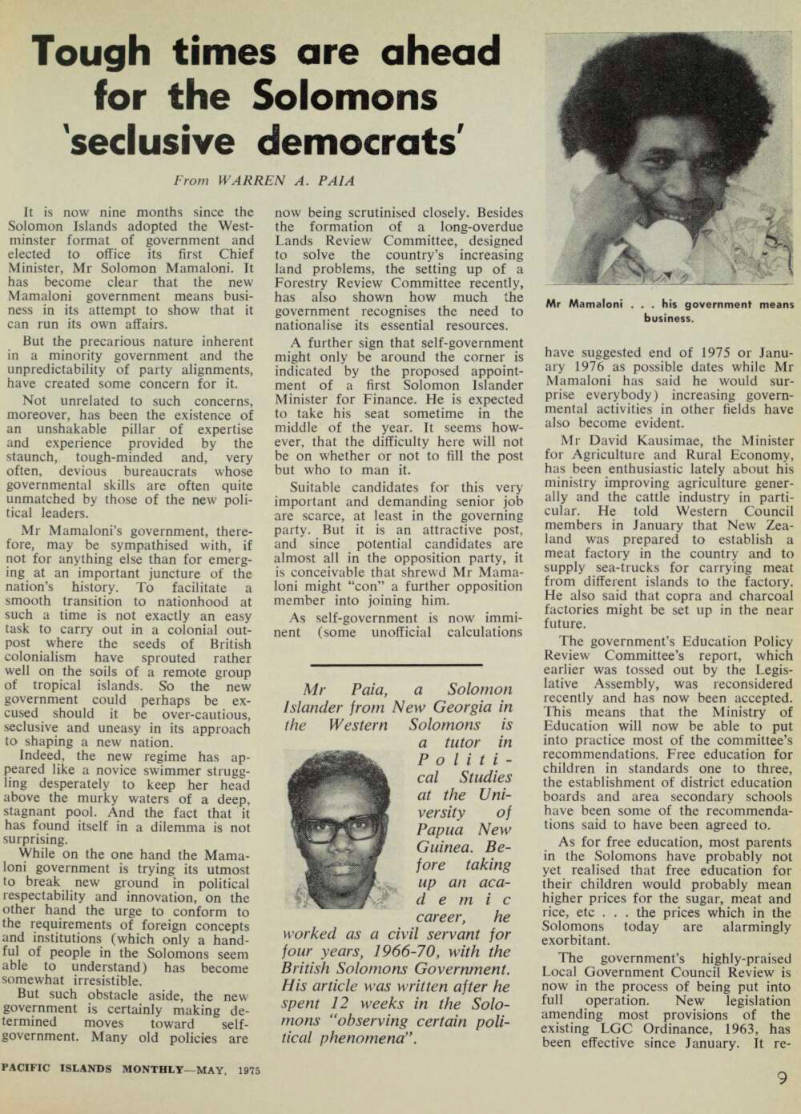
Mr Mamaloni . . . his government means business.
defines the powers and functions of a lot of officials beginning from the governor down to the ordinary council members.
But it seems that the paradox of the decentralisation programme in the Solomons is that while it de centralises certain important func tions, it, in fact, re-centralises in tegral aspects of decision-making and the power to have the final word.
While, in theory, the new policy makes councillors believe that they would be bosses in their respective areas, in practice the councillors and their presidents are made totally de pendent on the Ministry for Home Affairs and, inevitably, on the Pub lic Service.
In effect, therefore it tends to mean that the new Local Govern ment Council system unavoidably leads to the strengthening of central government and the turning of the now well-organised local councils into mere “agents” of it.
There is, of course, nothing unique about the decentralisation scheme in the Solomons. Its main themes have been based on the Anglo/ French models of devolution and de concentration of functions and powers. Unfortunately, in the Solo mons, the whole exercise appears to have been carried out (perhaps in advertently) according to colonial patterns that have existed in Africa and elsewhere.
Then the new policy has also re sulted in the restructuring of the whole governmental apparatus into a two-tier set-up: central and local governments; the district administra tion system being fused into the local government structure.
Direct contact with and easy access to the central government, however, could now be facilitated with ease by such a two-tier mechan ism. But in a highly-fragmented so
ciety where inhabitants do not yet fully enjoy the essence of mutual unity and respect, the new system could crack in the face of strong regional movements, or be chal lenged by the now-popular idea (even in the Solomons) of a provincial government system which many people in the country seem to see as a more realistic and constructive alternative than relentlessly to pur sue a course toward unitarism.
Because the civil service in the Solomons has been for a long time somewhat neglected, the new govern ment is continuing its recent move of restructuring it. One major empha sis in this exercise has been on the simplification of its hierarchical nature so that it could meet the re quirements of the new government set-up. A new classification of the general civil service hierarchy based on the well-known notion of ‘class’ or ‘level’ is now being employed.
Like most ex-colonial countries which, when moving to attain nation hood, have regarded economic via bility as being a necessary condition for independence, the Solomons has been no different in her concern over her economic plight. And indications so far have shown that she is doing all she can to solve the problem of under-development—even to the frightening extent, it seems, of open ing wide the country’s door to foreign investors.
It is, indeed, in the handling of political and economic issues that the new government could yet meet its greatest challenge. So far the gutless, directionless and lukewarm approach to establishing the foundation of a new state has concerned a number of people in the country. For ulti mately, they say, such an approach could only create a mediocre nation with no worthwhile philosophy to adhere to, no genuine principles to
cling to, no alternative constructive policies to pursue, etcetera.
And what is felt to be more serious is that a happy-go-lucky attitude to nation-building—by welcoming more aid, courting international business men, using one’s political power to enrich oneself, allowing the influence of like-minded parties from other countries to take root, etc—might only harm the country.
But in the Solomons, sad to say, any political or economic blunder appears possible at one’s whim—and the perpetrator be able to get away with it. How could a gross blunder of a public figure be found out, any way? By the press? No, not in the Solomon Islands.
The country’s news media (Radio Solomons and the Solomons News Drum) are government-controlled.
They have apparently become pro paganda machines of the regime, as they were before its establishment.
Through them, the 180,000 inhabit ants of those islands are continuously being subjected to the same old colonial indoctrination that has put many of them into a political stupor.
It has been said that in November 1974 the opposition party, USIPA (which, it is said, the Chief Minister has blatantly refused to recognise) called for the establishment of an autonomous broadcasting service.
The new government which appar ently enjoys its seclusive kind of de mocracy, took little notice of the eall. . .
Such an attitude is perhaps under standable: the colonial power is probably desirous of handing over the islands to local leaders in as quiet and orderly a way as possible.
However, the absence of unbiased news media through which the public could exercise its democratic right of scrutinising its own government,
Continued on p 79
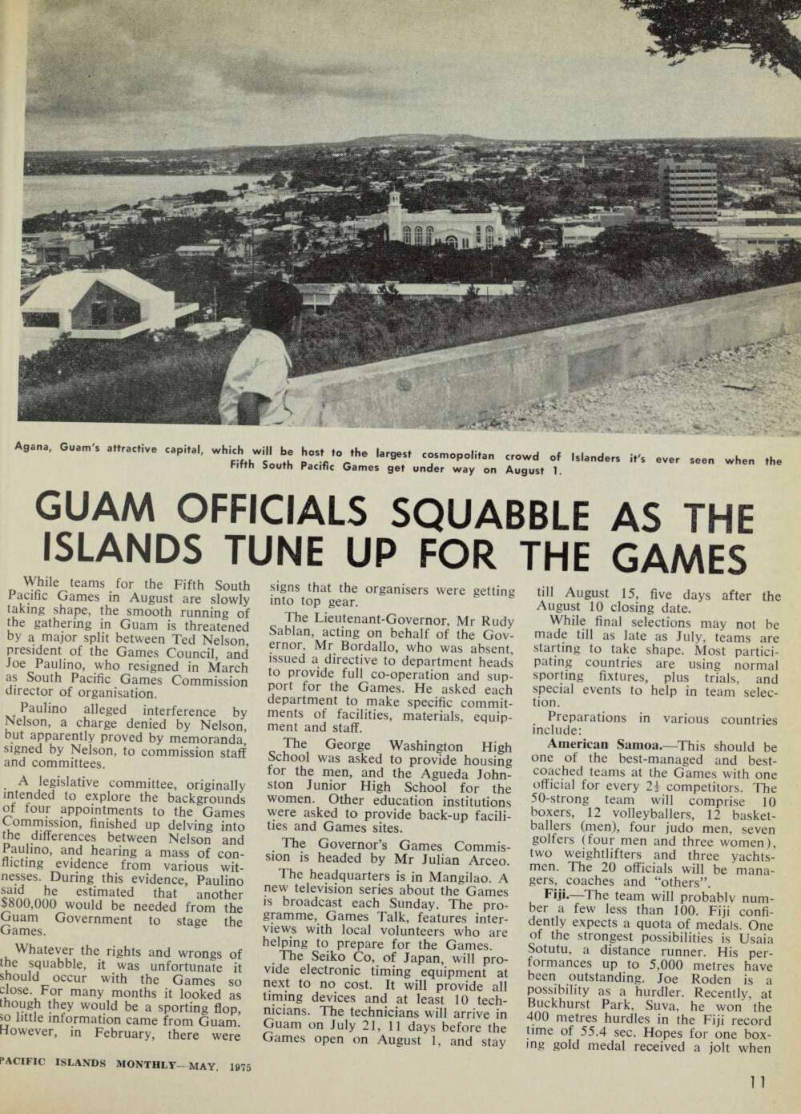
This was the Solomons Government team in September, 1973, when they were first chosen. Apart from High Commissioner Sir Michael Gass, in the centre, who left shortly afterwards, the team is still together-from the left, David kausimae (Minister for Agriculture and Rural Economy), Willie Betu (Minister of Education and Cultural Affairs), Gideon Zoloveke (Minister of Home Affairs), Mr Mamaloni, (Chief Minister), and Philip Solodia Funifaka (Minister of Works and Public Utilities).
ias conveniently provided a neat cur ain behind which the political ;aders have tended to hide them elves from the fury of the increas igly-disenchanted public.
And, while any behind-locked-door ictic of running a country could nly boost corruption and succour ishonest political practitioners, hard lets and serious rumours pertaining ) such events already occurring ave indeed been transmitted via the lands’ effective network of “coconut ireless“. Examples are numerous.
A young, disenchanted local leader om the chief’s own area recently ;nt a somewhat tough letter to the Dvernment. He wrote: “The plan of le new proposed government is now 1 rubbish. The local government ys a programme but this will not ? effective as the shipping here is dw run by business and not the wernment. The Ship today runs [amaloni’s business, therefore, tour g officers are not able to do what ey are supposed to be doing . . .
“Mamaloni is chopping the govern ent’s neck and tries to get his busi es to run the country. This is bad pervision. Is Mamaloni a poli :ian or the manager of the Patosha ampany? I don’t know which is tiich. Please look carefully into this id choose a new and better chief inister to run this country of
Its . . .
“I take this seriously on behalf of akira people and small neighbours ound”.
Government ships in the Solomons e in such short supply and the de and for them for public services in
that island world is understandably high. Yet the present government has apparently deemed it appropriate to allow the few large vessels available to be hired out to those thoroughly patronised development and invest ment companies. Other districts in the Solomons are said to have also suffered from this policy.
Another recent event, which had caused an uproar among the people in the district nearest to Bougain ville, and which had led them to call for secession from the rest of the Protectorate, was incited by a visit paid to the area by the country’s Minister for Agriculture and Rural Economy, Mr Kausimae. The row was over the insistence of the minis ter on resettling a group of people from the bauxite-rich Rennell Island on alienated Baga Island which is within the area of the district’s Local Government Council.
The Western District which Mr Kausimae visited on that occasion in January has regarded itself as neglected, has become suspicious of the central government’s actions, and has apparently become a politically angry region of the group. For sometime now, it has had ideas of secession.
The Western people have fre quently made it known both inside and outside parliament that they have not had a fair share of the national fund to which their district has contributed the largest amount.
Moreover, having the richest local government council in the country (which money surplus, it is said, the central government has also even tried to give to other councils or to put in a central fund—but all to no avail) tended to encourage the dis trict to talk of breaking away.
Furthermore, because of its rela tively-sophisticated population and concerned local leaders, the ‘West’ has begun to agitate for its rights. In addition, the problems caused by the preponderance of alienated lands in the area and the increasing disputes over customary lands have been of continuous concern to Westerners.
Their grievances have frequently been directed at the colonial central government which, they claim, in almost all cases has grabbed returned alienated lands without consulting the originally-dispossessed true owners of such lands.
Yet, in an off-handed and arm twisting manner, Mr David Kausimae tried to reach a favourable agreement on the resettlement question with these disgruntled people. To them in the January session of the Western Council he even put a surprisingly straight question: “What would you do if the central government goes
ahead and resettles the Rennellese on Baga?” The answer from the Western Council members was ex pectedly forthright: “If you are frightened that the Shortland Islands might join Bougainville, you would do well to also fear that prospect from the whole Western District”.
Although the minister’s negotiation for the resettlement plan met with very little success, on his return to Honiara he had apparently led the public, through the government radio, to believe that his proposal had been accepted by the Western people.
The Western Council’s negative decision on the matter surfaced later, and the episode raised some eye-brows in the capital.
The seemingly-worthwhile trip of the Chief Minister, Mr Mamaloni, to Papua New Guinea, Japan and New Zealand recently has now appeared tainted by certain alleged back-door private business deals in Papua New Guinea and Japan. These contacts were said to have been made in pri vate hotel rooms.
The winds of change are certainly blowing hard in the Solomons, but so far they have not exactly re freshed the suffocating island demo cracy.