disappointed
pp. 8-9 · Read in the full issue
New Caledonian journalists disappointed
From a Noumea correspondent Noumea journalists who flew to Australia to cover the visit of French Overseas Territories Minister Olivier Stirn sent home disappointing reports of economic statements on New Cale donia and alleged anti-French feeling in the Australian press.
Of course there was pleasure and pride in the official courtesy sur rounding the visit with its confirma tion of a rapprochement, at least at government level, between France and Australia.
As far as Caledonian problems are concerned, there was no exciting news for the Noumea journalists to send back. One brief sentence con firmed earlier ministerial promises of some change in the territory’s poli tical statutes. But on the main prob lem of economics, as one pro administration weekly expressed it, the Stirn visit was the “confirmation of a failure” ie, there were no heartening nickel developments after the minister’s announcements during his New Caledonian visit in January.
The Noumea journalists were keen to hear Mr Stim’s reactions to his
February talks in Paris with AM AX president lan MacGregor and INCO’s Edward Grubb.
However, the Noumea weekly could only repeat that the Cale donians are tired of vague promises and that Mr Stirn’s remarks in Syd ney were far from reassuring. In view of the lack of hope of anything from the French Government, the paper showed there was little point in the Caledonian Territorial Assem bly approving company tax reforms which Mr Stim stressed, again in Sydney, were urgently required to permit the building of long-promised new nickel works.
The Noumea press pointed out that on the national level, the main objects of the French ministerial visit were uranium and aeronautics.
The French were in fact lobbying for the use of French technology in the setting up of any Australian uranium-enrichment plant, as well as promoting the sale of French aircraft such as the airbus and Concorde. In return Australia was hoping for French sympathy in allowing greater beef exports to the Common Market.
As far as any fallout of benefits to Caledonians was concerned, hopes centred on an increase in tourist traffic from Australia, although shortcomings of Caledonian welcome and amusements were emphasised, especially compared with Fiji’s at traction to Australians. This is a sore point, since Minister Stirn last Janu ary had already exhorted the Cale donians to take a lesson from the immense revenue Fiji was earning from tourism.
On a more personal plane, the French visitors felt an anti-French sentiment in the Australian press. As one metropolitan French journalist expressed it, “. . . the Australian press still remains unpleasantly anti- French, fixed with a colonialist image of France”, with Australian politi cians and journalists frequently using the words “colony” and “colonial”, words which are ‘‘never used any more by the French”.
In an article entitled “Australian Press Sulky with Mr Stirn”, the same writer’s paper complained that Aust ralian journalists did not meet the French minister upon his arrival at Canberra airport. Moreover, when the Noumea press was invited to a press luncheon at the Journalists Club in Sydney they met only the club president, a non-journalist mem ber and a Papuan writer. The small cover given to the French visit sug gested that “the Australian press does not want to support the Whitlam government in its desire to extend a friendly hand to France”.
However, the importance of this
mission to the French is emphasised by trade follow-ups to come. An Austrahan visit is planned shortly by the French Minister for Overseas Trade, Mr Segard, as well as an economic and industrial mission, with a possible trip by French Prime Minister Jacques Chirac before the end of 1975.
Meantime, as France seeks to establish friendlier ties in the South Pacific, the Noumea press reported that Mr Stirn had asked Mr Whitlam and his Department of Foreign
Affairs to help improve Franco- Fijian relations, especially over diffi culties encountered with Fiji trade lln : on o « . . . u , . . .
Referring to the latest strike action announced against UTA French Air hnes at Nadl air Port in March, a Noumea daily claimed that Fiji union leader Tora was reportedly “sup ported by the International Corn munist Party to drive France from the South Pacific by all the means at his disposal”.
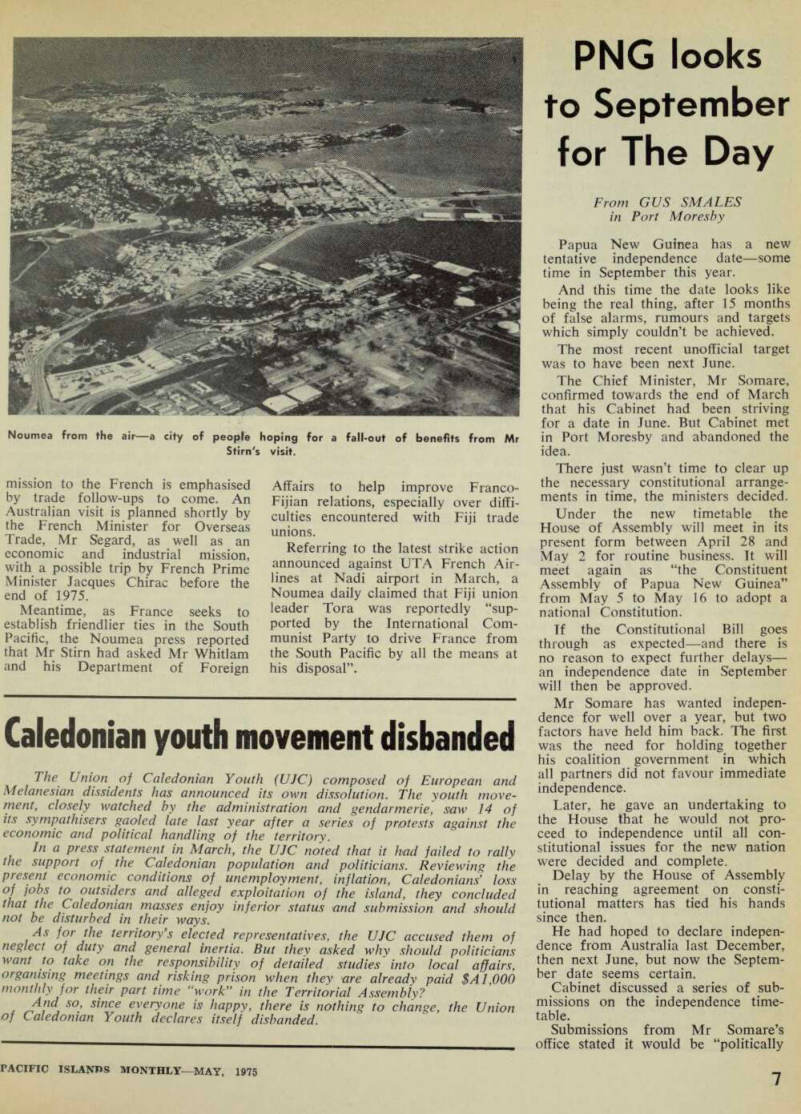
Noumea from the air—a city of people hoping for a fall-out of benefits from Mr Stirn's visit.