Pacific Islands Monthly
pp. 6-8 · Read in the full issue
Mr Stirn's Tahitian Love Song: A
New Style With New Chances
From AL PRINCE in Papeete
Olivier Stirn, the French Secretary of State for Overseas Departments and Territories, made an historic, seven-day visit to French Polynesia at the end of March, ruling out inde pendence and internal autonomy for Tahiti, but proposing more local auto nomy through a reformed, seven-man government council with Governor Daniel Videau as its president. Mr Stirn’s visit was historical, not only for what he did say but also for what he did not say, but implied.
Although Mr Stirn is due to return to Tahiti in six or eight months, but definitely before the end of the year, to continue the dialogue he began, two things became clear about Tahiti’s future as the minister boarded his plane at the end of a very busy visit.
First, Mr Stirn in no way indicated that France has any intention of pull ing out of French Polynesia at any time in the near future or tightening the generous purse strings that have contributed to a very modern, but increasingly expensive and infla tionary, way of life in Tahiti.
Secondly, Mr Stirn indicated that the relationship between France and French Polynesia, as spelled out in a 1966 law, will perhaps never be quite the same again. About this, Mr Stirn was more specific, saying that a new law governing this relationship will go into effect next January 1. Ostensibly, the purpose of Mr Stirn’s visit—his first as French President Valery Gis card d’Estaing’s Overseas Territories Minister—was to open a dialogue with local officials and political leaders on how this new law will be worded. This dialogue will continue in May when a delegation from Tahiti visits Mr Stirn in Paris and when he returns later this year.
Under this new law, instead of in dependence or autonomie interne — greater self-government short of in dependence—Mr Stirn said French Polynesia will get more autonomy through the reformed seven-man government council. The governor, he said, will have an equal voice with the
other six council members, who will represent local political factions.
The council will have full powers, even over administrative services, and added that the governor will no longer have his present absolute prerogatives as head of the current six-man gov ernment council. (It is perhaps be cause of the proposed change that Gov Videau has not been participat ing in votes by the current council for several months.) Mr Stirn said at a press con ference on his last day in Tahiti that he considers it normal for the gov ernor to remain president of the new council because “taking this presidency away from him would be an act of suspicion against the government (of France). I believe the political groups can accept this. One must give the territory autonomy and not ambiguous internal autonomy.”
However, what Mr Stirn described as the new relationship is not exactly what the three major political parties in Tahiti have been after. They had envisioned an elected official as head of a new government council, with the governor being nothing more than a High Commissioner.
But Mr Stirn said the exclusion of the governor as president of the new council would create undue suspicion towards France, and he indicated such suspicion by viewing internal auto
nomy as a stepping stone to indepen dence, although the local parties have argued that this is not true.
About a week after Mr Stirn left Tahiti, Agence France Presse, the French news agency, quoted him as saying in Paris that the political parties in Tahiti had abandoned their pre vious demand that the governor’s role as president be removed from a reform of the government council.
This prompted immediate, angry de nials by the autonomist and inde pendent parties.
But for the most part, the local political leaders appeared to be one big, happy family during Mr Stirn’s visit. A photograph in a local news paper showed former Territory Assembly President Gaston Flosse and French National Assembly Deputy Francis Sanford smiling with arms wrapped around each other as they accompanied the minister on a visit to some of the outer islands.
Mr Stirn arrived in Tahiti on March 19 under the theme of “a new style, new chances”. But on the day of his arrival, the three local French language newspapers carried an open letter to the minister from the autono mist party, which said, “We want to very frankly point out that at this moment the government is playing France’s last card in Polynesia. We hope that they play well.” The letter also reminded Mr Stirn that in two interviews just before coming to Tahiti he had said that “the large majority of Polynesians wish to remain French.”
But the letter pointed out that a delegation from Tahiti recently told Mr Stirn in Paris that: • “Polynesians in no way wish to renounce the right to independence that the Constitution of the Republic (of France) grants them; • “They will utilise this right in the case where the new territorial statute, which will be granted or im posed on them, will not give them the internal autonomy that a great maiority of them are claiming” and • “Therefore, their wish to re
main French will never be uncondi tional, but quite the contrary, will de pend in the near and distant future on the conditions in which France will or will not allow them to live free as they wish on the land of their an cestors, caring for their own matters themselves.”
And Mr Stirn got another reminder when he attended a meeting of the French Polynesia Territorial Assembly in Papeete the very next day. This came from Assembly President Frantz Vanizette, who told the Minister, “We don’t wish to pretend that the future of the territory, and its future as a whole, depends exclusively on the statutes of the territory. The example of the current world economic crisis is there to make us more modest.”
And Mr Vanizette said that although the French Constitution’s section governing overseas territories “leaves room for a possible accession to independence, in the context of
present discussions . . . independence
is not on the agenda either literally or implied.”
However, he stressed, “One thing is certain—and my personal experience of 18 years presence in this assembly is proof of this—unanimously— I re peat, unanimously—an evolution of the statute of our territory is wished.
For 17 years there has never been a session of the assembly where the statutory problem has not been brought up, either directly or in directly. Everyone, whether they had the majority or not, after having explored the present statute, ... by different roads and at different times, all of us have come to desire an evolution.”
When Mr Stirn’s time came to address Gov Videau and the assembly, the first thing he did was to rule out independence for Tahiti.
“I’ve already been able to see . . . that Polynesians do not want inde pendence. Some of you would have admitted this only as a last resort, with fear and against your will. They would have only done this if, to quote French President Giscard d’Estaing, ‘The change that took place was only because they were unable to find what they were looking for in France.’
“Therefore,” Mr Stirn said, “a referendum on independence is use less.”
The minister said that a French ministerial group will meet in Paris in June on the country’s overseas ter ritories with the aim of formulating a definite position. The text of this position, he said, will be submitted to the French Polynesia Territorial Assembly for approval and will be debated in the French National Assembly and Senate in Paris during the autumn (northern) session this
year and go into effect next January 1.
But Mr Stirn noted, “Of course, this does not naturally imply that the text is already ready. This merely means that the main lines of what appears to be suitable to the government, after its first contacts with you, have already been defined.
“Of course, the dialogue that has begun will enable us to reach legisla tion that I hope will be of such a nature that it satisfies all political tendencies making up the territory.
Of course, no one will be totally satisfied because when getting down to details and arrangements, different points of view appear.”
Mr Stirn said he hopes that an arrangement can be reached that “will do away with any misunderstandings or permanent fighting on this point.
It is clear that the rupture of ties with France is neither wanted nor hoped for. . . .”
In stating his theme of “a new style, new chances,” Mr Stirn said, “That is the contract, which, from the bot tom of my heart, I propose today to the Polynesians.” He later added, “I am sure that France can give the territory more real independence; that France can give the territory more dignity. But as a counterpart, French Polynesia must give France more justice and more brotherhood.”
He did not elaborate.
During his visit to the outer islands
a couple of days later, he said a fear that the territory would not remain French had to be done away with to enable the moral and economic con tract he has proposed for France and French Polynesia to work. “I can clearly here that French Poly nesia is, and will remain, French because of the close ties uniting you to France and because you give France a lot, and in return it gives you much too.”
A little more than a week after Mr Stirn left Tahiti, French Social ist Party leader Francois Mitterrand arrived, ostensibly to join his wife who had already spent a week’s vacation in Tahiti. Claiming that he had not come to hold any important
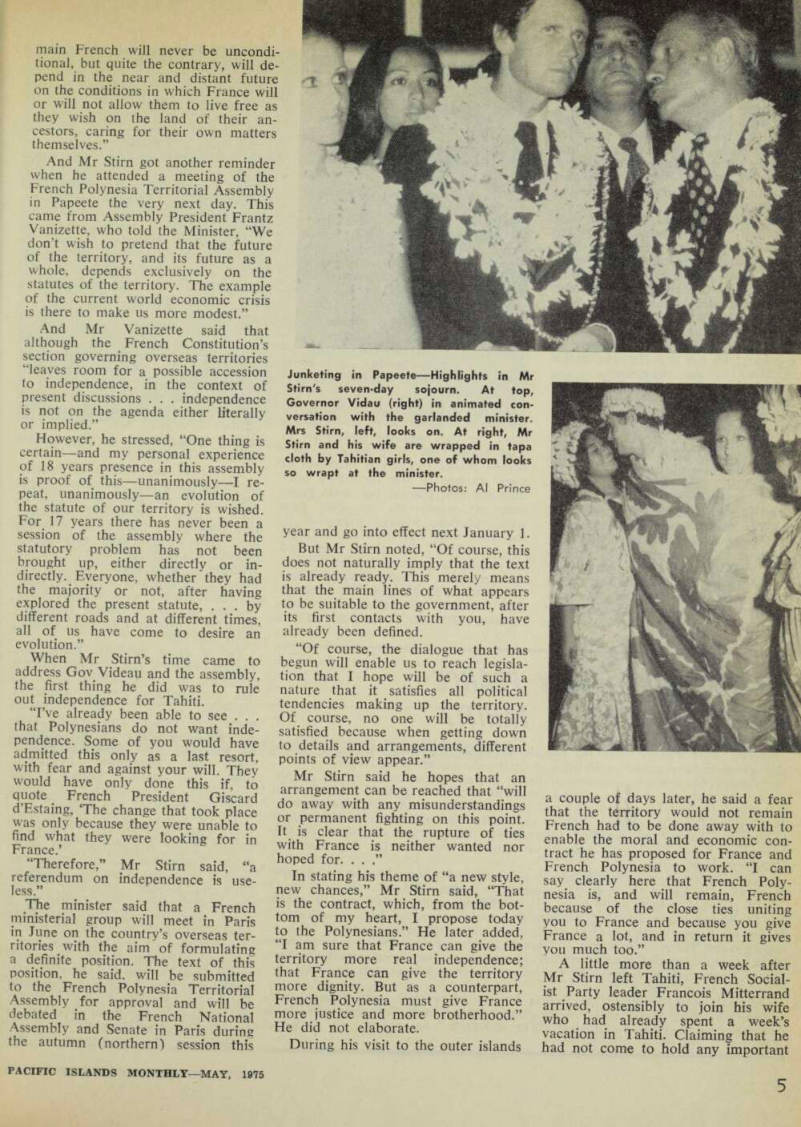
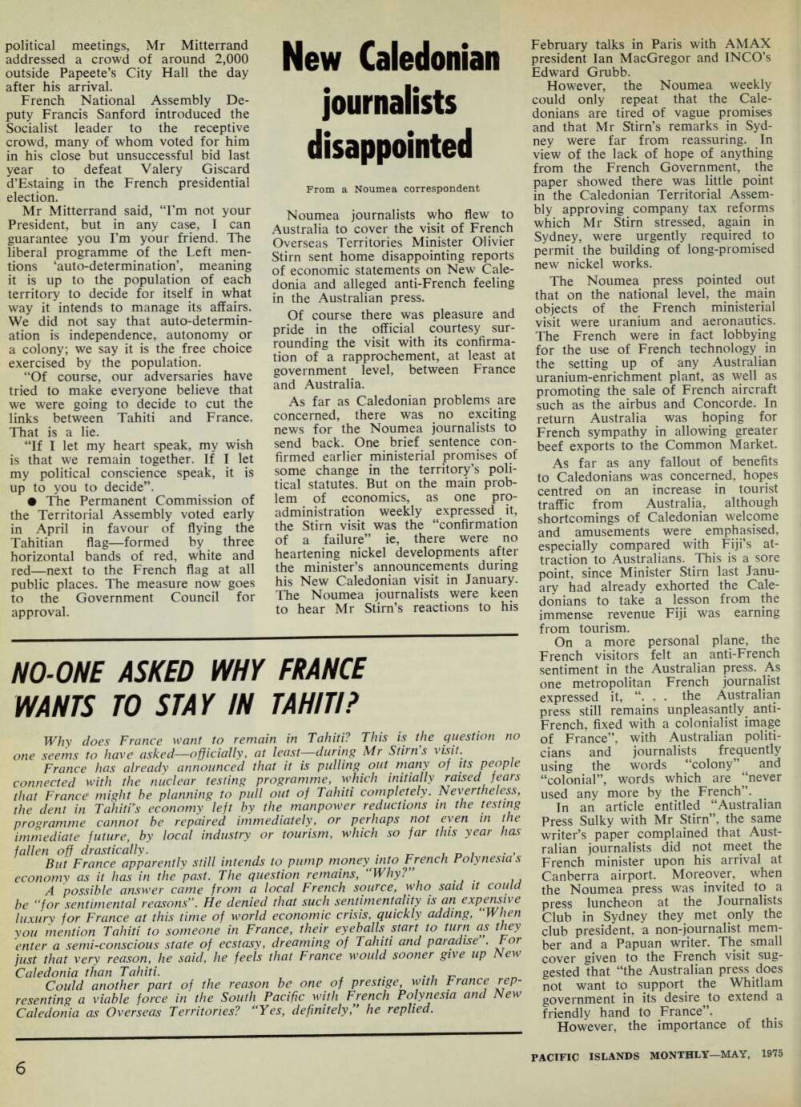
Junketing in Papeete—Highlights in Mr Stirn's seven-day sojourn. At top, Governor Vidau (right) in animated con versation with the garlanded minister.
Mrs Stirn, left, looks on. At right, Mr Stirn and his wife are wrapped in tapa cloth by Tahitian girls, one of whom looks so wrapt at the minister. —Photos: Al Prince
political meetings, Mr Mitterrand addressed a crowd of around 2,000 outside Papeete’s City Hall the day after his arrival.
French National Assembly De puty Francis Sanford introduced the Socialist leader to the receptive crowd, many of whom voted for him in his close but unsuccessful bid last year to defeat Valery Giscard d’Estaing in the French presidential election.
Mr Mitterrand said, “I’m not your President, but in any case, I can guarantee you I’m your friend. The liberal programme of the Left men tions ‘auto-determination’, meaning it is up to the population of each territory to decide for itself in what way it intends to manage its affairs.
We did not say that auto-determin ation is independence, autonomy or a colony; we say it is the free choice exercised by the population.
“Of course, our adversaries have tried to make everyone believe that we were going to decide to cut the links between Tahiti and France.
That is a lie.
“If I let my heart speak, my wish is that we remain together. If I let my political conscience speak, it is up to you to decide”. • The Permanent Commission of the Territorial Assembly voted early in April in favour of flying the Tahitian flag—formed by three horizontal bands of red, white and red—next to the French flag at all public places. The measure now goes to the Government Council for approval.