Deaths of Islands People
pp. 88-89 · Read in the full issue
Death Recalls A Great Png Trek
Mr Louis James O’Malley, who died in Sydney in February, during a long career in the public service in Papua New Guinea, won fame in 1935, when, as a 23-years-old patrol officer, he was second in command of an expedition which penetrated deep into the Highlands. The patrol was led by the famous Jack Hides.
The Lieutenant-Governor of Papua described the expedition as “one of the hardest and most difficult expeditions ever undertaken in any part of the island of New Guinea”.
The expedition received much pub licity in Australian newspapers for its feat. PlM’s editor, and founder, Mr R. W. Robson, commented . . .
“on this occasion the Australian press—and, in fact, the press of the world—gave to Mr Hides’ exploits and discoveries the same publicity they might have given to H. M.
Stanley’s travels a couple of genera tions ago”.
Hides and O’Malley set out from Dam on January 1, 1935 with 14 native police, 30 carriers and eight tons of stores. They went 350 miles up the Fly and Strickland rivers in the government launch, Vailala, and then on into the then unknown hinterland, over terrible country, for the next two months.
They once took seven days to cover 11 miles, over a limestone surface broken by great chasms and fissures, amid dwarfed and twisted vegetation. The police and carriers suffered from torn feet and bitterly cold rain. Six were disabled. The party abandoned half its stores.
From 7,000 ft, they finally gazed far over a series of thickly populated and intensely-cultivated valleys, the Tari Furoro River sys tem. They descended from the lime stone barrier, crossed the river, named Ryan, and a mountain, and entered the valley system. The Ryan, or Tari, seemed to be a tributary of the Kikori.
For five weeks, they marched through the Tari Furoro district, attacked repeatedly by hordes of per sistently-hostile natives. They saw an astonishing system of irrigation and cultivation. There was evidence of constant inter-tribal fighting and cannibalism. The first tribes met
were people with light brown skins and long curling hair. The party was refused food. They were conserving their rice, and were almost starving in the midst of plenty.
Travelling north and east, they crossed a mountain, about 13,000 ft high, which they provisionally named Mt Champion, and came down on May 5 into valleys, part of the headwaters of the Purari.
During May, they travelled east and south through a thickly populated region in which the people were hostile and treacherous. They were constantly under attack. The natives refused to give or sell food.
The men were bearded, and usually wore large wigs of human hair. The party, on May 13, fought a day-long battle against many hundreds of warriors. The native police were splendid—cool and unflinching.
At the end of May, the party turned south, and started the return trip across the terrible limestone barrier. They suffered great priva tions, chiefly from cold, and extreme hunger, and were extremely lucky to escape death. South of the barrier, near the Erewa River, they met friendly tribes, who gave them food, shelter and transport. They arrived at the government station at Kikori on June 19, just 160 days after they left Dam.
"Which is Hides and which is O’Malley?” asked the officer there, as two scarecrows, bearded, tattered, torn and emaciated, crawled wearily out of the canoes.
The two men went to Australia on leave to recuperate, and tell the story of their trip.
Mr O’Malley later served in a number of areas in Papua New Guinea, becoming District Com missioner, first at Kikori, which had so many memories for him, and later of Manus District, with headquarters at Lorengau. He retired in 1968 to live in Sydney. In World War 11, Mr O’Malley served with ANGAU, and reached the rank of major.
Mr L. H. Wilkinson Mr Lancelot Harcourt Wilkinson, who died at Cairns on February 7 after a severe illness, spent 40 years
in Papua, mainly in the Milne Bay\ district. He went to Papua in 19311 to work in the Misima gold mine. Hes was employed there till 1941, whenr he joined the RAF, training inr Canada, and taking part in Lancaster! bomber raids over Germany.
Mr Wilkinson started a business 2 at Maclean, NSW, on his discharge, , but the call of Papua was too strong<; and he returned there. After a short! time at Misima he bought a planta- tion in the Milne Bay district, carry- ing on a trading and recruiting enter- prise at the same time. He sold the ; plantation to become a trader only, e and then took on maintenance work : at Loani airstrip, near Samarai. He ; is survived by his wife and three ; children.
Lance Wilkinson was a regular ■ correspondent in PIM for many years, and his stories of Island life had the smell of copra about them.
He was the real Island “old hand” with many friends in all walks of life.
Mr Naku Ngati Mr Naku Ngati, who died recently at Muri, Cook Islands, was well known in his younger days as a sea man working on trading schooners in many parts of the Pacific. He was 80. He served in the Middle East in World War I. Mr Ngati was a deacon in the church at Ngatangiia. He is survived by a son and a daughter.
Mr W. Magnay Mr. William Magnay, superinten dent of operations in the Papua New Guinea Teacher Education Division, was killed recently in a car accident in Adelaide, He went to Papua New Guinea in 1954 as a primary school teacher. He had a wide knowledge of education in PNG, particularly in teacher education. He leaves a widow and two daughters.
Rev N. Wright The Rev Norman Wright, who was the first fulltime probation officer in Fiji, died recently in Adelaide, aged 80. He went to Fiji in 1927 to start probation work, and lay the founda tions of the present Social Welfare Department. Later he joined the Methodist Church, and worked for the Indian mission at Ba, Lautoka and Suva. In 1951, when his appoint ment in the church as Methodist secretary for education expired, he joined the Education Department as a probation officer. He retired in 1961 to live in South Australia. He is survived by his wife and adult family.
Mr G. A. Evans Mr George Albert (Sonny) Evans lied suddenly recently on Norfolk sland while planting corn. The son >f Andrew and Phoebe Evans, he was >orn on the island in 1902. He was a armer and carpenter most of his life, lis wife, Helen, died about 18 months arlier. He leaves a daughter, Mrs )olly Christian.
Pastor T. Marae Pastor Tambagato Marae, a well nown former pastor of the Pres yterian Church in the New Hebrides, ied recently at Tongoa. He was be eved to be more than 80. He was rdained pastor in 1946, and then ;rved mainly in the Shepherd Group 11 his retirement in 1958. He helped 4th missionary work before his rdination.
Mr R. Douglas Mr Reg Douglas, a planter, of ►acavula Estate, Taveuni, Fiji, died jcently. He took an active part in [immunity affairs on the island.
Pastor Andrew G. Stewart Pastor Andrew G. Stewart, a Adventist missionary in le Pacific Islands for more than 60 died in Sydney on March 10, hile being taken to hospital. He was i his 94th year. He lived at Pastor Stewart served in Fiji for ne years and then went to the New ebrides. Later he went to Papua ew Guinea. In 1964 he bought a essna 180, the first plane acquired / the mission for use in New uinea. This aircraft was named after m.
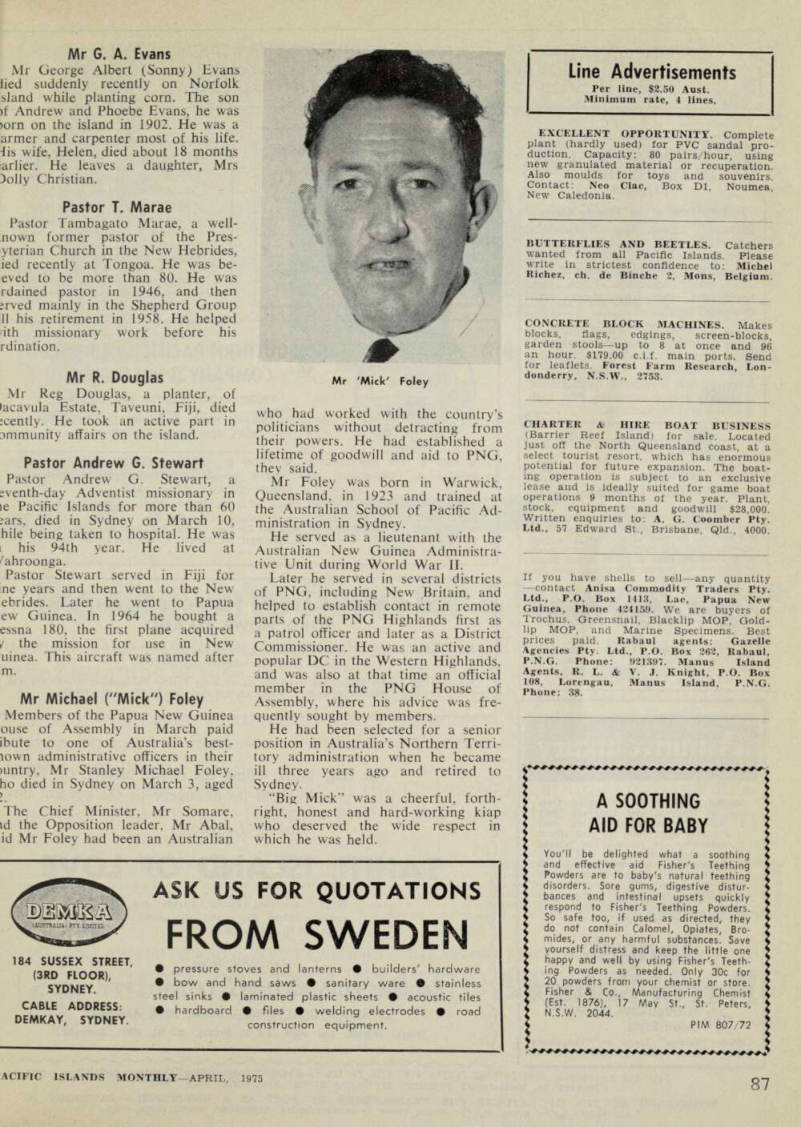
Mr Michael ("Mick") Foley
Members of the Papua New Guinea ouse of Assembly in March paid ibute to one of Australia’s best lown administrative officers in their >untry, Mr Stanley Michael Foley, ho died in Sydney on March 3, aged > The Chief Minister, Mr Somare, id the Opposition leader. Mr Abal, id Mr Foley had been an Australian
who had worked with the country’s politicians without detracting from their powers. He had established a lifetime of goodwill and aid to PNG, they said.
Mr Foley was born in Warwick, Queensland, in 1923 and trained at the Australian School of Pacific Ad ministration in Sydney.
He served as a lieutenant with the Australian New Guinea Administra tive Unit during World War 11.
Later he served in several districts of PNG, including New Britain, and helped to establish contact in remote parts of the PNG Highlands first as a patrol officer and later as a District Commissioner. He was an active and popular DC in the Western Highlands, and was also at that time an official member in the PNG House of Assembly, where his advice was fre quently sought by members.
He had been selected for a senior position in Australia’s Northern Terri tory administration when he became ill three years ago and retired to Sydney.
“Big Mick’’ was a cheerful, forth right, honest and hard-working kiap who deserved the wide respect in which he was held.
Mr 'Mick' Foley