fly-by-nights may
pp. 79-82 · Read in the full issue
Australia backs Papua New Guinea for millions
From GUS SMALES in Port Moresby Australia’s announcement in Febru ary that it is unconditionally guaran teeing a multi-million dollar world loan for Papua New Guinea is an intangible type of aid far more im portant than it might appear.
The loan, which will round out at between $lB and $l9 million in Aus tralian equivalents, will be in US dollars and will be for general de velopment purposes.
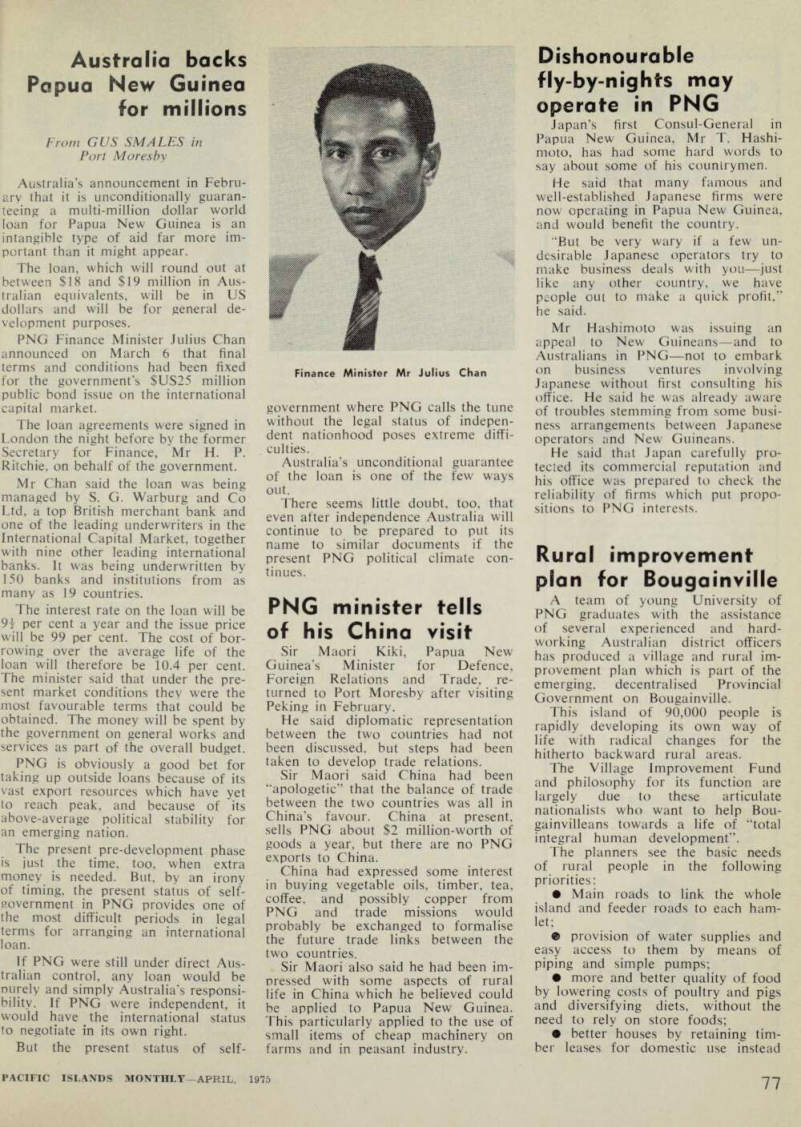
PNG Finance Minister Julius Chan announced on March 6 that final terms and conditions had been fixed for the government’s SUS2S million public bond issue on the international capital market.
The loan agreements were signed in London the night before by the former Secretary for Finance, Mr H. P.
Ritchie, on behalf of the government.
Mr Chan said the loan was being managed by S. G. Warburg and Co Ltd, a top British merchant bank and one of the leading underwriters in the International Capital Market, together with nine other leading international banks. It was being underwritten by 150 banks and institutions from as many as 19 countries.
The interest rate on the loan will be 9i per cent a year and the issue price will be 99 per cent. The cost of bor rowing over the average life of the loan will therefore be 10.4 per cent.
The minister said that under the pre sent market conditions they were the most favourable terms that could be obtained. The money will be spent by the government on general works and services as part of the overall budget.
PNG is obviously a good bet for taking up outside loans because of its vast export resources which have yet to reach peak, and because of its above-average political stability for an emerging nation.
The present pre-development phase is just the time, too, when extra money is needed. But, by an irony of timing, the present status of self government in PNG provides one of the most difficult periods in legal terms for arranging an international loan.
If PNG were still under direct Aus tralian control, any loan would be nurely and simply Australia’s responsi bility. If PNG were independent, it would have the international status to negotiate in its own right.
But the present status of self-
government where PNG calls the tune without the legal status of indepen dent nationhood poses extreme diffi culties.
Australia’s unconditional guarantee of the loan is one of the few ways out.
There seems little doubt, too, that even after independence Australia will continue to be prepared to put its name to similar documents if the present PNG political climate con tinues.
PNG minister tells
of his China visit
Sir Maori Kiki, Papua New Guinea’s Minister for Defence, Foreign Relations and Trade, re turned to Port Moresby after visiting Peking in February.
He said diplomatic representation between the two countries had not been discussed, but steps had been taken to develop trade relations.
Sir Maori said China had been “apologetic” that the balance of trade between the two countries was all in China’s favour. China at present, sells PNG about S 2 million-worth of goods a year, but there are no PNG exports to China.
China had expressed some interest in buying vegetable oils, timber, tea, coffee, and possibly copper from PNG and trade missions would probably be exchanged to formalise the future trade links between the two countries.
Sir Maori also said he had been im pressed with some aspects of rural life in China which he believed could be applied to Papua New Guinea.
This particularly applied to the use of small items of cheap machinery on farms and in peasant industry.
Dishonourable
fly-by-nights may
operate in PNG
Japan’s first Consul-General in Papua New Guinea, Mr T. Hashi moto, has had some hard words to say about some of his countrymen.
He said that many famous and well-established Japanese firms were now operating in Papua New Guinea, and would benefit the country. ‘But be very wary if a few un desirable Japanese operators try to make business deals with you—just like any other country, we have people out to make a quick profit,” he said.
Mr Hashimoto was issuing an appeal to New Guineans—and to Australians in PNG—not to embark on business ventures involving Japanese without first consulting his office. He said he was already aware of troubles stemming from some busi ness arrangements between Japanese operators and New Guineans.
He said that Japan carefully pro tected its commercial reputation and his office was prepared to check the reliability of firms which put propo sitions to PNG interests.
Rural improvement
plan for Bougainville
A team of young University of PNG graduates with the assistance of several experienced and hard working Australian district officers has produced a village and rural im provement plan which is part of the emerging, decentralised Provincial Government on Bougainville.
This island of 90,000 people is rapidly developing its own way of life with radical changes for the hitherto backward rural areas.
The Village Improvement Fund and philosophy for its function are largely due to these articulate nationalists who want to help Bou gainvilleans towards a life of “total integral human development”.
The planners see the basic needs of rural people in the following priorities: • Main roads to link the whole island and feeder roads to each ham let; ® provision of water supplies and easy access to them by means of piping and simple pumps; • more and better quality of food by lowering costs of poultry and pigs and diversifying diets, without the need to rely on store foods; • better houses by retaining tim ber leases for domestic use instead
Finance Minister Mr Julius Chan
of letting them go to commercial exporters; • finding a cheap source of power and light through hydro-electric schemes and human and animal waste digesters; ® the setting up of community village centres for social, political educational and recreational use.
The funds for village improvement projects would be limited to a maxi mum of $2,000 excluding such major works as hydro-electricity schemes.
It’s hoped that a spirit of self reliance will be engendered by the people’s participation in the form of money or man-power. The point was made that during Bougainville’s abundant cocoa flush between $2 million and $3 million was dissipated in part on beer and trade store goods.
The new village governments will discuss and choose community needs and ensure that no one person will benefit financially from projects nor that they be profit ventures only. Im provement funds will go only to Bougainvilleans.
Air Niugini
makes a profit
Air Niugini has made a profit of $167,245 in its first eight months of operation till the end of the 1973/74 financial year.
Delivering the Air Niugini report in the House of Assembly in March Transport Minister lambakey Okuk said total revenue was $10,168,357, total expenses were $9,600,440 and tax totalled $400,663.
The PNG Government will get 60 per cent of the profit, Ansett 16 per cent and Qantas and TAA 12 per cent.
Mr Okuk must have licked his lips before tabling the report. He had been under fire from the other side of the House over Air Niugini’s finances. Questions were hurled at him about the “expensive insuf ciency” of the airline and its manager, Mr Ralph Conley.
Allegations were made that there was trouble and discontent in Air Niugini, and an Australian member, Mr Tim Ward, the Opposition’s Shadow Minister for Transport, claimed Mr Okuk was trying to hide a “stinking, putrid mess”.
There were suggestions that the government wanted to get rid of Mr Conley, and Mr Okuk told the House that the government intended to advertise the post.
The announcement of the profit made by the airline, which must have come as a surprise to most members and, maybe, to Mr Okuk himself, should silence the airline’s critics.
No treasures
in the Cooks
The Cook Islands will not get its manganese industry after all. The seabed nodules on which the Cook Islands and New Zealand industrial interests pinned so many hopes of future wealth do not contain enough nickel, copper and cobalt to make mining them an economic propo sition. Nodules, collected by an ex pedition from the NZ Department of Scientific and Industrial Research in 1974, were scientifically analysed, with a gloomy report.
Dr Geoffrey Glasby, DSIR expe dition leader and NZ Oceanographic Institute scientist, said tests on the nodules indicated the metal content was far below the three per cent level regarded as necessary for economic exploration. The average contents were .4 per cent nickel, .22 per cent copper and .38 per cent cobalt. Com parative percentages of metal in nodules found near Hawaii were 1.16, 1.02 and .25 respectively.
The finding is a blow for the Cook Islands Premier, Sir Albert Henry.
He based his recent successful general election campaign partly on a promise to mine the nodules and build a new industry for the group. At the Law of the Sea conference in Caracas in 1974, Sir Albert emphasised the need for his country and other Island territories to control the wealth of the seas and the seabed in an economic zone which, he suggested, should ex tend for 200 miles around each Island.
A big, privately-owned New Zealand group, RAO Holdings Ltd, recently expressed an interest in de veloping the Cook Islands deposits.
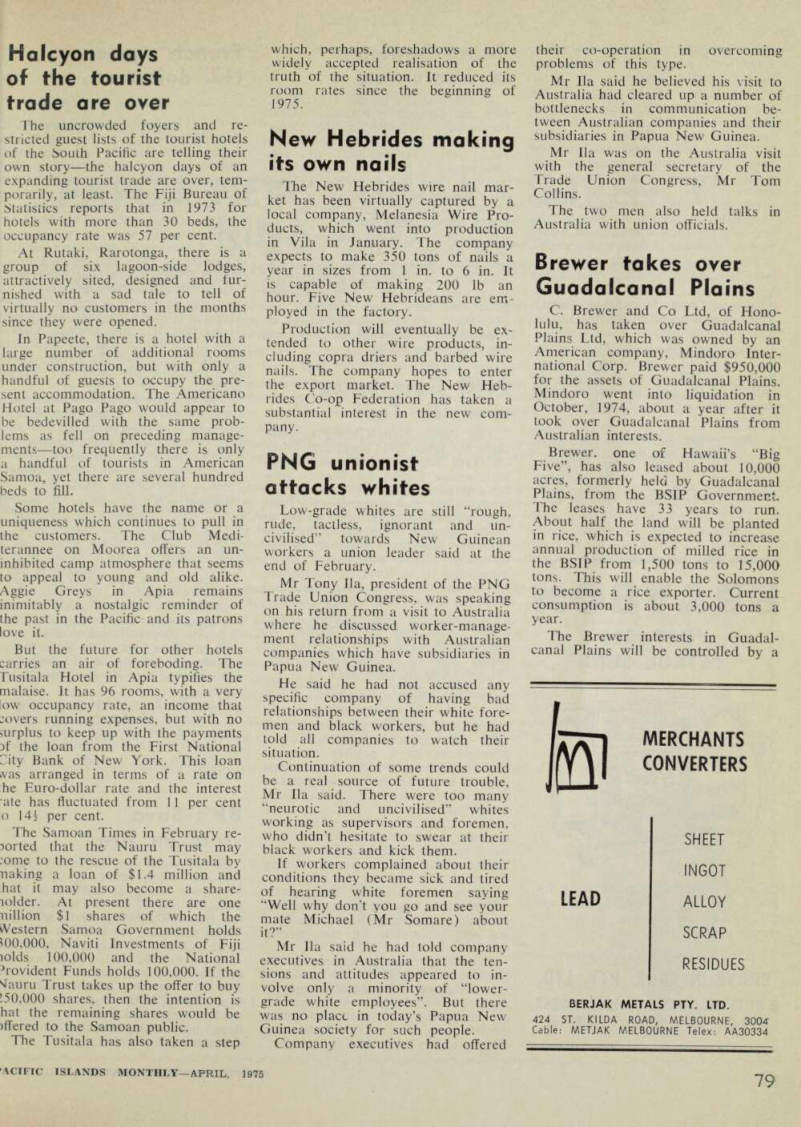
Mr Hans-Joachim Hauck (above) has taken over the management of the Regent of Fiji Hotel, on Denarau Island, Nadi Bay.
The 300-room hotel is scheduled to open in May. Mr Hauck has been a hotelier for 16 years in Montevideo, Venezuela, Dusseldorf, Paris, Cologne and Honolulu.
Halcyon days
of the tourist
trade are over The uncrowded foyers and re stricted guest lists of the tourist hotels of the South Pacific are telling their own story—the halcyon days of an expanding tourist trade are over, tem porarily, at least. The Fiji Bureau of Statistics reports that in 1973 for hotels with more than 30 beds, the occupancy rate was 57 per cent.
At Rutaki, Rarotonga, there is a group of six lagoon-side lodges, attractively sited, designed and fur nished with a sad tale to tell of virtually no customers in the months since they were opened.
In Papeete, there is a hotel with a large number of additional rooms under construction, but with only a handful of guests to occupy the pre sent accommodation. The Americano Hotel at Pago Pago would appear to be bedevilled with the same prob lems as fell on preceding manage ments —too frequently there is only a handful of tourists in American Samoa, yet there are several hundred beds to fill.
Some hotels have the name or a uniqueness which continues to pull in the customers. The Club Medi terannee on Moorea offers an un inhibited camp atmosphere that seems to appeal to young and old alike.
Aggie Greys in Apia remains
inimitably a nostalgic reminder of the past in the Pacific and its patrons love it.
But the future for other hotels carries an air of foreboding. The
Tusitala Hotel in Apia typifies the
malaise. It has 96 rooms, with a very low occupancy rate, an income that covers running expenses, but with no surplus to keep up with the payments Df the loan from the First National Zity Bank of New York. This loan was arranged in terms of a rate on he Euro-dollar rate and the interest ate has fluctuated from 11 per cent o 14i per cent.
The Samoan Times in February re ?orted that the Nauru Trust may :ome to the rescue of the Tusitala by naking a loan of $1.4 million and hat it may also become a share lolder. At present there are one nillion $1 shares of which the Western Samoa Government holds 100,000, Naviti Investments of Fiji lolds 100,000 and the National 3 rovident Funds holds 100,000. If the 'Jauru Trust takes up the offer to buy 150,000 shares, then the intention is hat the remaining shares would be )ffered to the Samoan public.
The Tusitala has also taken a step
which, perhaps, foreshadows a more widely accepted realisation of the truth of the situation. It reduced its room rates since the beginning of 1975.
New Hebrides making
its own nails
The New Hebrides wire nail mar ket has been virtually captured by a local company, Melanesia Wire Pro ducts, which went into production in Vila in January. The company expects to make 350 tons of nails a year in sizes from 1 in. to 6 in. It is capable of making 200 lb an hour. Five New Hebrideans are em ployed in the factory.
Production will eventually be ex tended to other wire products, in cluding copra driers and barbed wire nails. The company hopes to enter the export market. The New Heb rides Co-op Federation has taken a substantial interest in the new com pany.
PNG unionist
attacks whites
Low-grade whites are still “rough, rude, tactless, ignorant and un civilised” towards New Guinean workers a union leader said at the end of February.
Mr Tony Ila, president of the PNG Trade Union Congress, was speaking on his return from a visit to Australia where he discussed worker-manage ment relationships with Australian companies which have subsidiaries in Papua New Guinea.
He said he had not accused any specific company of having bad relationships between their white fore men and black workers, but he had told all companies to watch their situation.
Continuation of some trends could be a real source of future trouble, Mr Ila said. There were too many “neurotic and uncivilised” whites working as supervisors and foremen, who didn’t hesitate to swear at their black workers and kick them.
If workers complained about their conditions they became sick and tired of hearing white foremen saying “Well why don’t you go and see your mate Michael (Mr Somare) about it?”
Mr Ila said he had told company executives in Australia that the ten sions and attitudes appeared to in volve only a minority of “lower grade white employees”. But there was no place in today’s Papua New Guinea society for such people.
Company executives had offered
their co-operation in overcoming problems of this type.
Mr Ila said he believed his visit to Australia had cleared up a number of bottlenecks in communication be tween Australian companies and their subsidiaries in Papua New Guinea.
Mr Ila was on the Australia visit with the general secretary of the Trade Union Congress, Mr Tom Collins.
The two men also held talks in Australia with union officials.
Brewer takes over
Guadalcanal Plains
C. Brewer and Co Ltd, of Hono lulu, has taken over Guadalcanal Plains Ltd, which was owned by an American company, Mindoro Inter national Corp. Brewer paid $950,000 for the assets of Guadalcanal Plains.
Mindoro went into liquidation in October, 1974, about a year after It took over Guadalcanal Plains from Australian interests.
Brewer, one of Hawaii’s “Big Five”, has also leased about 10,000 acres, formerly held by Guadalcanal Plains, from the BSIP Government.
The leases have 33 years to run.
About half the land will be planted in rice, which is expected to increase annual production of milled rice in the BSIP from 1,500 tons to 15,000 tons. This will enable the Solomons to become a rice exporter. Current consumption is about 3,000 tons a year.
The Brewer interests in Guadal canal Plains will be controlled by a
new company. Brewer Solomons Associates, which will be managed by Mr Richard Ward.
The BSIP Chief Minister, Mr Solomon Mamaloni, was obviously delighted with the deal. In a state ment after the agreement was signed, he said it would save the jobs of about 200 Solomon Islanders, for merly employed by Guadalcanal Plains. New jobs would become available as expansion continued. The rice industry would be saved, and rice sold for local consumption would be sold at lower than overseas prices.
The government would get increas ingly substantial revenue, and would have the right to buy into the busi ness on “very favourable terms”.
There would be other benefits for the Solomon Islands.
Apart from the money it paid for the assets of Guadalcanal Plains, Brewer would invest a further $4 million in the next few years, which should produce an efficient rice in dustry.
The Brewer group has wide rang ing interests. Its main business is sugar, but it also owns insurance companies, hotels, cattle ranches, meat-packing plants and rice projects.
Copra bonanza
in Micronesia
Copra planters in the Trust Terri tory are enjoying a bonanza. About the middle of February the United Micronesian Development Association paid out 5U5205,000 to sub contractors. It was the highest amount paid for copra in a single week in tne last 22 years. UMDA is the marketing contractor for the Copra Stabilisation Board.
The payments were made while the grade one price of SUS42S a ton was operative. However, the bonanza is not likely to continue. World prices have been receding. The authorised price in the Trust Territory of SUS3OO a ton was expected to be reduced soon if world prices do not
increase substantially.
PNG Govt takes
over Ok Tedi
The Papua New Guinea Govern ment has taken over operations in the Ok Tedi copper field from Kenne cott, whose licence for further drill ing expired on March 13 and was not renewed by the government. Talks with Kennecott have failed so far to reach agreement on tax and other financial provisions required by the company. These talks are not yet considered to be formally completed.
Mr Somare said in parliament that Kennecott was insisting on a mini mum rate of return on their invest ment higher than other investors in Papua New Guinea had accepted and higher than the company was receiv ing elsewhere in the world.
Also the company wanted auto matic indexation—provision to deal with future inflation—that was more
far-reaching in its possible impact
than any measures conceded by a government to a mining company anywhere in the world. These points were to be agreed before the size and richness of the ore body had been established.
The Chief Minister said the gov ernment would now undertake two more years of drilling and evaluation before a final decision to start mining was made. No drilling has been done for the past three years. An approach will be made to a company of highest international standing to manage drill ing and evaluation for the govern ment.
Existing services provided by the Kennecott company in the past will be maintained. A study will begin on
April 2 to investigate the possibility
of integrating transport and other infrastructure for Ok Tedi and other possible mine sites.
French squeeze
NZ dairymen
From a Noumea correspondent The French Government appears to be counting on New Zealand to de fend Paris interests in the South Pacific in return for France lending an ear to the Kiwis’ plea for con tinued sales of their dairy products to the UK and Common Market.
New Zealand Prime Minister Mr W. E. Rowling was reported to have been discussing his trade problem late February in Paris with French Presi dent V. Giscard d’Estaing. After hear ing of New Zealand’s anxiety not to lose the dairy sales, French Foreign Minister J. Sauvagnargues was quoted as saying that the French nuclear tests in the Pacific had not been men tioned in talks with the French Presi dent, since this was a “closed dossier”.
The French Foreign Minister was then quoted as saying that France attaches “great importance to the role that New Zealand can play in the Pacific and hopes she will continue to play an important restraining role there”. The French press report, re layed to Noumea, then noted that “certain small States in this region are opposed to the maintaining of French possessions. This is why France wishes . . . New Zealand to play a ‘restraining’ influence upon friends who were formerly under her sphere of influence”.
So, if New Zealand wants to keep selling goods to the Common Market, it has to play ball and have its milk men acting as honorary French am bassadors in the Pacific and defending French treatment of its island terri tories.
Actually, France has been working on this kind of blackmail for several years, but the question still remains as to whether New Zealand exporters would get any reward for their efforts.
BP's Suva
store on fire
Suva’s worst fire for many years, probably since most of Gumming S.reet was destroyed in 1921, severely damaged one of the city’s landmarks, the Burns Philp (SS) Co Ltd store.
Initial estimates put the loss at close to $2 million. The fire, reported about 1.30 am on March 12, destroyed the milk bar, toy and pharmacy sections, and part of the supermarket, and badly damaged the rest of the super market, men’s and women’s wear sec tions. sports and crockery sections and the tourist department.