Pacific
p. 53 · Read in the full issue
Art In
Russia
By Marjorie Crocombe
Leningrad, the old capital of Russia, has an excellent museum which contains a lot of items from the Pacific. The Russian explorer, Mickluho-Maklay was the main single collector. He must have been quite a man, living alone and unarmed in New Guinean villages long before any other white man in that area.
But he also visited, collected and drew accurate pictures in islands all the way across the Pacific, a hundred years ago. The Leningrad Ethno graphic Museum is named after him.
Last year, during a visit to the main museums in Europe which have Pacific collections, 1 spent several fascinating days there.
Their Polynesian collection has 900 objects from Samoa, Tonga, Cook Islands, Tahiti, Hawaii and Easter Island. Most of it was collected by Russian explorers early last century (Krusenstern, Lisyansky, Kotzebue, Bellingshausen, Litke and others) but some were collected by Captain James Cook and presented to the Russian governor of Kamchatka.
The Micronesian collection is smaller, but includes valuable items from the Gilberts and Carolines in particular.
The Melanesian collection contains 5,000 objects, mainly from New Guinea. It also contains some ex cellent material from the New Hebrides.
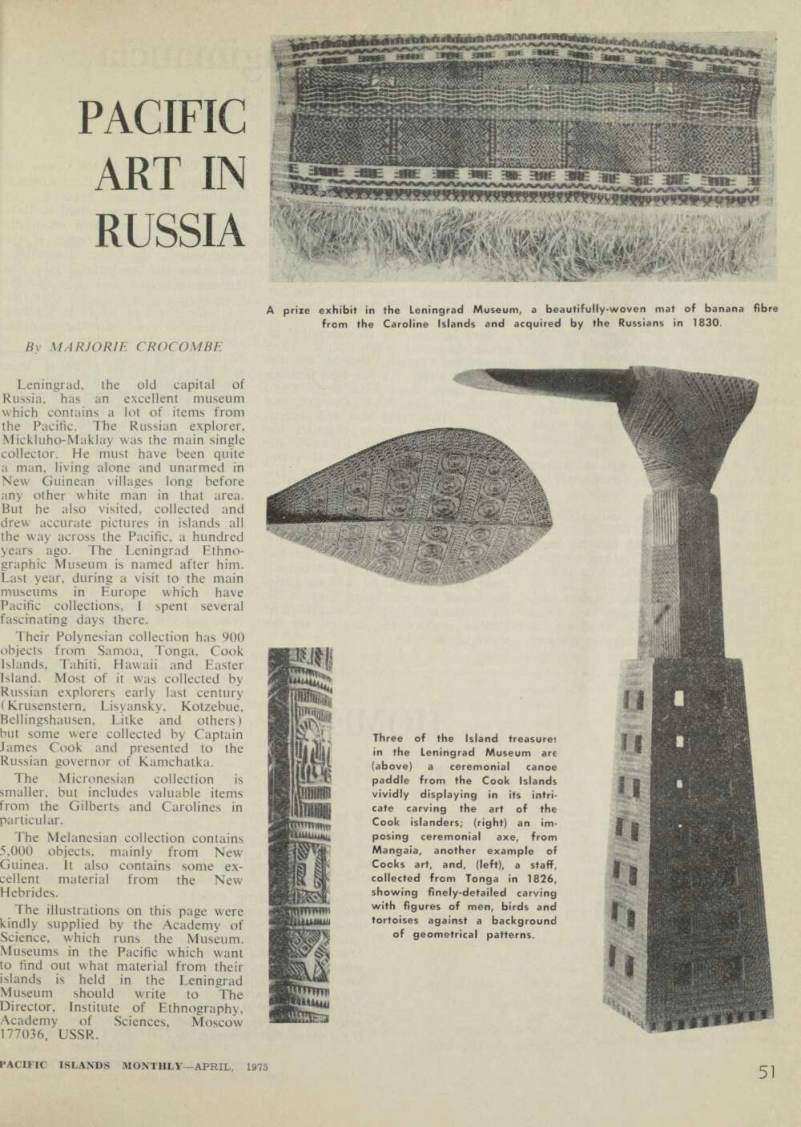
The illustrations on this page were kindly supplied by the Academy of Science, which runs the Museum.
Museums in the Pacific which want to find out what material from their islands is held in the Leningrad Museum should write to The Director, Institute of Ethnography, Academy of Sciences, Moscow
177036, Ussr.
A prize exhibit in the Leningrad Museum, a beautifully-woven mat of banana fibre from the Caroline Islands and acquired by the Russians in 1830.
Three of the Island treasures in the Leningrad Museum are (above) a ceremonial canoe paddle from the Cook Islands vividly displaying in its intri cate carving the art of the Cook islanders; (right) an im posing ceremonial axe, from Mangaia, another example of Cooks art, and, (left), a staff, collected from Tonga in 1826, showing finely-detailed carving with figures of men, birds and tortoises against a background of geometrical patterns.