bawdy boarding houses ...
pp. 35-37 · Read in the full issue

A red light is dying in Fiji's bawdy boarding houses ...
From ROBERT KEITH-REID in Suva
Lights are going out all over Fiji —red lights, that is.
After years of agitation by indig nant inhabitants of what may out wardly appear to be more respectable zones of Suva’s suburbia, authorities are at last cracking down on ‘guest houses’.
For guesthouses read brothels, be cause in Fiji that’s what most of them are. For a decade now they have been doing a rip-roaring unfettered trade thanks to legal loopholes that have made it hard for the police to make a head-on attack on prostitu tion.
But now it looks as if proprietors of Fiji’s bawdy boarding houses are in for a lean time.
Recent months have seen the closure of about a dozen of the best known, or perhaps most notorious of them. Several sport “Closed for business until further notice” signs on the front door.
The instrument of their demise is the Hotel Licensing Board, a weapon forged by the government last year for just this purpose. Since January 1 this year Fiji’s 130-odd hotels, from the biggest swish joint to the most humble bed-and-breakfast, have had to have an operating licence from the board to be able to stay in busi ness.
Qualifications for a licence are simple enough. There’s an annual fee to be paid and several rules to comply with.
Chief of these is that a guest register is kept; the premises them selves kept clean and in good repair; and that a licence from the board is displayed for all those who enter for a night’s sleep to see.
Most hotels being thoroughly re spectable establishments, have, of course, not had a moment’s trouble getting their licences. The other 10 per cent have fallen foul of a few other rules set down in the legislation which created the board.
They say a licence can be refused or withdrawn if the premises covered by it are too noisome for the local health department’s peace of mind, or if it is proved to be a den of im morality.
Usually the sleasy-looking guest houses are both, as members of the hotel board have found at first hand.
Chairman Mr Harold Picton-Smith, who is the Fiji Solicitor-General, re
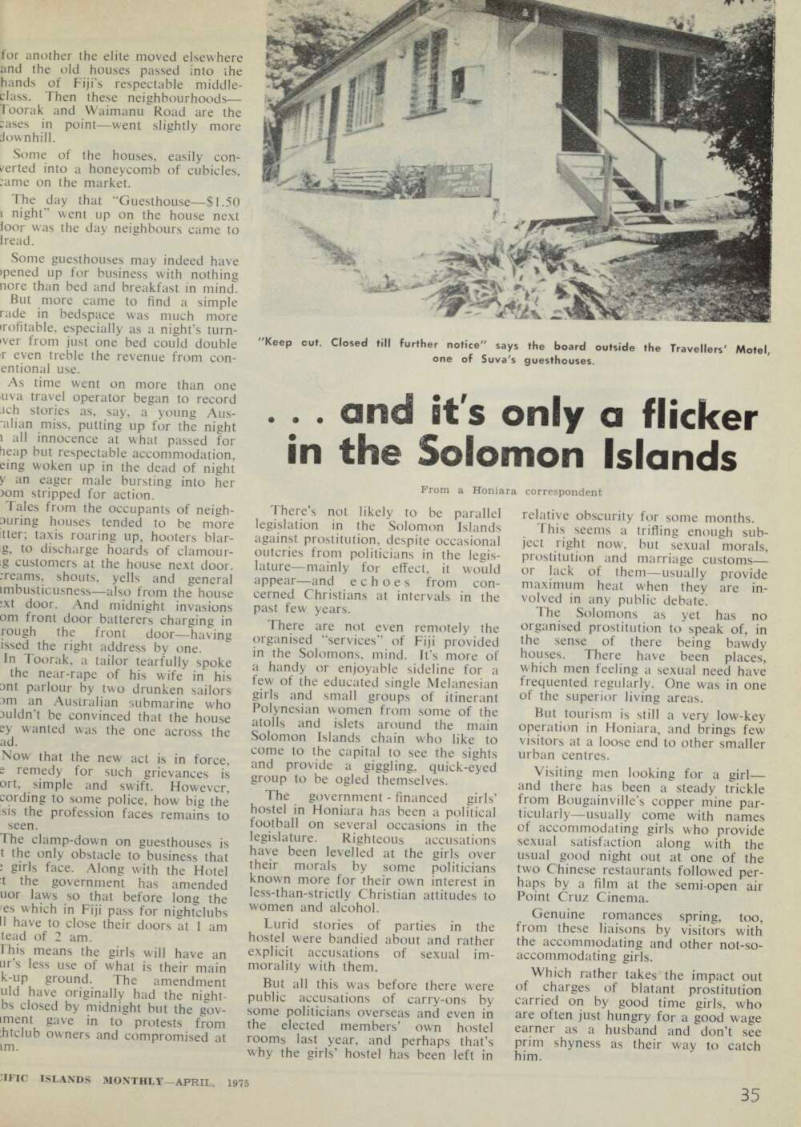
ported at a public hearing in February that a personal spot check by board members the night before on three Suva guesthouses, Cliff Top Motel, Travellers Motel and Blue Diamond, had been quite an eye opener.
“Scrungy” rooms, much in need of a coat of paint, rickety service, worn beds and foul bathrooms and lavatories had been the rule. in one room the board had stumbled upon a Korean fisherman and two of his local, temporary, girlfriends—“ Both known prosti tutes,” reported Superintendent Pre mesh Raman, who accompanied the inspection trip.
Most of the women seen that night were in the same category, he added.
According to the superintendent, rooms at the Cliff Top which, unlike the others, at least had the distinction of being clean, were occupied by an average of two prostitutes each.
Indignant denials from the mana gers of all three guesthouses and by the owners of establishments of the same ilk at Lautoka and Nadi have not been entertained by the board with any sympathy. At the Suva meeting the board got a spate of written complaints about the Blue Diamond, a guesthouse in the Nasese area, an otherwise peaceful upper working class and lower middle-class residential suburb a mile from town.
The Blue Diamond’s reputation among Nasese residents is far from sparkling. Letters complained that rooms in the grimy two-storey con verted house were the scenes of a constant round of rowdy all-night parties at which Korean, Japanese and Chinese fishing boat crews enter tained and were entertained by ladies with a price on their virtue.
“We can’t get a decent night’s sleep,” was the consensus of com plaint. It was a cascade of stories like these, some times from house holders on the verge of tears over the disruption to their home life caused by the goings-on next door, that drove the government to draft and at last enact the Hotel Licensing Act last year.
What happened was that those with an eye for a quick dollar had bought some of the sprawling, old wooden houses in the city area which 50 years ago had been the castles of the colonial elite. As one era made way
for another the elite moved elsewhere and the old houses passed into the hands of Fiji's respectable middle class. Then these neighbourhoods— Toorak and Waimanu Road are the cases in point— went slightly more downhill.
Some of the houses, easily con certed into a honeycomb of cubicles, came on the market.
The day that “Guesthouse—sl.so i night” went up on the house next loor was the day neighbours came to Iread.
Some guesthouses may indeed have tpened up for business with nothing nore than bed and breakfast in mind.
But more came to find a simple rade in bedspace was much more irofitable, especially as a night’s turn •ver from just one bed could double r even treble the revenue from con entional use.
As time went on more than one uva travel operator began to record Jch stories as, say, a young Aus 'alian miss, putting up for the night i all innocence at what passed for heap but respectable accommodation, eing woken up in the dead of night y an eager male bursting into her )om stripped for action.
Tales from the occupants of neigh auring houses tended to be more itter; taxis roaring up, hooters blar g, to discharge hoards of clamour g customers at the house next door, creams, shouts, yells and general imbusticusness —also from the house ext door. And midnight invasions om front door batterers charging in rough the front door—having issed the right address by one.
In Toorak, a tailor tearfully spoke the near-rape of his wife in his ant parlour by two drunken sailors am an Australian submarine who auldn’t be convinced that the house ey wanted was the one across the ad.
Now that the new act is in force, s remedy for such grievances is ort, simple and swift. However, cording to some police, how big the sis the profession faces remains to seen.
The clamp-down on guesthouses is t the only obstacle to business that c girls face. Along with the Hotel :t the government has amended uor laws so that before long the jes which in Fiji pass for nightclubs II have to close their doors at 1 am tead of 2 am. khis means the girls will have an ar’s less use of what is their main k-up ground. The amendment uld have originally had the night bs closed by midnight but the gov iment gave in to protests from ihtclub owners and compromised at im.