Pacific Islands Monthly
pp. 6-85 · Read in the full issue
Fiji Government Loses Battle
For Price And Income Control
From Robert Keith-Reid
in Suva
Fiji can offer the world a lot as a laboratory for an experiment in multi-racial communal living. But as a laboratory for an experiment in fighting inflation it’s been a flop.
In February, the Fiji Government admitted the failure of its prices and incomes policy when Deputy Prime Minister Ratu Sir Penaia Ganilau told the House of Representatives that a report urging a return to free collective bargaining and lifting of price controls had been accepted.
From March 31 pay controls be come a matter of history, much to the glee of trade unions. Price con trols go by the board also, except for curbs on rent, local freight rates and a dozen items —including flour, rice, tea, bread, canned fish and meat, milk, butter and kerosene —felt to be household essentials.
“On prices”, said Ratu Penaia, “we’re prepared to allow these to be regulated by the law of supply and demand and free market forces”.
As for pay—well, he said there had been “voluntary offers of co operation from employers and labour”.
In short, the sky was once more the limit.
The government’s capitulation came 22 months after the raising of the curtain on a three-act anti inflation drama.
It came 10 months after the body charged with directing the show, the three-man Prices and Incomes Board, had more or less washed its hands of the whole business.
The show opened in April, 1973 with the announcement that because of the serious impact inflation was having on the economy, a compre hensive prices and incomes control policy would be imposed. It would be modelled along tried (and found wanting) British and American lines.
When he broke the news, Minister for Commerce Mr Mohammed Khan, in whose portfolio the policy had been thrust, admitted the British
and US failures but was quick to add, more or less, that “it can’t hap pen here”.
“Fiji can succeed where others have failed because we are a small country and our economy is not too complicated. We are fortunate enough to be able to see the trees as well as the wood”.
The government was certainly justified in stepping out boldly along the path. Inflation, which had been insignificant—under 1 per cent in 1968—had jumped to close to 10 per cent by the time Mr Khan pressed the control buttons.
“From creeping it began to walk and then run and the government dare not let it start to gallop,” he said.
The reason for the increase was partly imported.
Inflation in Australia and New Zealand —the sources of more than half Fiji’s imports—had caused dras-
tic increases in the cost of imported goods, particularly food.
The trend had worsened with hefty increases in Fiji-Australia and Fiji- New Zealand freight rates.
On the home-front it had been noted that merchants had somehow zipped up their mark-ups from 40 per cent in 1969 to as much as 89 per cent by 1970, increases which couldn’t be explained away by cost increases.
Also on the home-front, pressure by increasingly-vocal and militant trade unions had sent hourly pay rates zooming.
Between June, 1970 and April, 1973 they rose 61 per cent while the estimated increase in national pro ductivity was only 2.6 per cent. Mr Khan’s announcement was followed by the enactment of the Counter Inflation Act.
This created the Prices and In comes Board (PIB) with power to govern any pay or price increase.
The board was to work according to guidelines set by the government.
The policy was, initially, imposed in three phases. First came Phase One, right after Mr Khan’s an nouncement —a 90-day total freeze on all prices, salaries, wages, divid ends and rents, to allow for time to prepare for Phase Two—a time covering the second half of 1973 during which pay increases were limited to eight per cent and various curbs were applied to prices and profits.
Finally, came Phase Three —introduced in February 1974, a month later than intended and meant to run until the end of the year.
And after Phase Three —the government was a bit vague about that, but it was generally assumed that there would be some form of continuing overall control.
Phase Three, in theory, limited pay rises to 10 per cent and con tinued with curbs on prices, profits, rents and dividends. It sounded
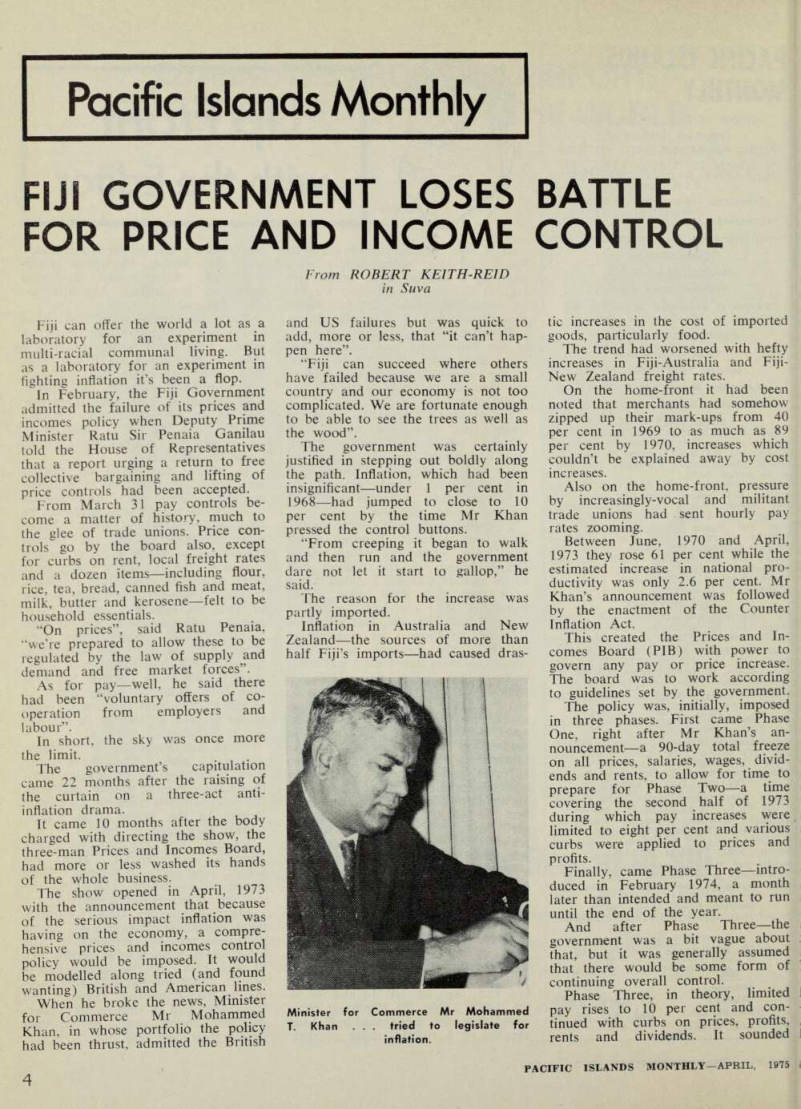
Minister for Commerce Mr Mohammed T. Khan . . . tried to legislate for inflation.
simple and to give Mr Khan credit he didn’t claim that it was going to be a complete cure.
“It is not a panacea which will cure all the ills which afflict us”, he said. “It will provide time for us to take breath and do some stocktaking while we press ahead with other measures to contain this enemy, in flation”.
Nor did Mr Khan claim that the government was out to halve the enemy; it was out only to hold it down to a level that could be lived with.
And he and Prime Minister Ratu Sir Kamisese Mara were realistic in admitting that the policy was not going to make their Alliance Govern ment popular. The government, said Ratu Sir Kamisese, was prepared to be unpopular; better this than to hide its head in the sand.
Mr Kahn stressed the government was trying to legislate inflation into control because it didn’t think it could be reined by voluntary re straint.
The freeze descended and in the 90 days that followed little was said by workers or their bosses. They were waiting for Phase Two revela tions. It was when these were revealed that the uproar started.
They were disclosed at the end of June, at the same time that the PIB, under the chairmanship of Dr Nor man Ross, a British economist ap pointed on contract to the $14,000a-year job for two years, was for mally established.
The uproar came from the unions when they heard that pay rises would be held to eight per cent for the rest of the year. Businessmen heard that price increases would be held down to the amount needed to affset their own cost increases.
Dr Ross, a distinguished British jconomist and arbitrator on leave of absence from the University of Bir mingham, arrived in Suva with the revelation that the government had first asked him to chair a PIB in 1970.
But the proposition had been dropped, presumably because of pre accupation with Fiji’s independence, which came in that year.
Ten per cent inflation was serious, he said, but Fiji was not in a crisis situation —yet. The PlB’s aim was to :ut this rate to “about five per cent”, a “somewhat ambitious” target, he said.
On the board with him was a top Fiji civil servant, Mr Sharda Nand, who had ridden out a tough two ycar spell as Fiji’s lone price con holler before the PlB’s creation.
Number three was Mr Graham
Cox, a British technical aid account ant who arrived in October.
The PIB was given its guidelines —which it had a big hand in devis ing—and was told to set about im plementing them. This it did and Fiji’s economy tumbled into a tur moil that has not settled yet.
For really, when all was said and done, the government’s policy de pended absolutely on everyone play ing ball, unions and employers, and the unions refused to do this right from the start. The idea of any sort of limitation of pay was anathema to them.
The months that followed de veloped into an almost daily slang ing match between government, the PIB and the unions, usually con ducted through the press and to a lesser extent in parliament.
On the union side the voice heard loudest was that of Mr James Ra man, secretary of Fiji’s biggest trade union, the Factory and Commercial Workers’ Union, and also secretary of the Fiji Trades Union Congress.
An extremely intelligent and hard working man, Mr Raman had hither to been known for driving a hard bargain, but also as a man who was realistic in recognising the breaking point of a camel’s back.
But at the time of the PlB’s mani festation he was, and still is, having troubles in his own particular field.
Another trade union figure, Mr Apisai Tora, a somewhat more mili tant person, formed a rival to the TUC, the Fiji Council of Trade Unions.
Half-a-dozen unions fell under his sway, including a couple of break aways from the TUC, and Mr Raman seemed to fear that there might be more.
To boost the TUC’s holding power, as it were, and also to retain command of his own union it be came necessary for him to mount a campaign against the PIB with rather more vigour than he otherwise might have done.
One strategy was to get pay rises that were at least as hefty as those being won by Mr Tora’s lusty tac tics and this of course meant side stepping the eight per cent limit when possible. And if it was not possible to sidestep, well, a head-on attack was needed.
At first the attitude of employers was restrained, but the current of opinion among them quickly became critical as price and profit controls began to bite.
Fiji’s big two, the Carpenter and Burns Philp groups groaned that they were being crippled. Said Carpenters man Mr Tom Copley, claiming that
earnings had been cut by at least 5c for every dollar invested, “The in centive to work has been taken away”.
The answer to inflation was to expand the economy; price control was restricting it, he said.
The Fiji Manufacturers Associa tion lamented that wage guidelines were “based on the British system and inappropriate for an island economy with unskilled manpower”.
Fiji housewives found that lots of foodlines were disappearing from supermarket shelves because, im porters claimed, price limits meant that they were being sold below cost.
Both employers and unions com plained that the National Economic Council, the body through which their representatives, the government and the PIB were supposed to have dialogue on price and pay issue, was being ignored by government and the PIB.
The unions began shaping up to the PIB and government with claims that surpassed the initial eight per cent limitation by hefty margins. In several cases Mr Khan found it ex pedient to avert showdowns by using his powers to overrule PIB decisions and give unions what they asked for.
Continued on p 82
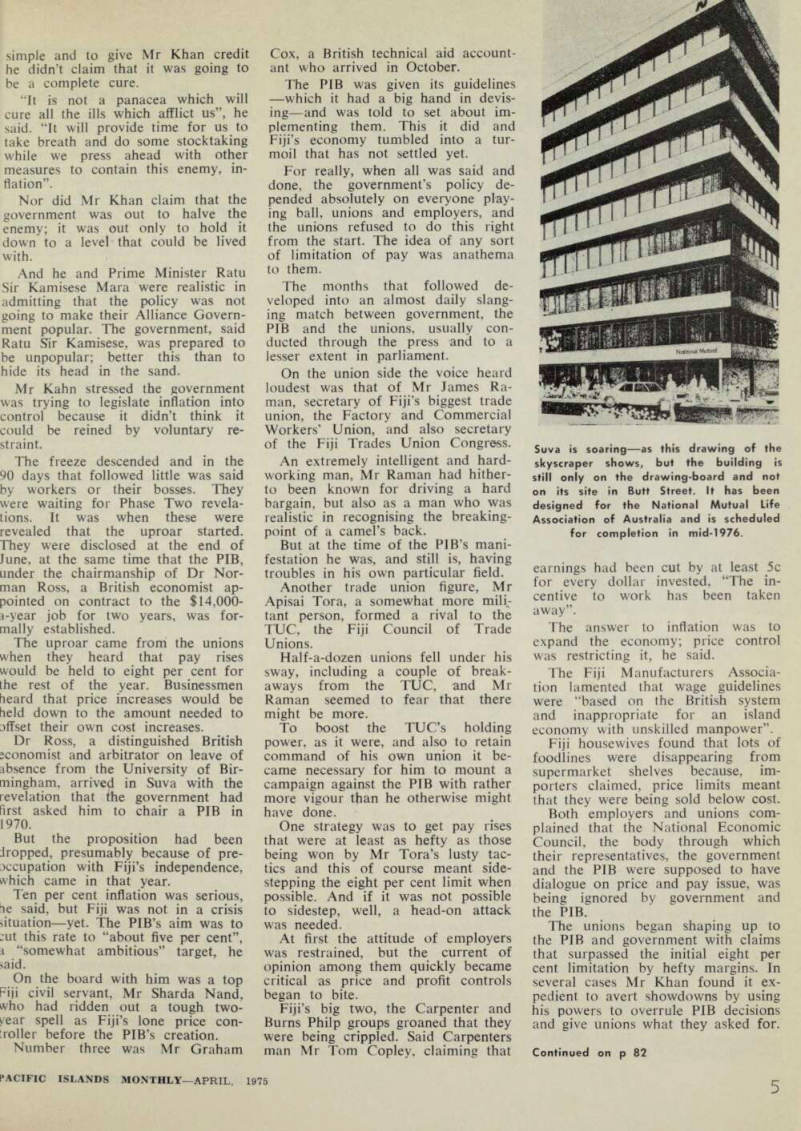
Suva is soaring—as this drawing of the skyscraper shows, but the building is still only on the drawing-board and not on its site in Butt Street. It has been designed for the National Mutual Life Association of Australia and is scheduled for completion in mid-1976.
One concession led to another and in May, 1974 the inevitable hap pened. Claims by brewery workers for 60c an hour and by cement workers for 61c were cut back by the PIB to 57.25 cents.
The FTUC, in retaliation, an nounced a general strike and made demands on the government which include a cost-of-living adjustment to pay rates every three months and “recognition of collective bargain ing”.
The PIB condemned the cost of living request as inflationary and interpreted the recognition demand as being simply the restoration of unconditional bargaining rights.
This, it said, would simply mean the collapse of the pay side of the prices and incomes policy.
The Cabinet and FTUC got to gether and the government side quickly agreed on the cost of living concession, various other concessions and that “where the employer and employee are able to reach an agree ment on the basis of past practice and historical relativity” the pay
rates agreed upon by them should be beyond a PIB veto.
The PIB became very bitter and made it very clear that it felt that the government had weakly backed down to avoid a general strike.
One half of the whole anti inflation strategy, pay control, had indeed collapsed and the con sequences would be dire, it warned.
It said that as the government hadn’t consulted it in striking a deal with the FTUC, it “disclaimed any responsibility for consequences flow ing from the agreement’’. These con sequences, it forecast, would include massive unemployment and high inflationary wage jumps.
Since wage increases for the most part would virtually be unrestricted, the board said it would have diffi culty in denying businessmen the price increases they would seek to absorb them.
Hence the whole policy would be nullified.
Subsequent months saw the PlB’s words of doom borne out almost to the last letter.
On a couple of occasions it issued a couple of “we told you so” state ments in which it reiterated that it was all the government’s fault.
Thanks to the cost of living ad justments—which soon cosily be came know as Coda increases—and the mysterious “historical relativity” clause, wage rates began to climb at astronomical rates.
In a year when they were sup posed to have been held down to 10 per cent many rates were upped from 28 per cent to 69 per cent between January and October alone.
At arbitration courts unions gaily quoted “historical relativity” and asked for the earth.
Employers and the PIB asked arbitrators to kindly explain what the phrase meant, since they didn’t know.
At arbitration hearings between building companies and their work ers PIB member Mr Sharda Nand said bluntly that only the PlB’s over lord, Mr Khan, could explain.
“He and he alone should be able to explain that code” he said. “You can drive a horse and cart, and, in this case, a bulldozer through this phrase”.
Thanks to Coda increases some unions hardly bothered with pay de mands.
The theory behind Coda was that every three months the PIB declared a limit for rises based on the rise of the consumer price index for the previous three months. The increase was not to be automatic; employees had to ask for it and employers could negotiate for a smaller in crease.
Actually, the first Coda increase? was for January to June, hitting 9.37* per cent. Negotiating with the civii' service the government settled fon 8.83 per cent. For July to September it was 4.53 per cent —which civil servants got—and for October-!
December three per cent.
Employers, dazed by the train ole events, began surrendering with autoe matic Coda increases to the maxi-i mum specified.
The cumulative effect of such in-r creases was staggering and by thei end of the year the bulk of Fiji’s' urban workers looked to be up tco 70 per cent better off than they were at the beginning of it.
They were certainly showing signs of prosperity; while Ministen for Finance Mr Charles Stinson hacb been calling for thrift and restraint,! the number of shiny new cars om the roads of Fiji had never seemedb greater.
And Fiji’s hotels were full—thea expensive cocktail sections of themn that is, not the cheap public bars— with uproarious representatives off the working class toasting them selves, and the next Coda increase,,; with unending glasses and jugs oft beer.
Towards the year-end relations be tween the PIB and the government! became very strained as the PIB con tinued to show its disgust at the way\ things had so quickly turned out.
Ratu Mara, who in earlier Parlia mentary debates had defended thee PIB against Opposition attacks, be gan to hint, from August, that its? days might be numbered. About thee same time, partly in response toe Opposition sniping, the government! set up a House of Representatives ? select committee, on which the e Opposition refused to serve, to de- cide the PlB’s and associated policy’s i future.
The committee was asked to report j by the end of the year so that its i findings could be acted upon before .
Phase Three expired at the end of 1 December.
But the job was too big and when r the committee said it would be Feb- ■ ruary before its report would be ; ready the government extended i Phase three to March 31.
Before the committee delivered 1 its report the PIB came out with its ; first—and now presumably last— annual report.
This was a blockbuster and spelt J the end of the government’s romance ; with it.
“Had the board been allowed to < continue with the policy as laid down \ by government in January (1974) increases in wages and salaries ; would have been restricted to levels ;
)f around 20 to 25 per cent”, it laid. But due to the Cabinet-FTUC leal in May they had soared to ‘unprecedented rates” since then.
“It is ironical that a year in which ncomes are purported to have been inder control for counter-inflationary easons should have witnessed the argest number of record percentage ncreases in the wage rates of un killed workers since 1969 and poss bly since records have been kept”.
The board’s report said a lot more lasty things.
“The country needs to be alerted o the fact that it is living well be 'ond its means and that to continue 0 try to do so will delay the de 'elopment of the economy and re ard the nation’s progress towards ull economic independence.
“At the worst it could result in otal economic collapse”.
This last remark made the Prime dinister very annoyed.
“We are not about to collapse nor ire we bankrupt” he thundered at n Alliance Party convention.
Ratu Sir Kamisese, graduate from he London School of Economics, aid the board was forgetting itself.
“We had thought as a government ve should decide on a policy for hem to execute. But to tell us now /hat the economic organisation hould be is gratuitous advice”.
At the same meeting Finance dinister Mr Stinson claimed that 7 iji wasn’t really doing so badly as be PIB said.
Inflation last year had touched only” about 17i per cent instead f the 24 per cent figure predicted t one point.
“Fiji may fare better than some 1 our neighbours in 1975” he said, nd added that it shouldn’t be bought that the government thought be PIB was useless.
It had served a “very definite” urpose, “but whether it is required o the same extent during 1975 is /hat the select committee has been itting on”, he said.
The committee’s report, in late ■ebruary, was all for change. Fiji ouldn’t afford a PIB of the size and omplexity that was really needed or the job the government had set iut to do, it said.
But the PIB that had been created lad had a useful psychological im >act. There was, therefore, “some aerit” in retaining some form of imited control on certain items.
Otherwise, all other controls in luding wage controls should be bandoned.
The government agreed entirely.
Hard times lay ahead for some Fiji industries and it was hoped that realisation of this would lead to a tempering of pay demands, said Ratu Sir Penaia in announcing the govern ment’s acceptance of the report.
Control of what little remains of the policy will be switched from Mr Khan to Mr Stinson because, the Deputy PM said, for the Minis ter of Commerce to be promoting and at the same time controlling business was “anomalous”.
His sentiments were publicly re echoed, more or less by the FTUC and employers. But in private the Fiji Employers Consultative Associa tion took a much different outlook.
Early in March, it was warning its members that the first lot of claims by the unions bore no sign of the restraint the government had asked for, and some of the unions had promised.
If employers couldn’t convince the unions by argument, and, if neces sary, by disclosure of their books, that they couldn’t afford the claims, they had better be prepared to de monstrate the ultimate proof by closing their businesses down, FECA advised.