Wins A New
pp. 79-81 · Read in the full issue
Ratu Mara
Sugar Market
Fiji’s Prime Minister, Ratu Sir Kamisese Mara, won an important new market for Fiji in February— the European Economic Community, which has agreed to take 165,000 tonnes of Fiji sugar in 1975 for $4O million. The amount which will go to the EEC will be about half the 1975 production. Ratu Sir Kamisese made several trips to the UK and to EEC headquarters in Brussels in recent years to take part in top-level talks on sugar marketing.
He built up personal contracts to such an extent that he was able to play a major role during the latest round of talks to break a deadlock and swing the EEC into agreeing to pay £stg26o a tonne for sugar ex ported to the EEC from the Pacific (which means Fiji), the West Indies and Africa. Flushed with success, and possibly tired, he flew home via Sydney and Auckland.
In Sydney he took a sideswipe at Qantas (see report page 66) and Air New Zealand about over-flying Fiji, criticised the Australian immigration policy, and said New Zealand was not paying enough for Fiji sugar.
His criticism of Qantas and of New Zealand was not well-timed, and rather suggested that the Prime Minister was a tired man and had not been kept up-to-date with the news by his advisers.
He berated New Zealand for re fusing to renegotiate the price it paid for Fiji sugar to bring it into line with world prices, and added that New Zealand boasted it got its sugar at the lowest price in the world. He said Fiji had contractural obligations to supply New Zealand with sugar, but as she would not have enough in 1975 to supply all its markets, she would supply those who paid the most at the expense of those
who paid less. Fiji preferred friends who would come to her aid when needed, and Fiji was then in need.
But New Zealand was not acting like a particular friend.
That comment was made after Hurricane Val swept through part of Fiji. New Zealand, which had an aid mission scheduled to go to Fiji a few days later, gave the mission an extra task of seeing what it could do to provide help for hurricane victims.
And in 1972, after Hurricane Bebe did so much damage in Fiji, New Zealand committed $200,000 for a building programme in the Yasawas to replace damaged houses, hardly the action of a country not acting like a particular friend.
However, the New Zealand Government conceded it would have to pay more for Fiji sugar. The Trade Minister, Mr Warren Freer, saw Ratu Sir Kamisese in Auckland, and discussed world sugar prices. He said later New Zealand would in evitably have to pay more for Fiji sugar. Although world prices dropped sharply the previous month, New
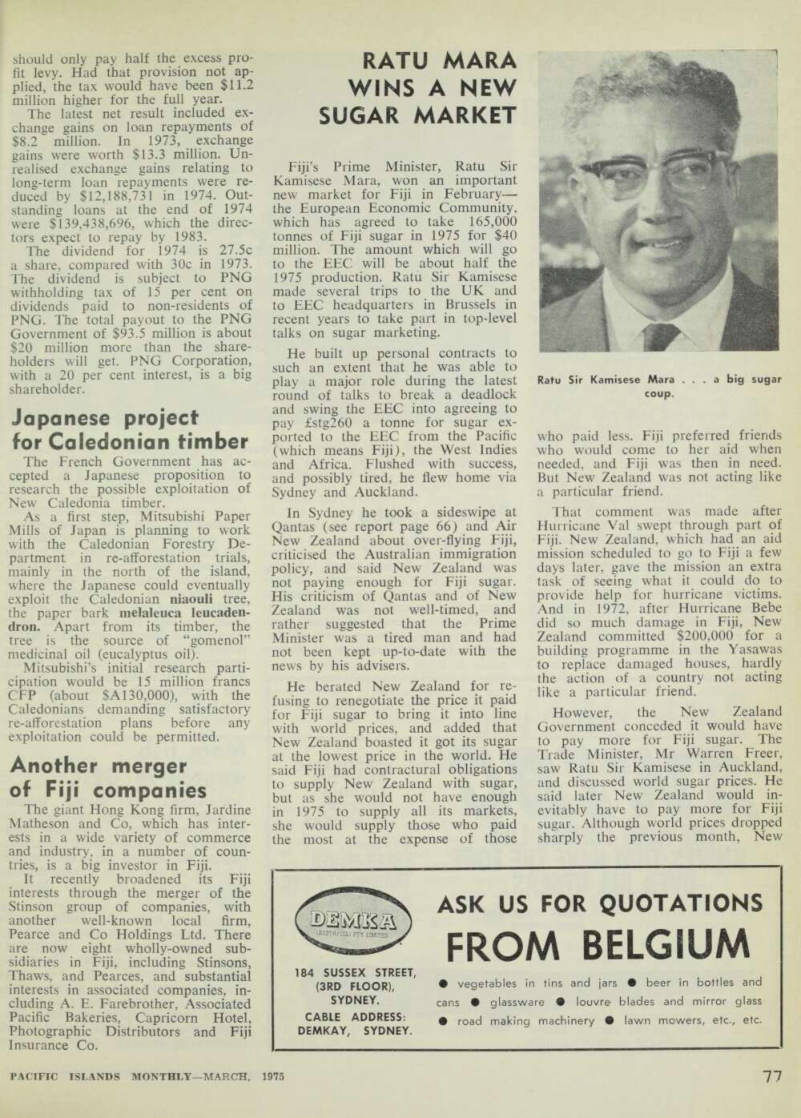
Ratu Sir Kamisese Mara . . . a big sugar coup.
Zealand paid considerably less than the world price.
There are obvious advantages for Fiji in the agreement with the EEC.
While Fiji is guaranteed top prices, there is a system of subsidies which guarantees the sugar producer against crop failure. Ratu Sir Kamisese said Fiji was moving to a closer associa tion with Europe because of prob lems it had in the past with Aust ralia and New Zealand. Fiji believed it was time now for it to handle its own trade affairs. Only a few weeks before he left for Brussels he said Fiji would market its own sugar, instead of CSR Ltd.
Fiji now needs to make greater efforts to lift sugar production. The trend to lower production must be reversed, now the country has a “foot” in Europe’s door to add to its other lucrative markets. Although sugar prices have dropped sharply, there could be a rise in a few months when the effect of the hurricane which devastated Mauritius in Feb ruary starts to bite. Early estimates were that 20 per cent of the crop was destroyed. • South Pacific Foods Ltd, which operates at Sigatoka, Fiji, expects to export about 1350,000-worth of pro cessed fruit in 1975, compared with $190,000 in 1974. The main markets are Australia, the US, Canada and Japan. The company plans to be in a new factory by the end of 1975.
A subsidiary of the company, Orchid Canneries Fiji Ltd, recently won a contract to supply 4 oz packets of passionfruit and guava pulp to super markets in the US and Canada.
Fishery probe
in the Cooks
An 80 ft fishing vessel, Altair, built as a North Sea trawler in Bel gium 50 years ago, is at Rarotonga from Gothenburg, Sweden, with Captain Sven Eskill Carlson and three Swedish crewmen. Two of the crew were schoolteachers in Raro
tonga some years ago.
Altair will be used to determine the commercial fishing potential in the Cook Islands. Plans are to fish the ocean around the Cooks’ north ern atolls and sell the catches on the wharf at Rarotonga’s Avatiu Harbour and through the Govern ment Freezer. The vessel will have 20 tons of freezer cargo. If fishing is successful, plant for processing fish scraps into fish meal will be set up, but this is an expensive project and funds will have to come from the fishing profits.
More fish
wanted in GEIC
A number of Pacific Islands countries are looking to fishing to provide more food for their own use, and to develop export industries.
One of the latest is the GEIC, which is taking an interest in a brine shrimp culture venture by Atoll Marine Products.
A team from the Gilbert and Ellice Islands Development Author ity recently went to Christmas Island to start the project. The team will also discuss with Fiji and Hawaii interests other marine ven tures, such as tuna fishing and har vesting, crayfish processing and big game fishing, as well as several other commercial projects.
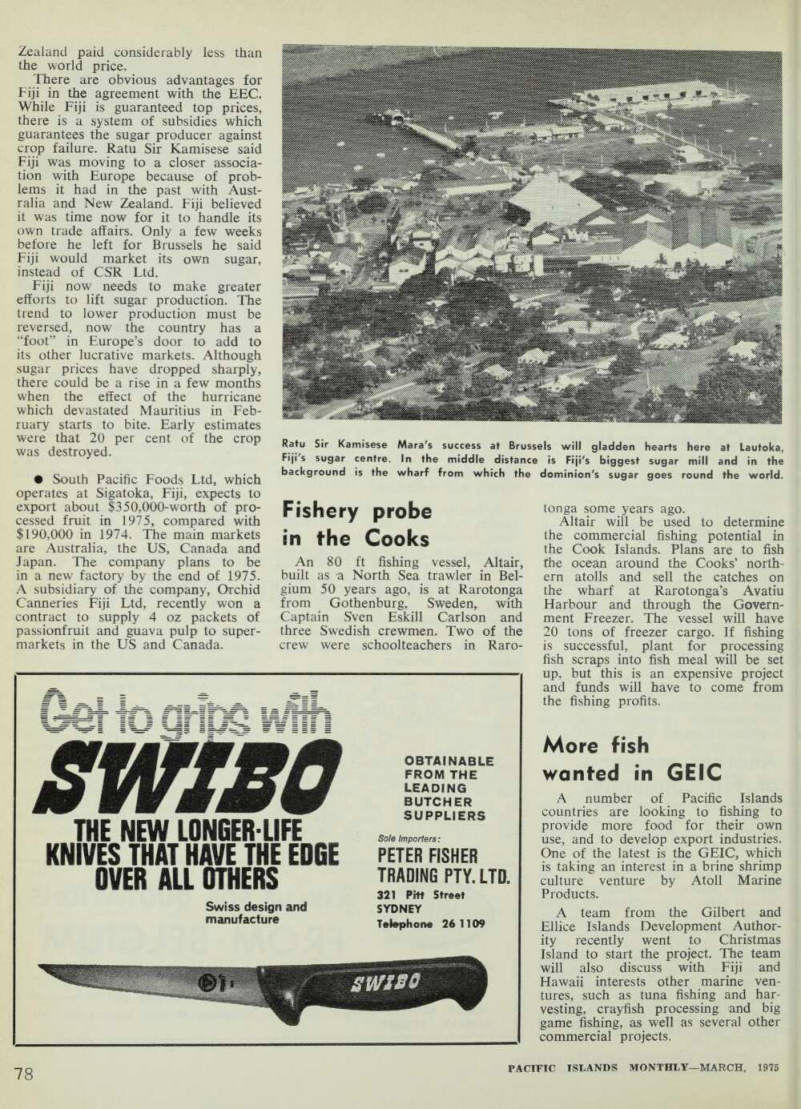
Ratu Sir Kamisese Mara's success at Brussels will gladden hearts here at Lautoka, Fiji's sugar centre. In the middle distance is Fiji's biggest sugar mill and in the background is the wharf from which the dominion's sugar goes round the world.
• Singapore Airlines plans to open a new service from Singapore to New Zealand, via Port Moresby, possibly late in 1975. The airline which is also studying new destina tions, including Fiji and Timor, con siders Port Moresby is an ideal intermediate point between Singapore and Auckland. • The Cook Islands Broadcasting and Newspaper Corporation was scheduled to release a new publica tion, Cook Islands Photo News, late in January or early February. The journal, of 28 pages, was expected to have a print run of 1,000. The range of pictures will be wide. • Australia and Japan have signed an agreement under which Australia will sell more than three million
. . . and briefly tonnes of raw sugar to Japanese sugar mills over the next five years.
The deal is reported to be worth more than $1,200 million. CSR Ltd, which is the marketing agent for all Australian (and Fiji) sugar, nego tiated the agreement with a group of Japanese refining companies, led by Mitsubishi Corporation and Mitsui and Co Ltd. • The New Hebrides company, Burns Philp and International Trus tee Company Ltd, has changed its name to the South Seas International Trust Co Ltd. The change, in name only, does not affect the company’s structure or personnel.
• Mr Mahuru Rarua Rama, 45, of Port Moresby, and Mr Jawing Muttu Gware, of Lae, have been ap pointed to the board of the Bank of South Pacific Ltd. Mr Rama Rama was elected Lord Mayor of Port Moresby in 1974. He is a business man, with interests in passenger buses and taxis. Bank of South Pacific Ltd was inaugurated on October 1, 1974, to acquire the PNG business of the National Bank of Australasia Ltd in readiness for PNG’s independence. • Fiji plans to use some of its pine forests to supply the raw material for a paper mill. The Prime Minister, Ratu Sir Kamisese Mara, said recently it was a long-range plan, which would be among projects he would discuss during a tour of the Middle East in March.