Composing With The Help
p. 55 · Read in the full issue
Of The Spirit People
Meli Tuqota—Fijian musician
By Margaret Knox
Years ago Meli Tuqota, now one Df Fiji’s promising young musicians, ivas growing up in the Fijian village Df Gasauvu near Saqani in Cakau- Irove, which covers part of eastern yanua Levu and Taveuni.
Music was very much part of the ife of the village and it was taken [or granted that people could sing unefully or beat correct rhythms on he lali and the bamboo derua. The Did chants, using a scale of only five lotes, were still to be heard but they vere fast disappearing. Perhaps the •ich harmonies of the hymn singing n the Methodist Church and later he guitar music heard on the radio vere more powerful influences on the /oung Meli.
Meli’s grandfather, Joape, and his :our uncles were all musical and one Df his uncles was a composer. He composed with the help of the veli. /eli are spirit people or elves. They ire very small and have long hair ind beards. They look very old and they are very lively. In fact everything the veli do is by opposites —on a warm day they shiver with cold; they are unable to pick up a Dlade of grass and yet they can lift leavy rocks; they cry when they are lappy and laugh loudly when they ire sad. Composers of meke tunes vould ask these little spirit people o help them. The music would Dften come to the composers in Ireams.
The kind of music that Meli’s mcle and others composed with the iclp of the veli would suit the kind Df quick movements seen in many of he dances and the words and actions hat go with the music often go by Dpposites giving the war dances and Dther stories told in songs and move nent, their humour.
All of this was part of Meli’s Dackground, but he was quite un conscious that he had special musical »ifts or that he might one day be come a composer. He attended the ocal primary school and then went
on to the Seventh-day Adventist training centre at Fulton College for a year. There he showed himself to be a good artist and it was to de velop this skill rather than his musi cal ability that he was given a year’s scholarship in 1965 to study at Avondale Seventh-day Adventist College at Newcastle in Australia.
Here he also took part in college concerts and heard and saw an orchestra for the first time. It was the instrumental backing to the singing that made him want to learn more about music. When he came back to Fiji he formed a musical group and gradually taught himself to play the piano, guitar, recorder and ukelele. He was working as a teacher and he became interested in teaching music. His talents were spotted by the Fiji Education Depart ment’s music adviser, Mr Bob Smith, and Meli was able to attend many seminars on music.
He has already composed a num ber of pieces which have been per formed. One of them is the music for the Ballad of the Uluilakeba, which commemorates the loss of the copra boat the Uluilakeba in De cember, 1973. This ballad was writ
ten as part of the folk literature course at Corpus Christi Teachers’
College and it happened that Meli was teaching there two days a week as part of his work for the Fiji Education Department. He composed the music for the ballad and it was performed by a group of students at the opening of the Laucala Bay Catholic Church in 1974. He has used the same theme as the subject for a cantata he is composing.
Now Meli is in London on a year’s scholarship studying music at the London University School of Education. He is looking forward to learning more about composing and orchestration. He would like to have the ability to write down the music that is in his head quickly and ac curately. For himself he strives for perfection but when he teaches he says he doesn’t look for perfection.
Rather he tries to help his pupils develop their potential just as far as they can.
Meli’s wife Finau, who is from Tonga, is with him in London and she is also very interested in music and is a teacher. While in London she hopes to take a course to im prove some aspect of her teaching.
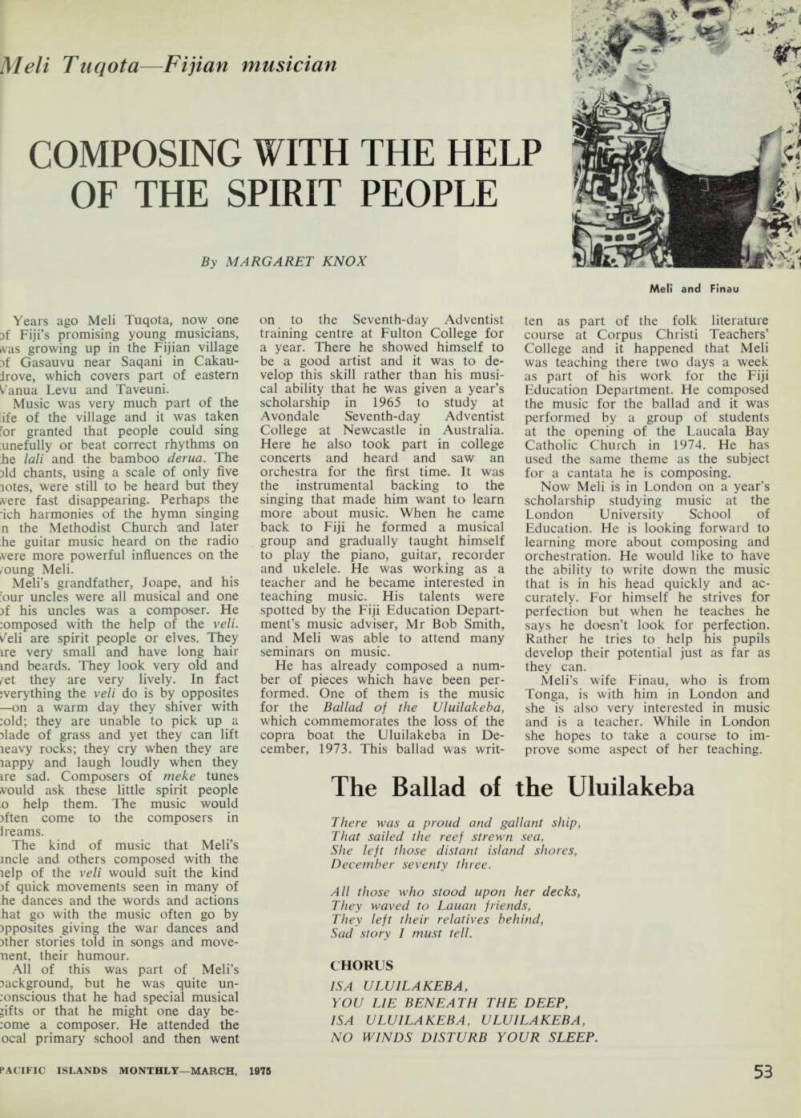
Meli and Finau