Returned Honeymooner’ Looks At
pp. 27-32 · Read in the full issue
Tonga's Sunny And Shady Sides
Australian John Slender, who married his Tongan wife Fatai in Tonga three years ago, went back with her to Tonga around the year-end for a second honeymoon. Had Tonga done a quick change in three years—or stood still, he wondered on the way. The answers he got he gives below.
By John Slender
There’s nothing new about a fella visiting Tonga twice in three years, and I’ll hardly make the Guinness Book of Records but this is how I saw the kingdom on that second visit.
Arrival at Fua’amotu Airport was much the same though they’ve speeded up Immigration and Cus toms clearance but then Tonga’s now in the jet age. The new concrete run way may have fallen in love with Mr Pacific’s BAG One-Eleven, but he concrete adds a few degrees to he temperature.
The drive from the airport to Nukualofa was much the same. First mpressions lingered with the same )ld half-built concrete houses and the lilapidated state of some of the old lomes. Tonga hadn’t changed, eh?
Jut it had. There were many new ottages and this time the local paint uppliers had cracked the jackpot.
There was no doubt that the hous ig standards are improving. Houses 'ere being completed. Obviously, the wners were planning and building dthin the limits of their resources, hank goodness for those working ips they took overseas. It was good ) see the results of the person who ad saved hard while away.
The road into the capital was an idictment of the government’s atti ide towards road maintenance and instruction. Three years had passed nee I had last taken this same urney but the roads had aged five jars. My heart really bleeds for the ongan motorist. He pays 70 seniti ibout 80 cents Aust) for his gallon juice and all of his spare cash is ken up in repairs to his vehicles, ow can a country talk about its )wn international airline” and 0,000 ton DW tankers” when there I’t a hundred yards of decent road ty in the whole kingdom!
I would estimate that better roads Me would save Tonga up to 20 r cent a year in its fuel bill. And, dly needed are some effective isses on driving techniques and hide maintenance. Yet standing t like a Rolls Royce in the Sahara e new Holden Statesmen
vehicles given to Tonga by the Aust ralian Government. How much bet ter if their value of $35,000 had been spent on road-making equipment.
Another thing that came quickly to mind was the hundreds of acres of unused land. Yet the cry of shortage of land still goes on. The large parcels of land must be dis tributed more evenly and any land owner who does not work his land should have it seized and redistri buted.
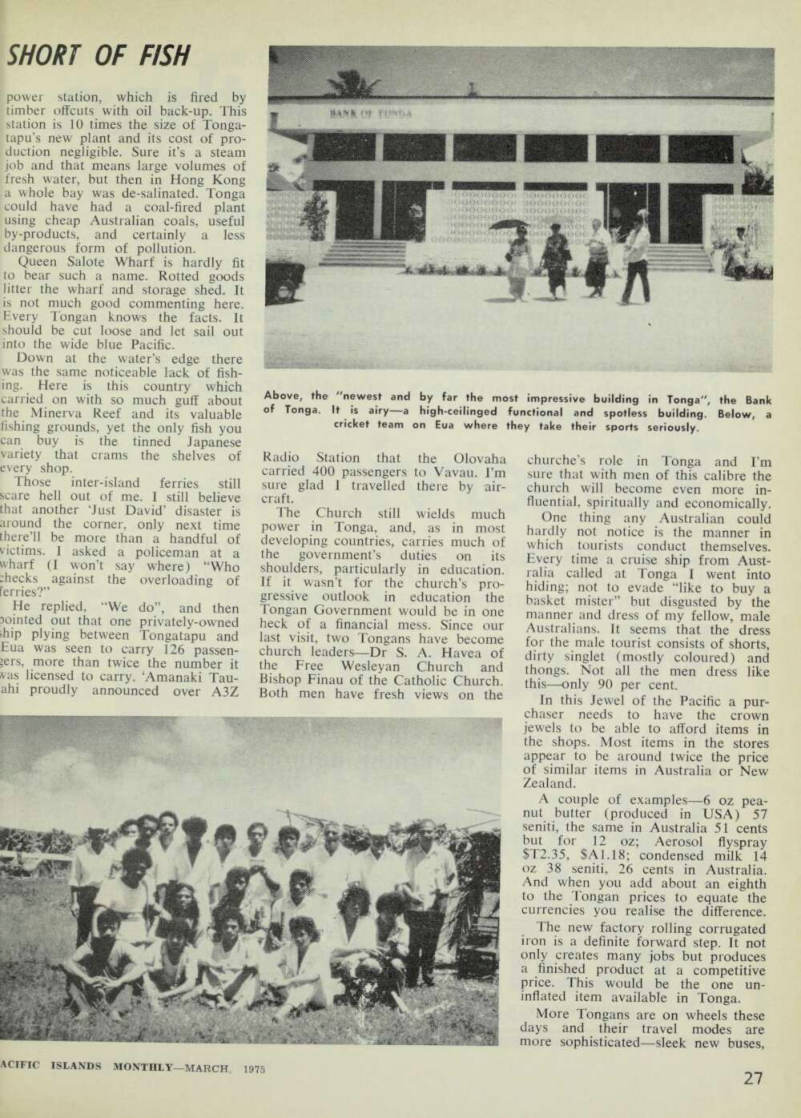
The newest, and by far the most impressive building, would be the new Bank of Tonga. It is airy—a high ceilinged functional and spot less building. The female staff are dressed in Tongan vala with a dis tinctive Tongan pattern. The bank’s success is rather overwhelming, far exceeding expectations; an apprecia tive addition to the Kingdom. A case of experts, not amateurs, running the show.
One bank officer pointed out that when many tourists went to cash
travellers cheques they jibbed when told the exchange rate was only 87 seniti for one Australian dollar. And later on, during a visit to the Fa’onelua Park where handicraft sales are held when the tourist ships arrived, I learned the reason. For example, the price of a basket may be ST3 but the seller would accept SA3 to secure a sale. Thus the Ton gan loses out and bears the full bur den of the exchange difference.
The other new addition to Tonga is its power station. I reckon here is another example of amateurs making decisions. The power is generated by thirsty diesel motors, hence the nine seniti, or so, for 1 kilowatt hour, of energy. That 70,000 ton ship will soon be needed. Diesel fuel won’t be getting any cheaper, so Tongans, a friendly piece of advice, “turn off that switch”. Tonga abounds with its own source of energy which could easily be used to generate electricity —its timber waste. In South Aust ralia, Mt Gambier has a 25 megawatt
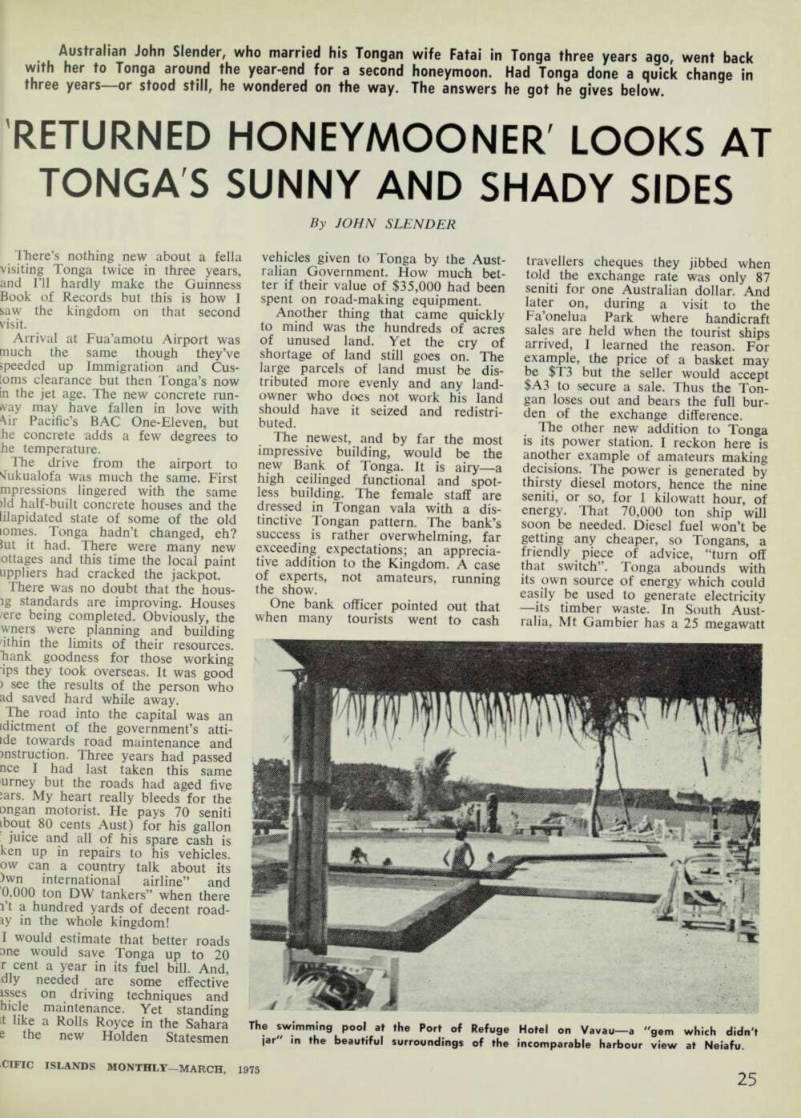
The swimming pool at the Port of Refuge Hotel on Vavau—a "gem which didn't jar" in the beautiful surroundings of the incomparable harbour view at Neiafu.
Short O Fish
power station, which is fired by timber offcuts with oil back-up. This station is 10 times the size of Tonga tapu's new plant and its cost of pro duction negligible. Sure it’s a steam job and that means large volumes of fresh water, but then in Hong Kong a whole bay was de-salinated. Tonga could have had a coal-fired plant using cheap Australian coals, useful by-products, and certainly a less dangerous form of pollution.
Queen Salote Wharf is hardly fit to bear such a name. Rotted goods litter the wharf and storage shed. It is not much good commenting here.
Every Tongan knows the facts. It should be cut loose and let sail out into the wide blue Pacific.
Down at the water’s edge there was the same noticeable lack of fish ing. Here is this country which carried on with so much guff about the Minerva Reef and its valuable fishing grounds, yet the only fish you can buy is the tinned Japanese variety that crams the shelves of every shop.
Those inter-island ferries still scare hell out of me. I still believe that another ‘Just David’ disaster is around the corner, only next time there’ll be more than a handful of victims. I asked a policeman at a wharf (I won’t say where) “Who :hecks against the overloading of ferries?”
He replied, “We do”, and then Dointed out that one privately-owned ship plying between Tongatapu and Eua was seen to carry 126 passen gers, more than twice the number it vas licensed to carry. ‘Amanaki Tau ahi proudly announced over A3Z
Radio Station that the Olovaha carried 400 passengers to Vavau. I’m sure glad I travelled there by air craft.
The Church still wields much power in Tonga, and, as in most developing countries, carries much of the government’s duties on its shoulders, particularly in education.
If it wasn’t for the church’s pro gressive outlook in education the Tongan Government would be in one heck of a financial mess. Since our last visit, two Tongans have become church leaders—Dr S. A. Havea of the Free Wesleyan Church and Bishop Finau of the Catholic Church.
Both men have fresh views on the
churche’s role in Tonga and I’m sure that with men of this calibre the church will become even more in fluential, spiritually and economically.
One thing any Australian could hardly not notice is the manner in which tourists conduct themselves.
Every time a cruise ship from Aust ralia called at Tonga I went into hiding; not to evade “like to buy a basket mister” but disgusted by the manner and dress of my fellow, male Australians. It seems that the dress for the male tourist consists of shorts, dirty singlet (mostly coloured) and thongs. Not all the men dress like this—only 90 per cent.
In this Jewel of the Pacific a pur chaser needs to have the crown jewels to be able to afford items in the shops. Most items in the stores appear to be around twice the price of similar items in Australia or New Zealand.
A couple of examples—6 oz pea nut butter (produced in USA) 57 seniti, the same in Australia 51 cents but for 12 oz; Aerosol flyspray 5T2.35, $A1.18; condensed milk 14 oz 38 seniti, 26 cents in Australia.
And when you add about an eighth to the Tongan prices to equate the currencies you realise the difference.
The new factory rolling corrugated iron is a definite forward step. It not only creates many jobs but produces a finished product at a competitive price. This would be the one un inflated item available in Tonga.
More Tongans are on wheels these days and their travel modes are more sophisticated—sleek new buses,
Above, the "newest and by far the most impressive building in Tonga", the Bank of Tonga. It is airy—a high-ceilinged functional and spotless building. Below, a cricket team on Eua where they take their sports seriously.
A Gem Which Didn't Jar
more Mini-Mokes, trucks and cars and fewer in the Ve’etolu ranks.
And the travel agency business must be good. There seems to be one on nearly every corner, while one organ isation has an overseas employment service. That one will go. The government is taking over the job of placing peripatetic Tongans in temporary work overseas.
Standing out like a sore thumb is ‘that’ German Consulate office.
Seems quite a laugh but then equally humorous is the lack of any Aust ralian permanent diplomatic organis ation—it’s incredible when Australia is a near neighbour.
The Queen Salote memorial build ing is smaller than the tall weeds that smother its ‘would-be splendour’.
Such a shame, but full marks to Princess Pilolevu who is, at least, endeavouring to get things moving so that it can be finished.
We’d heard that the Port of Re fuge Hotel in Vavau was really something. We’d wondered if any man-made object would really merge with the beautiful surround ings of Neiafu Harbour, but there it was —a gem which didn’t jar. It :ouldn’t have been bettered.
On Vavau I saw my old mate, Dr Viliami Tufui, the group’s senior medical officer. He and his staff of less than 20 administer to the needs of a population of around 18,000 — little time for leisure.
After four days on Vavau I con cluded that the Vavau folk are more industrious than those on Tongatapu.
And the same goes for ’Eua, which now has a new airport, many new cottages and some spectacular churches.
My favourite was Hango, the Free Wesleyan Church’s farming complex.
It’s a large undertaking, effectively laid out, and indeed a sight for the eyes of a former country boy. The college has clearly demonstrated that nearly any type of farming can be successfully carried out in Tonga provided people with know-how are brought in and their knowledge studied and applied, not criticised through ignorance.
The people of ’Eua are not a wealthy section of Tonga’s commun ity. They exist with the bare essen tials. But they are not whingers. They work hard and enjoy their leisure hours to the utmost.
The timber industry has a good
share in the economy of ’Eua and all mills are doing good business as do the truck owners who transport the timber.
It looks likely that in a few years ’Eua will be supplying Tongatapu with larger quantities of meat, veget ables and timber.
The sum total of my impressions is that Tonga hasn’t progressed to any great extent in the last three years. The scales appear heavily loaded in favour of the nobles, top government officials and those with fat bank accounts, and it seems the poor people will remain that way for some considerable time.
But there are hopes. Many of the young people are asking more ques tions, probing for answers to ques tions that should have been asked long ago; expressing opinions more openly than previous generations.
Tonga has some very well educated people overseas, but I doubt if many of them will return permanently to pass on their know ledge to Tonga’s betterment.
The kindom needs trade unions, not the Aussie brand, but some organisation which will cater for the workers and their rights.
Tonga still openly advertises waste and inefficiency. Red tape seems the order of the day. Ever tried to see
a senior government officer? Damn near impossible to get past the in quiry counter clerk.
Don’t be the least bit surprised if some really influential and well known people have a lash at the next general elections. Tonga needs some changes badly and urgently.
Others can take their order of priority.
I hope sincerely that when I next visit Tonga (that’s if they’ll allow me in), I’ll see changes that will bring about more equal opportunities for all the people.