Tropicalities
pp. 19-21 · Read in the full issue
Fiji miners
want a
sex break
Fiji may pioneer a new industrial principle. The Fiji Mineworkers’
Union, in a log of claims, seeks a 30-minute “sex break”, at midday, because, the union says, “that is the best time for sex”. The privilege, if granted, will apply to married men only—alternative arrangements will be made to accommodate bachelors.
The union secretary, Mr Navitalai Raqona, explaining the reason for the claim, said that existing conditions left men and their wives completely exhausted by late evening. After all, a man had a sexual obligation to his wife. He finished work at 5 pm, com pletely exhausted, and went home to his wife and family. He was in no condition for healthy sexual relation ship by the time he went to bed.
The “sex break” would be added to the normal lunch break. After lunch and a short rest a man was in prime physical and mental condition and ready for his sexual obligations.
Mr Raqona said the union regarded the matter as serious, and would fight all the way for the sex break, regard less of whether people considered it immoral.
PXG searches
for an anthem
Natural history themes, the climate, the landscape and political freedom all get a mention in one or another of the 35 entries for Papua New Guinea’s national anthem com petition.
Some of the entrants haven’t worried about a melody at all—they have confined themselves to high sounding poetry in the hope that some other enthusiast can come up with the music. And a few entrants have cribbed by borrowing melodies from other national anthems or from popular music.
The chairman of the committee which will select an anthem, Mr
Kwamala Kalo, said that the words only entries and the borrowed-melody entries had been eliminated from the contest. The rules made it clear that a complete anthem with words and original music was required.
Any sort of musical notation was acceptable, and if an entrant wanted to sing his melody assistance would be given to take down the necessary notation.
Officially the competition closed in mid-January but the committee was taking entries until the month-end.
The committee will begin consider ing the entries in February, but if it considers none of them is up to scratch it could extend the closing date again.
Papuans, New Guineans and non nationals living in Papua New Guinea have contributed most of the entries but a few entries have come from Australia and Japan.
The contest organisers hope to re duce the entries to a short list of five.
These will be played over National Radio by the Band of the Royal Papua New Guinea Constabulary.
Public opinion will then be sought before the final choice is made.
Some members of the government admitted they were not sure which would come first—lndependence Day or the birth of the new anthem.
But under present plans, they said, the anthem was to be launched in time for Independence Day celebra tions.
Well, if it
isn't Aborina!
This is the third time that Gilbertese-born Aborina Stellmach (formerly Aborina Tenanorake of North Tarawa and now of Munich) has appeared in PlM’s pages. But then Aborina was a film star, provid ing some of the glamour for the film Sailing in the Trade Winds which German film director Karl-Heinz von Stellmach made for the Roman Catholic Church in the colony. And film stars are always having their pictures taken.
Like other stars before her, Abo-
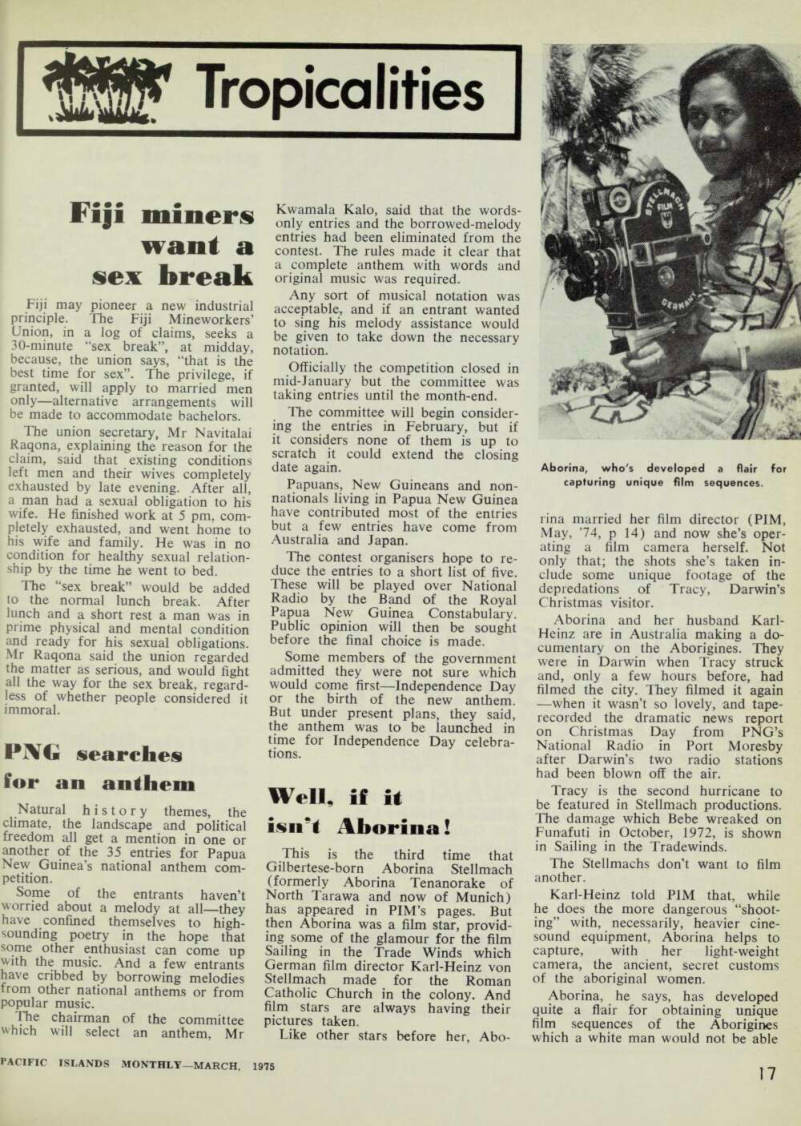
rina married her film director (PIM, May, 74, p 14) and now she’s oper ating a film camera herself. Not only that; the shots she’s taken in clude some unique footage of the depredations of Tracy, Darwin’s Christmas visitor.
Aborina and her husband Karl- Heinz are in Australia making a do cumentary on the Aborigines. They were in Darwin when Tracy struck and, only a few hours before, had filmed the city. They filmed it again —when it wasn’t so lovely, and tape recorded the dramatic news report on Christmas Day from PNG’s National Radio in Port Moresby after Darwin’s two radio stations had been blown off the air.
Tracy is the second hurricane to be featured in Stellmach productions.
The damage which Bebe wreaked on Funafuti in October, 1972, is shown in Sailing in the Tradewinds.
The Stellmachs don’t want to film another.
Karl-Heinz told PIM that, while he does the more dangerous “shoot ing” with, necessarily, heavier cine sound equipment, Aborina helps to capture, with her light-weight camera, the ancient, secret customs of the aboriginal women.
Aborina, he says, has developed quite a flair for obtaining unique film sequences of the Aborigines which a white man would not be able
Aborina, who's developed a flair for capturing unique film sequences.
to get. She was trained as a “camera man” in her husband’s Munich studio, which is among the oldest in Germany, but also one of the most up-to-date.
Charles, the
prinee of sails
Prince Charles has tried out his Gilbertese sailing canoe several times on one of the lochs at Balmoral.
Buckingham Palace reported he had lots of fun trying to master the tech nique of changing the sail. He be came quite expert in this, but not without a number of duckings.
Where Sunday
is Saturday!
The loop round Tonga, which puts it west of the international dateline, is a worrying matter to the Seventh day Adventist Church, and in parti cular to Mr Lionel Hughes, principal of the church’s Beulah College in Tonga. Tonga lies east of the 180th meridian, and is almost due south of Samoa, yet is a day ahead of Samoa.
The Seventh-day Adventist Church leaders in Tonga maintain that Sun day there is really Saturday because of Tonga’s position in relation to the dateline. Mr Hughes has made in quiries overseas and also in Tonga, but has not been able to find any international law which ratifies the loop round Tonga. He says that even after a year in Tonga, it still “jars” him to go to church on Sundays. He is looking for information which would confirm (or otherwise) the validity of the dateline loop.
‘Captain Bligh’
well almost
A 20th century William Bligh will have a much easier voyage than his famous forebear when he sets out on May 2 to retrace the 3,600-mile path of the Bounty launch into which Captain William Bligh and his loyal followers were cast by the Bounty mutineers in 1789. The new “Bligh is 45-years-old American, Captain William Verity, who will start his voyage from a point about 25 miles south-west of Tofua, in Tonga, where Bligh started his marathon voyage which ended in the Dutch East Indies.
Verity has built a 23 ft near-replica of the launch, but, unlike Bligh, he
will not have to put up with scant rations, or contend with savage Fijians as he passes through the Koro Sea. He will have an outboard motor, radio and charts. His launch will have 18 in. freeboard, compared with the bare 8 in. of the boat carry ing Bligh and his companions.
He will carry a newspaperman and a cameraman, and also hopes to take a young Tongan along. He arrived at Nukualofa recently and has put his proposal before the Cabinet there.
Captain Verity recently tested his launch on a trip from Tonga to Pago Pago. It took him 22 days, but he spent much time circling various islands, particularly Tofua. He has made an extensive research into the Bligh story and has a high opinion of Bligh. He hopes to prove what a great seaman Bligh was, although that is not a matter really requiring any proof.
Starfish damage
to reef
Mr Jean Tapu, French Polynesia’s Fisheries Officer, and twice holder of the world record for underwater fish ing, was at Rarotonga in January as a member of a 60-strong sports team.
During his visit he instructed local enthusiasts in the finer points of under-water fishing.
He said he was disturbed at the amount of damage done to the island’s reef by the Crown of Thorns starfish which should be cleaned out.
He found that much of the reef was already dead and damage went as deep as 15 fathoms.
Cooks’ Fisheries Officer, Mr Tom Marsters, said the starfish were not as numerous round Rarotonga now as they were a few years ago. They are seldom seen on the reef flats and the harbour entrances, where once they were numerous. Either their natural enemies are killing them off, or they are moving away to fresh feeding grounds.
Ata Island
repulses ‘invaders 9
It can be a dangerous business trying to land on uninhabited Ata Island, lonely southern outpost of Tonga, as an expedition from the Tonga Department of Agriculture found out recently. Sent out to make a two-day survey of natural re sources, a survey party called the whole thing off and left the island to the seagulls when three men were injured while attempting to land on the only accessible part of the
boulder-strewn inhospitable coastline.
The men were thrown into the surf from a rubber dinghy. However, they were able to get back to the patrol boat, much the worse for wear. They required hospital treatment when they arrived back at Nukualofa. One man had a broken elbow and badly bruised foot, another an injured back, and the third a gashed forehead.
Tongans living on the island, which is 85 miles south of Tonga tapu, were evacuated to Eua in the 19th century after suffering from raids by blackbirders. The cliffs round the island are 200 ft and more high. Peaks on the island rise to 1,600 ft.
Ata Island, in 1965, became “home” for six young Tongans, aged 16 to 18, for 15 months. They had “borrowed” a 24 ft whale boat for a night’s fishing, and got caught up in a storm. The boat drifted for eight days, and was beginning to break up when Ata was sighted. The boys took to planks and after swim ming for a day and half a night were washed up on a rocky ledge.
They were rescued in September, 1966, by the crew of Just David, owned by Mr Peter Warner, and skippered by John Derrick and taken to Nukualofa, where they were arrested and charged with having stolen the whale boat. They were released the same month to go back to Ata to take part in a TV docu mentary.
Just David, which became an inter-island ferry in Tonga, foundered and sank in the tiny harbour of Eua Island, a few miles from Tongatapu, with the loss of eight lives, on June 19, 1973.
Placating
Hie fire god?
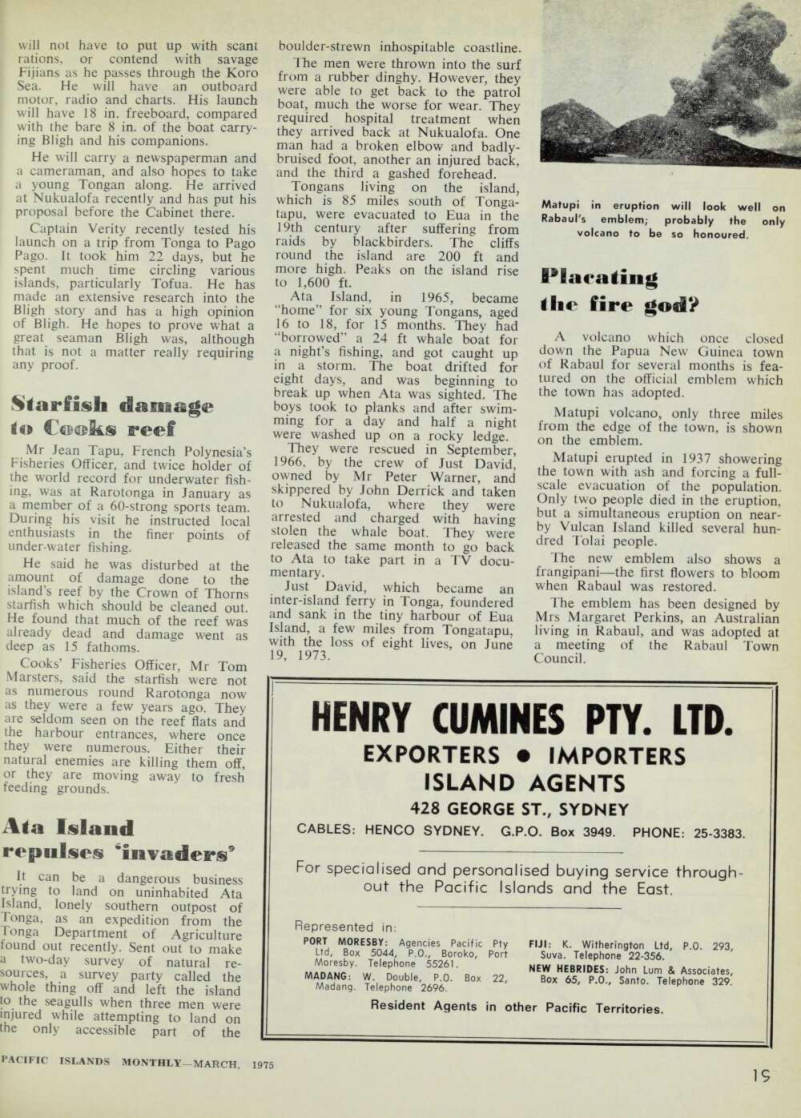
A volcano which once closed down the Papua New Guinea town of Rabaul for several months is fea tured on the official emblem which the town has adopted.
Matupi volcano, only three miles from the edge of the town, is shown on the emblem.
Matupi erupted in 1937 showering the town with ash and forcing a full scale evacuation of the population.
Only two people died in the eruption, but a simultaneous eruption on near by Vulcan Island killed several hun dred T'olai people.
The new emblem also shows a frangipani—the first flowers to bloom when Rabaul was restored.
The emblem has been designed by Mrs Margaret Perkins, an Australian living in Rabaul, and was adopted at a meeting of the Rabaul Town Council.
Matupi in eruption will look well on Rabaul's emblem; probably the only volcano to be so honoured.