Fiji’s most flourishing industries
p. 17 · Read in the full issue
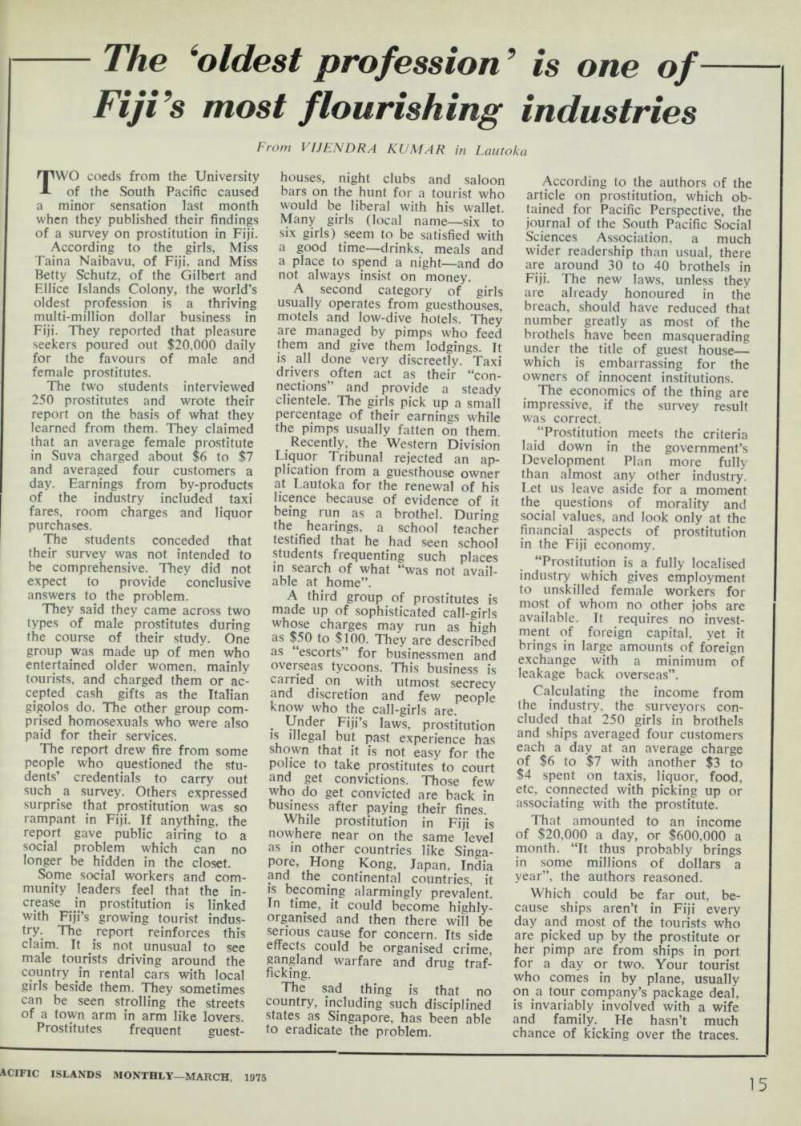
The 6 oldest professioone of Fiji’s most flourishing industries
From VI JEN DR A KUMAR in Lautoka
TWO coeds from the University of the South Pacific caused a minor sensation last month when they published their findings of a survey on prostitution in Fiji, According to the girls, Miss Taina Naibavu, of Fiji, and Miss Betty Schutz, of the Gilbert and Ellice Islands Colony, the world’s oldest profession is a thriving multi-million dollar business in Fiji. They reported that pleasure seekers poured out $20,000 daily for the favours of male and female prostitutes.
The two students interviewed 250 prostitutes and wrote their report on the basis of what they learned from them. They claimed that an average female prostitute in Suva charged about $6 to $7 and averaged four customers a day. Earnings from by-products of the industry included taxi fares, room charges and liquor purchases.
The students conceded that their survey was not intended to be comprehensive. They did not expect to provide conclusive answers to the problem.
They said they came across two types of male prostitutes during the course of their study. One group was made up of men who entertained older women, mainly tourists, and charged them or ac cepted cash gifts as the Italian gigolos do. The other group com prised homosexuals who were also paid for their services.
The report drew fire from some people who questioned the stu dents’ credentials to carry out such a survey. Others expressed surprise that prostitution was so rampant in Fiji. If anything, the report gave public airing to a social problem which can no longer be hidden in the closet.
Some social workers and com munity leaders feel that the in crease Jn prostitution is linked with Fiji’s growing tourist indus try. The report reinforces this claim. It is not unusual to see male tourists driving around the country m rental cars with local girls beside them. They sometimes can be seen strolling the streets of a town arm in arm like lovers.
Prostitutes frequent guest
houses, night clubs and saloon bars on the hunt for a tourist who would be liberal with his wallet.
Many girls (local name—six to six girls) seem to be satisfied with a good time—drinks, meals and a place to spend a night—and do not always insist on money.
A second category of girls usually operates from guesthouses, motels and low-dive hotels. They are managed by pimps who feed them and give them lodgings. It is all done very discreetly. Taxi drivers often act as their “con nections” and provide a steady clientele. The girls pick up a small percentage of their earnings while the pimps usually fatten on them.
Recently, the Western Division Liquor Tribunal rejected an ap plication from a guesthouse owner at Lautoka for the renewal of his licence because of evidence of it being run as a brothel. During the hearings, a school teacher testified that he had seen school students frequenting such places in search of what “was not avail able at home”.
A third group of prostitutes is made up of sophisticated call-girls wh ose charges may run as high as $5O to $lOO. They are described as escorts” for businessmen and overseas tycoons. This business is carried on with utmost secrecy and discretion and few people know who the call-girls are. . Under Fiji’s laws, prostitution is illegal but past experience has shown that it is not easy for the police to take prostitutes to court and get convictions. Those few who do get convicted are back in bu siness after paying their fines.
While prostitution in Fiji is nowhere near on the same level as in other countries like Singa pore, Hong Kong, Japan, India and the continental countries, it is becoming alarmingly prevalent.
In time, it could become highly organised and then there will be serious cause for concern. Its side effects could be organised crime, gangland warfare and drug traf ficking.
The sad thing is that no country, including such disciplined states as Singapore, has been able to eradicate the problem.
According to the authors of the article on prostitution, which ob tained for Pacific Perspective, the journal of the South Pacific Social Sciences Association, a much wider readership than usual, there are around 30 to 40 brothels in Fiji. The new laws, unless they are already honoured in the breach, should have reduced that number greatly as most of the brothels have been masquerading under the title of guest house— which is embarrassing for the owners of innocent institutions.
The economics of the thing are impressive, if the survey result was correct.
“Prostitution meets the criteria laid down in the government’s Development Plan more fully than almost any other industry.
Let us leave aside for a moment the questions of morality and social values, and look only at the financial aspects of prostitution in the Fiji economy.
“Prostitution is a fully localised industry which gives employment to unskilled female workers for most of whom no other jobs are available. It requires no invest ment of foreign capital, yet it brings in large amounts of foreign exchange with a minimum of leakage back overseas”.
Calculating the income from the industry, the surveyors con cluded that 250 girls in brothels and ships averaged four customers each a day at an average charge of $6 to $7 with another S 3 to S 4 spent on taxis, liquor, food, etc, connected with picking up or associating with the prostitute.
That amounted to an income of $20,000 a day, or $600,000 a month. “It thus probably brings in some millions of dollars a year”, the authors reasoned.
Which could be far out, be cause ships aren’t in Fiji every day and most of the tourists who are picked up by the prostitute or her pimp are from ships in port for a day or two. Your tourist who comes in by plane, usually pn a tour company’s package deal, is invariably involved with a wife and family. He hasn’t much chance of kicking over the traces.