Mrs Bigler
pp. 14-83 · Read in the full issue

makes her bow— with both feet
From a Saipan correspondent Have the Marshall Islands in thn United States Trust Territory of th« Pacific Islands, commonly known a* Micronesia, acquired a Joan of Area cum-Josephine Abaijah in the person of attractive Mrs Carmen Milnr Bigler, the first Micronesian woman to sit in the Congress of Micronesia* Silent for the first three weeks oc the first session of Congress since thr December elections, Mrs Bigler, Li her maiden speech early in February jumped with both feet into one o Micronesia’s hottest political argu ments —the sharing between the disi tricts of government revenue, a sub ject on which the Marshall! threatened last year to pull out o
the partnership. . .
The Marshalls, which mclub
Kwajalein, the money-spinning mu
sile base, contribute around 57 pe< cent of the TTs tax revenue. Tho want half of it back instead of m present 20 per cent. The argumei; has gone on for the past three yean, Mrs Bigler, describing herself j “honoured, humbled and somewhr apprehensive”, proceeded to hot u the controversy with a speech whioi captured all ears. A congress release through MM quoted her as reminding member;
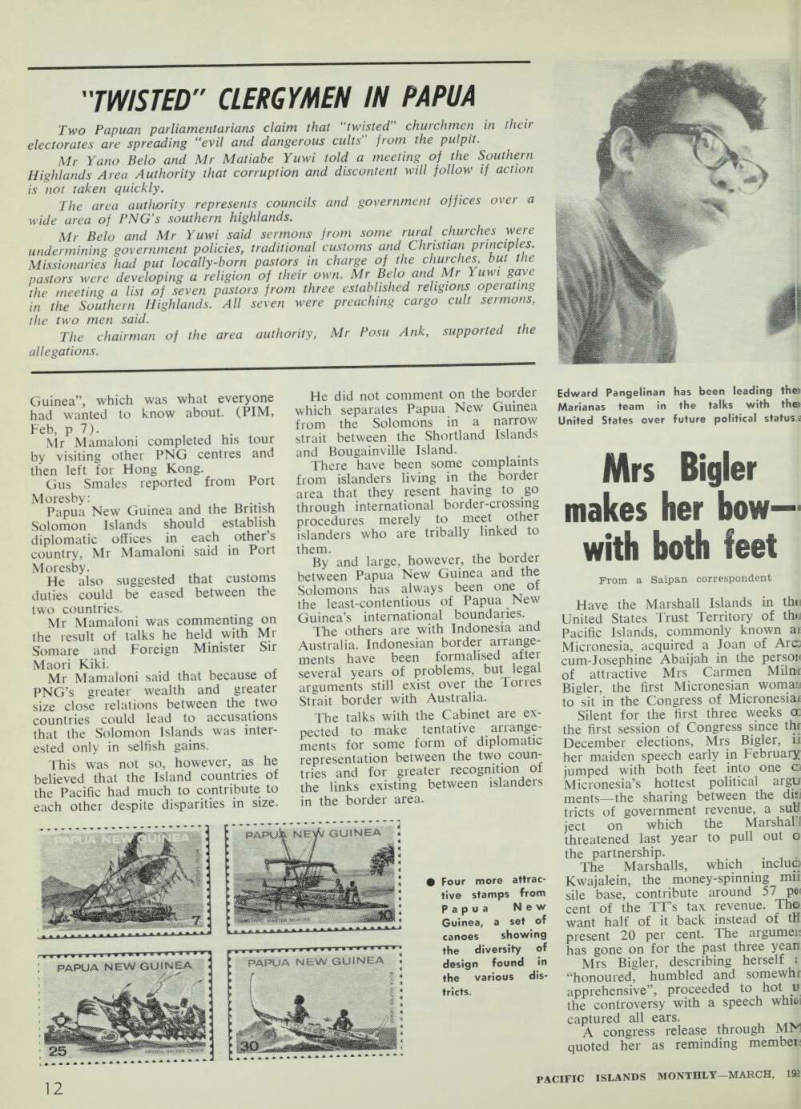
Edward Pangelinan has been leading the Marianas team in the talks with tho United States over future political status.
I “It was not the people of Mokil who were involuntarily dispossessed of their atoll. It was not the people of Yap who had their islands totally obliterated by 33 nuclear explosions.
It was not the people of Lukuno who are ravaged by radiation related diseases, or the people of Koror, who were dislocated and forced to live in a dreadful slum. It ; is the Marshallese people of Eniwe tak, Bikini, Rongelap, Utirik and Ebeye.
“The military has given us money but they have also given us tremen dous social problems. We need money to try to help solve some of these problems; to try to help the people of Bikini and Eniwetak re build and regain their home islands and return to a more normal life after more than 20 years of forced exile; to provide medical care to the many people of Rongelap and Utirik suffering from life-long radiation caused injuries, and to help the people of Ebeye to create a livable community out of a densely popu lated, disease-ridden slum”.
Then she pointed the finger. “One basic problem now is a lack of atten tion from the IT Government, and, sometimes, from the Congress of Micronesia as well”.
She brought US Secretary of State Henry Kissinger into the argument, recalling that, in a reference to Micronesia, he was reported as say ing, “There are only 90,000 of them.
Who gives a damn?”
All Micronesians were repelled by such arrogant thinking, she said, but those same words could be applied to the Marshallese—“They are only Marshallese. Who gives a damn?”
There was more in the same strain, but she ended on a pacific note: “More than anything, I want to avoid the antagonism which has marked
Continued on p 81
debate on this issue in the past, an tagonism which is driving a wedge between us and striking a mortal blow to the dream of a united Micronesia. Let us reason together and solve this problem in the spirit of harmony and goodwill”.
There were other bitter speeches railing at the niggardliness of the United States and Japan over Micro nesian war claims.
Truk Congressman Lambert Aafin and Marianas representative Herman R. Guerrero called on the two powers to compensate Micronesians fully for war damage.
Aafin described as “deplorable and shocking”, the War Claims Com mission’s policy of awarding only 16 per cent of the amount of an agreed claim.
At the same time, Mr Guerrero declared, “The United States and the Government of Japan appear to be ready to wash their hands of their international legal and moral res ponsibilities”.
One contentious bone the Congress got rid of was the question of the credentials of three new members vhose election had been challenged m the grounds that there had been rregularities and breaches of the electoral laws.
The Credentials Committee had ecommended the seating of two of he members and the rejection of he third, but Congress overruled the eommittee in a secret ballot and ap jroved the seating of all three— Bdgar Edwards, of Ponape, Chiro Mbert, of Truk, and Lambert Aafin, ITuk.
The committee had rejected Aafin md urged the High Commissioner to ‘all a special election and asked Congress to direct the Attorney jeneral to investigate Aafin’s elec ion for possible criminal prosecution
of the government officials con cerned.
The recommendations fell on deaf ears. When Aafin took his seat on a 9-8 vote he said, “I have always held the belief that the free, open and outward expression of the mind is the most beautiful attribute in all God’s creation”.
The Congress session’s dramatics tended to overshadow the much big ger issues of the future status talks between the United States and the Micronesians, but the talks came to the fore again with the arrival at Sai pan of US Ambassador Franklin Haydn Williams for the resumption of talks with the Marianas Political Status Commission.
This could be the end of the road for the Marianas, who want a com monwealth of their own in political union with America. All that re mained to be done, so far as the talks were concerned, was the review of the final wording of the docu ments and the signing of the joint agreement. This was accomplished on February 15.
There could be a hitch, however.
Several congressmen have argued that the referendum through which the Marianas people will be asked for their final views on future asso ciation with the United States, should embrace all Micronesians, the point being that the Marianas shouldn’t be allowed to opt out of the “consortium” without the blessing of the remainder—the Marshalls and the Carolines.
Chairman of the Marianas Poli tical Status Commission ex-Senator Edward Pangelinan, who lost his seat in the Congress in the last elections, has been reappointed a member of the Status Commission by Saipan’s Mayor Vicente D. Sablan, taking the seat vacated by Senator Olympic T.
Borja, who resigned because of other pressing duties.
Presumably, Mr Pangelinan, who has been concerned with the nego
tiations from the beginning, will con tinue as commission chairman.
Meanwhile, there are no signs that resumption is pending of the talks between the Congress of Micronesia’s Joint Committee on Future Status and the United States. The Micro nesians suspended the talks in pro test at America’s action in returning land to the various districts by executive order instead of through an agreement with Congress.
However, High Commissioner Edward E. Johnston might have cleared the air a little. In late Janu ary he explained that, so far as “so called military retention areas” were concerned, there were no such lands in Palau, Yap, Truk, Ponape or the Marshalls, and all the remaining “military retention” land in the Marianas would be returned to the Marianas. This would complete the return of all such lands throughout Micronesia held by the United States under agreement executed almost 30 years ago.
Around the same time, Congress Speaker Bethwel Henry referred to Senator Salii’s statement that the talks might be stopped because of America’s action in issuing an executive order for the return of lands, and said the matter was still being studied by the joint committee, which had made no decision.