Mr Stirn dispenses youthful
pp. 7-9 · Read in the full issue
charm but few ideas
Prom a Noumea correspondent
While sticks of gelignite and wall slogans marked the recent Noumea visit of French Overseas Territories Minister Mr Stirn, in many other ways his dispensing of youthful charm and vitality was very similar to the “Operation Smiles” of OT Minister Michel Inchauspe, in 1968.
However, Inchauspe came at a time when Paris was confidently talk ing about the 6,000 new workers needed from France to assist with the mammoth nickel development ahead.
Olivier Stirn had to face islanders disillusioned with waiting vainly for 10 years for the promised projects to materialise and having to cope in the meantime, so the “locals” said, with an influx of metropolitan French ousting locals from their jobs and overtaxing territorial resources, leav ing a budget deficit unable to finance the swollen ranks of the French ad ministration.
In face of the built-up tension, Stirn had to tread a cautious path, making few promises, vaguely sug gesting possible reform, aimed mainly at appeasing the most vocal of the disillusioned sectors—the Melanesians, trade unionists and young people.
During his week-long visit late January, the Paris Minister had, in fact, no new concrete developments to announce to the Caledonians. As he aired ideas for slight economic and political readjustments, he re jected the idea of internal autonomy and instead entertained Caledonians with a new hope of more direct sub sidies from France, to be achieved by a system of “regionalisation”—an old idea sounded out in the Pacific at the time of Inchauspe’s visit.
Then, a project was submitted to the Territorial Assembly proposing a new consultative body, within or outside the existing Territorial As sembly. But the regions plan was rejected in France, provoking the re signation of President de Gaulle.
The bureaucracy which really maintains the power in France has not relinquished the principle, how ever, and Olivier Stirn used it skil fully as a decoy from the autonomy issue and as a weapon against the unemployment problem, where that fear flourishes most, among the in land municipalities and in the trade unions.
As far as the French administra tion is concerned, the vaguely-defined scheme would seemingly allow more
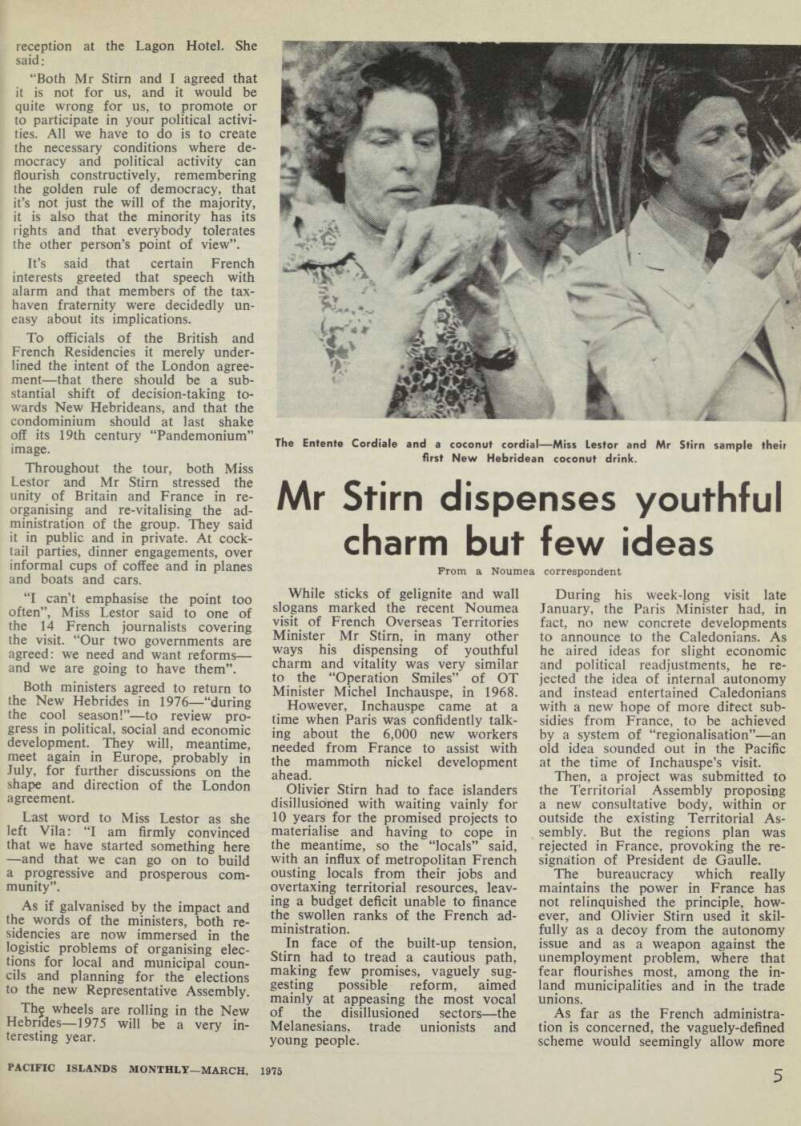
The Entente Cordiale and a coconut cordial—Miss Lestor and Mr Stirn sample their first New Hebridean coconut drink.
direct intervention of the public ser vice and thus further reduce the in fluence of the elected Territorial As sembly. For the Caledonians, the “region” idea was presented as a scheme to permit more direct French subsidies for development, while also allowing a greater voice to trade unions and others who would be “consulted” over local affairs. The minister did not recommend dividing the territory into two regions, after strong opposition was raised against this suggestion.
As expounded in the pro-adminis tration press, the region idea was coupled with widespread criticism of Territorial Assembly members for their ineffectiveness and for voting recent tax increases—as if the Assem bly could be blamed for the island’s economic failure. Thus the region plan really seems another move to divide Caledonian power groups and distract their attention while consoli dating rule by Paris bureaucrats.
On the autonomy issue, as Terri torial Assembly President Yann Celene Uregei pointed out, the assembly has been voting for reforms for years, all to no avail. After all the demands made on Paris, the
minister finally suggested that wider powers could be given to the five man Conseil de Gouvernement (Governor’s Advisory Council). But, there was no suggestion that elected Caledonians could control the executive since the governor, answer ing to Paris, remains the island’s executive head.
Apart from the “region” reform and the window-dressing of the Governor’s Council, the French Minister stated that the municipali ties (communes) in New Caledonia would receive equal status with their metropolitan counterparts.
In this way they would have greater control over municipal bud gets and hence be less dependent upon the Territorial Assembly, whose influence is thus further reduced.
In recent years, the municipalities have been placed under the control of a strong administrative force, with the territory divided into four subdivisions, each headed by a French public servant who supervises muni cipal councils and answers through the governor to Paris. Over the past year, New Hebrideans have been brought to New Caledonia to study this French system of local govem-
Big Brother Role
ment, since in the New Hebrides also the French have been keen to deve lop municipal government.
One essential message the Over seas Territories Minister brought to the Caledonians was to remind them that they represent France in the Pacific. He thus urged them to re member their “big brother” role to the Wallisians and New Hebrideans, while nobly reflecting French culture.
He further insisted that the justi fication for the presence and action taken by France was to excel in the art of co-existence of different races and, above all, France must demon strate this ability in New Caledonia.
If some extremist elements were not satisfied with the result, then at least Mr Stirn was less threatening than Governor Eriau, and urged that such outsiders simply be ignored.
The main problem faced by the Caledonians, as defined to Minister Stirn by Territorial Assembly Presi dent Yann Celene, was the Paris failure to achieve the planned nickel expansion. It is this failure which has led to loss of confidence, lack of finance and increasing unemployment caused by a cutback in the con struction industry.
Unfortunately, the minister could only promise that the islanders should expect some nickel news in the next few months, a promise they have heard ever since Minister Bil lotte’s assertions in 1966.
The minister did say, however, that France could now be more open to foreign investment in the territory for fear of missing out in the nickel race, since Caledonian nickel ore no longer represents 75 per cent of the known-world reserves, but only 30 per cent.
During February and March, the minister said, he would meet with the presidents of US Amax and Canadian INCO, companies which are interested in the north and south of the island respectively. As a con dition to all new nickel factory de velopment, the minister insisted that the Territorial Assembly must ap prove a change in the local tax sys tem. Then the first project to go ahead would be the new partnership between the SLN and the state oil company Aquitaine (SNPA).
The new fiscal system would avoid taxation simply on the basis of the volume of a company’s exports irres pective of profit or loss, and would allow tax only on the basis of profits declared. For a preliminary period, the French would guarantee the terri-
torial budget to the level of revenue collected in 1974.
Of course the nickel companies would maintain their headquarters in Paris, under the control of the cen tral government, so the territory could not question the amount of tax paid.
Meanwhile, the minister insisted that this taxation of company profits would not be extended, as feared, to the taxation of private individuals, who would thus continue to pay their contribution to the Treasury through the numerous indirect (sales etc) taxes. As for meeting the 1975 bud getary deficit of about SAIO million, the minister indicated that France would solve the difference but in sisted that the territory must also seek to impose new taxes on the locals.
Amid the economic downturn, un employment problems were placed before the minister, with unionists particularly resentful of jobs going to metropolitan French rather than Caledonians. In addition, fears were expressed over a possible influx of more overseas workers following re cent political changes in the status of New Hebrideans. Already jobs in Noumea are a valuable source of support for French influence in the New Hebrides and Wallis.
Meanwhile, the French Minister was soon expected back in the Paci fic. After Prime Minister Whitlam’s December visit to Paris, Olivier Stirn planned to visit Canberra in March —to sign a French uranium deal with Australia?
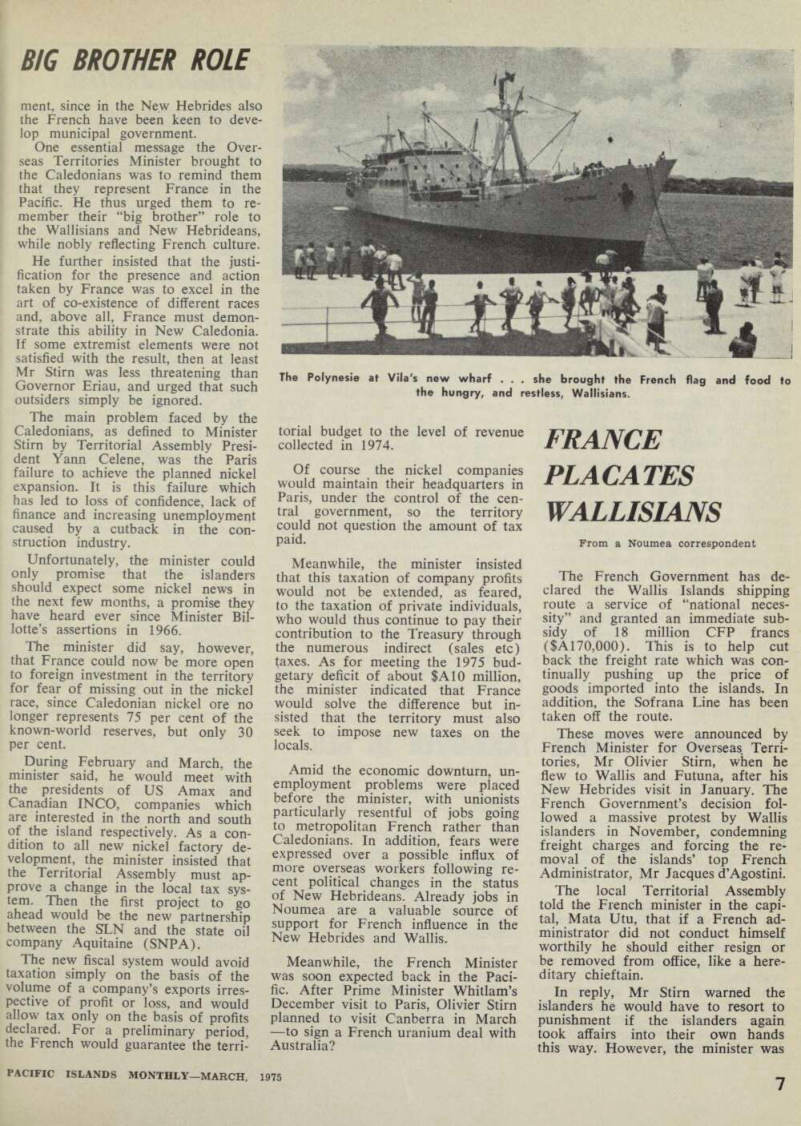
The Polynesie at Vila's new wharf . . . she brought the French flag and food to the hungry, and restless, Wallisians.