Pacific Islands Monthly
pp. 6-7 · Read in the full issue
Paris And London Prime A Fuse
In The New Hebrides
From a Vila correspondent
Joan Lestor and Olivier Stirn left a charge in the New Hebrides . . . a living, lingering spark of excite ment which, except for the most blase and the unimaginative, still illuminates and invigorates the cor ridors of the British and French Residencies.
Tinder for the spark was provided by the personalities of the two minis ters —Miss Lestor, from the Foreign and Commonwealth Office in Lon don, speaking her mind with obvious sincerity, and Mr Stirn, from the Department of Overseas Territories in Paris, listening sympathetically and pledging his support for political, social and economic development in the condominium.
They made impact. Their four-day joint visit to the islands—talking, listening, discussing, observing—be came much more than a top-level public relations exercise, as many of the scoffers and cynics thought.
And in an interview at the end of her 96 hours in the New Hebrides, the British Minister Miss Lestor said: “This is an area of enormous po tential that has been neglected over the years quite shamefully. There are lots of people here, expatriates, New Hebrideans, all sorts of people, who are very anxious to get a great deal more development going. There has been a lot of wastage and we really must get to work in terms of long
term planning”.
Perhaps the most interesting reac tion to the visit of the two ministers came from the group’s political parties. Both sides —the National Party on one hand, and the menage a-trois of UCNH, MANH and Na griamel on the other —had been ominously quiet immediately before the ministers’ arrival.
After their talks and interviews with Miss Lestor and Mr Stirn, how ever, they agreed (for the first time ever!) that there had been value and relevance in the ministerial trip.
Even the National Party-organised
demonstration outside the condo minium headquarters in Vila, where the ministers met a large cross-sec tion of political, financial and com mercial leaders, was neatly side stepped and deflated by the Briton and the Frenchman.
Talking about the small group of banner-waving demonstrators . . .
“Independence In 1977”, “You
Are Not Our Ministers” And
“Freedom Yes, Condo
MINIUM NO” . . . Miss Lestor de clared: “I was pleased to see that some of you, quite rightly, used your democratic right to bring to our attention some of the points you want tackled. I would have thought the New Hebridean people pretty passive if nothing of this sort had been organised”.
Mr Stirn said; “Nothing better could have happened for the first visit of the British and French minis
ters than to see and hear this sort of thing. It is a symbol of demo cracy and liberalism which Britain and France want to see here in the New Hebrides”.
Inside the condominium HQ the National Party maintained its attack.
President Father Walter Lini said the reforms agreed in London seemed designed to maintain French and British domination of the group.
Miss Lestor replied: “That is not true. Mr Stirn and I are here to dis cuss the reforms with you and many other people and discover how effec tive and meaningful changes can be made. There is no question of a sys tem being imposed on the people of the New Hebrides.
“We want to initiate reforms which will be acceptable to all the people living in these islands”.
This point was emphasised by Miss Lestor in what was perhaps her most telling speech of the tour, during a
reception at the Lagon Hotel. She said: “Both Mr Stirn and I agreed that it is not for us, and it would be quite wrong for us, to promote or to participate in your political activi ties. All we have to do is to create the necessary conditions where de mocracy and political activity can flourish constructively, remembering the golden rule of democracy, that it’s not just the will of the majority, it is also that the minority has its rights and that everybody tolerates the other person’s point of view”.
It’s said that certain French interests greeted that speech with alarm and that members of the tax haven fraternity were decidedly un easy about its implications.
To officials of the British and French Residencies it merely under lined the intent of the London agree ment—that there should be a sub stantial shift of decision-taking to wards New Hebrideans, and that the condominium should at last shake off its 19th century “Pandemonium” image.
Throughout the tour, both Miss Lestor and Mr Stim stressed the unity of Britain and France in re organising and re-vitalising the ad ministration of the group. They said it in public and in private. At cock tail parties, dinner engagements, over informal cups of coffee and in planes and boats and cars.
“I can’t emphasise the point too often”, Miss Lestor said to one of the 14 French journalists covering the visit. “Our two governments are agreed: we need and want reforms— and we are going to have them”.
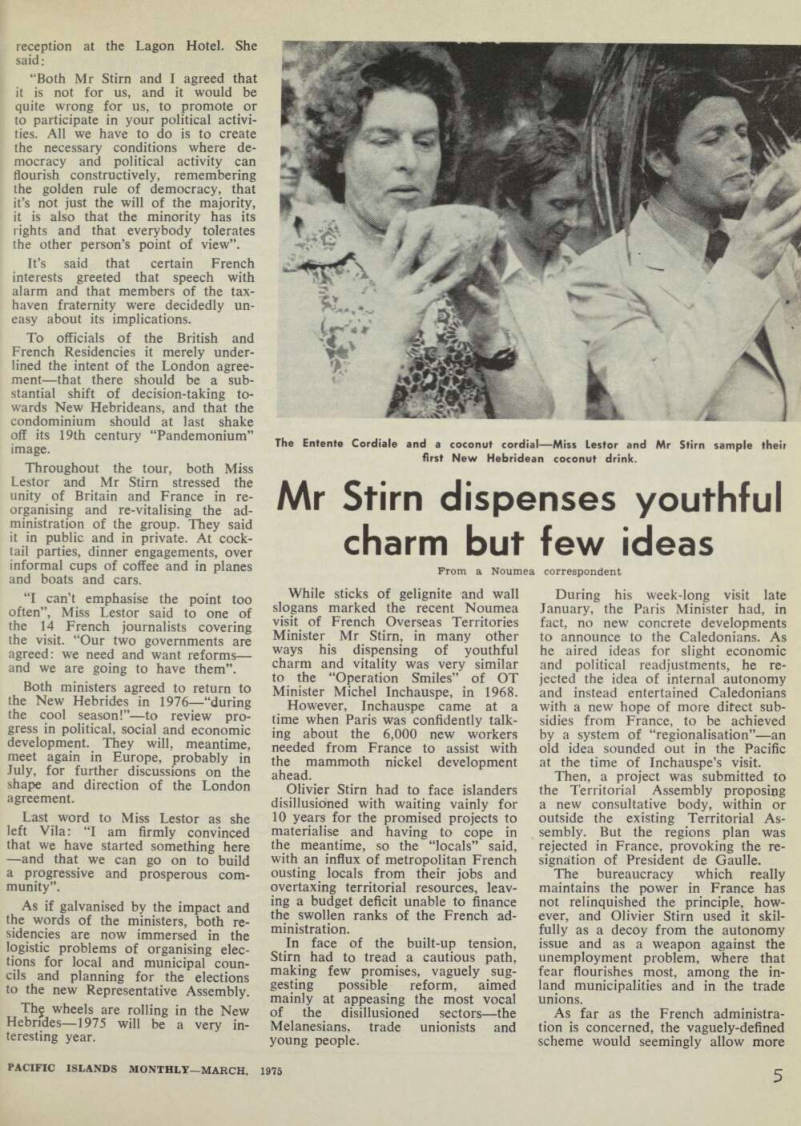
Both ministers agreed to return to the New Hebrides in 1976—“ during the cool season!”—to review pro gress in political, social and economic development. They will, meantime, meet again in Europe, probably in July, for further discussions on the shape and direction of the London agreement.
Last word to Miss Lestor as she left Vila: “I am firmly convinced that we have started something here —and that we can go on to build a progressive and prosperous com munity”.
As if galvanised by the impact and the words of the ministers, both re sidencies are now immersed in the logistic problems of organising elec tions for local and municipal coun cils and planning for the elections to the new Representative Assembly.
Thj wheels are rolling in the New Hebrides—l97s will be a very in teresting year.