the Gilbertese horizon
pp. 31-33 · Read in the full issue
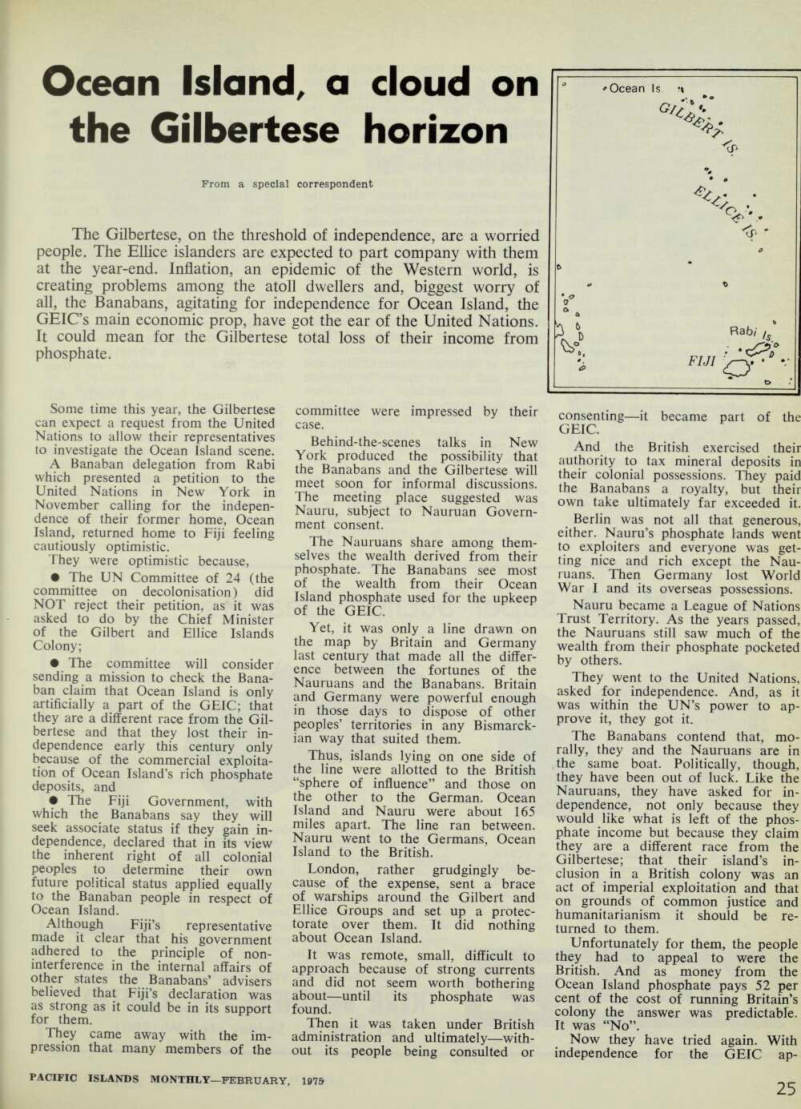

Ocean Island, a cloud on the Gilbertese horizon
From a special correspondent
The Gilbertese, on the threshold of independence, are a worried people. The Ellice islanders are expected to part company with them at the year-end. Inflation, an epidemic of the Western world, is creating problems among the atoll dwellers and, biggest worry of all, the Banabans, agitating for independence for Ocean Island, the GEICs main economic prop, have got the ear of the United Nations.
It could mean for the Gilbertese total loss of their income from phosphate.
Some time this year, the Gilbertese can expect a request from the United Nations to allow their representatives to investigate the Ocean Island scene.
A Banaban delegation from Rabi which presented a petition to the United Nations in New York in November calling for the indepen dence of their former home, Ocean Island, returned home to Fiji feeling cautiously optimistic.
They were optimistic because, • The UN Committee of 24 (the committee on decolonisation) did NOT reject their petition, as it was asked to do by the Chief Minister of the Gilbert and Ellice Islands Colony; • The committee will consider sending a mission to check the Bana ban claim that Ocean Island is only artificially a part of the GEIC; that they are a different race from the Gil bertese and that they lost their in dependence early this century only because of the commercial exploita tion of Ocean Island’s rich phosphate deposits, and • The Fiji Government, with which the Banabans say they will seek associate status if they gain in dependence, declared that in its view the inherent right of all colonial peoples to determine their own future political status applied equally to the Banaban people in respect of Ocean Island.
Although Fiji’s representative made it clear that his government adhered to the principle of non interference in the internal affairs of other states the Banabans’ advisers believed that Fiji’s declaration was as strong as it could be in its support for them.
They came away with the im pression that many members of the
committee were impressed by their case.
Behind-the-scenes talks in New York produced the possibility that the Banabans and the Gilbertese will meet soon for informal discussions.
The meeting place suggested was Nauru, subject to Nauruan Govern ment consent.
The Nauruans share among them selves the wealth derived from their phosphate. The Banabans see most of the wealth from their Ocean Island phosphate used for the upkeep of the GEIC.
Yet, it was only a line drawn on the map by Britain and Germany last century that made all the differ ence between the fortunes of the Nauruans and the Banabans. Britain and Germany were powerful enough in those days to dispose of other peoples’ territories in any Bismarck ian way that suited them.
Thus, islands lying on one side of the line were allotted to the British “sphere of influence” and those on the other to the German. Ocean Island and Nauru were about 165 miles apart. The line ran between.
Nauru went to the Germans, Ocean Island to the British.
London, rather grudgingly be cause of the expense, sent a brace of warships around the Gilbert and Ellice Groups and set up a protec torate over them. It did nothing about Ocean Island.
It was remote, small, difficult to approach because of strong currents and did not seem worth bothering about—until its phosphate was found.
Then it was taken under British administration and ultimately—with out its people being consulted or
consenting—it became part of the
Geic
And the British exercised their authority to tax mineral deposits in their colonial possessions. They paid the Banabans a royalty, but their own take ultimately far exceeded it.
Berlin was not all that generous, either. Nauru’s phosphate lands went to exploiters and everyone was get ting nice and rich except the Nau ruans. Then Germany lost World War I and its overseas possessions.
Nauru became a League of Nations Trust Territory. As the years passed, the Nauruans still saw much of the wealth from their phosphate pocketed by others.
They went to the United Nations, asked for independence. And, as it was within the UN’s power to ap prove it, they got it.
The Banabans contend that, mo rally, they and the Nauruans are in the same boat. Politically, though, they have been out of luck. Like the Nauruans, they have asked for in dependence, not only because they would like what is left of the phos phate income but because they claim they are a different race from the Gilbertese; that their island’s in clusion in a British colony was an act of imperial exploitation and that on grounds of common justice and humanitarianism it should be re turned to them.
Unfortunately for them, the people they had to appeal to were the British. And as money from the Ocean Island phosphate pays 52 per cent of the cost of running Britain’s colony the answer was predictable.
It was “No”.
Now they have tried again. With independence for the GEIC ap-
Ak! Iikjca Cv Cyriicp
/J/V Uhcaj T Laujjc
proaching the Ellice Islanders have declared their unwillingness to con tinue in association with the Gil bertese because they fear domination.
T hey want to break away.
The Banabans con meed a Ellice move is justified, believe that they have an even stronger case for taking Ocean Island out of the C °Thev were onnosed at the United Nations by the GEIC Government, u/hirh rpfprrpH to Orean as “one of our islands” and attempted to show that the Banabans were really Gil bertese and that the colony therefore had a right to the island.
The Fiji Government said that if Britain agreed to separate status for Ocean Island, Fiji would be willing to consider favourably a proposal that the Banabans had made, that Ocean Island be associated with Fiji.
Quite apart from ethnic and econ ornic matters, the Banabans say it is contrary to Pacific custom for the people of one island to take some thing that traditionally belongs to the people of another. They have talked to ordinary Gilbertese who tiave given the impression of being embarrassed by the situation.
Government men, in whom tradition might run just as strongly, find an uneasy excuse by pleading that as officials they have to observe the official code, not the tribal. So now ft looks as if the Banabans and the Gilbertese will meet on neutral ground to talk things over.
And the neutra i ground that has been nom i nated ls Nauru, where the obv j ous s i gns G f prosperity will be ute bm eloquent testimony to the difference that a line drawn almost °made to the lives of two ago nas . made 10 me lives or IWO neighbouring races, The Banabans have often said that they do not want the GEIC to be the l° ser through possible Banaban independence for Ocean Island. They have equally often reiterated that the colony is Britain s responsibility, not theirs; and that it should be possible for Britain—perhaps with cooperation from Australia and New Zealand—to make up any deficit m the colony s budget that would occur lf all the phosphate revenue went to the Banabans.
Britain, they reckon, was an indirect beneficiary from Ocean Island phosphate for a great many years because it helped successive British Governments to maintain their
cheap-food policies. And Australia and New Zealand were more direct beneficiaries, they argue, because farmers in both countries bought the phosphate at prices far below those obtaining in the world market.
Banaban logic is that it would not be amiss, then, for the three to take up the colony’s economic slack. In the United Nations they accused Britain of hiding behind the Gil bertese.
But that, as they see it, is an economic matter that should not affect the fundamental issue of in dependence. Privately, they have said they believed that after Britain pulls out it would be to the advantage of the Gilbertese to have an independent Banaba as neighbour, with the Banabans financing whatever develop ment may be possible on their island.
“We could be their friends. And they are going to need friends and somebody to help them when the British go”, they say.
Bertram Jones, now a senior executive of Matt Wilson Limited, and formerly secretary to the Bana bans, went with the Rabi delegation to the United Nations for the hear ing of their petition.
His opinion was that there was a
lot of sympathy in the committee for the Banaban case.
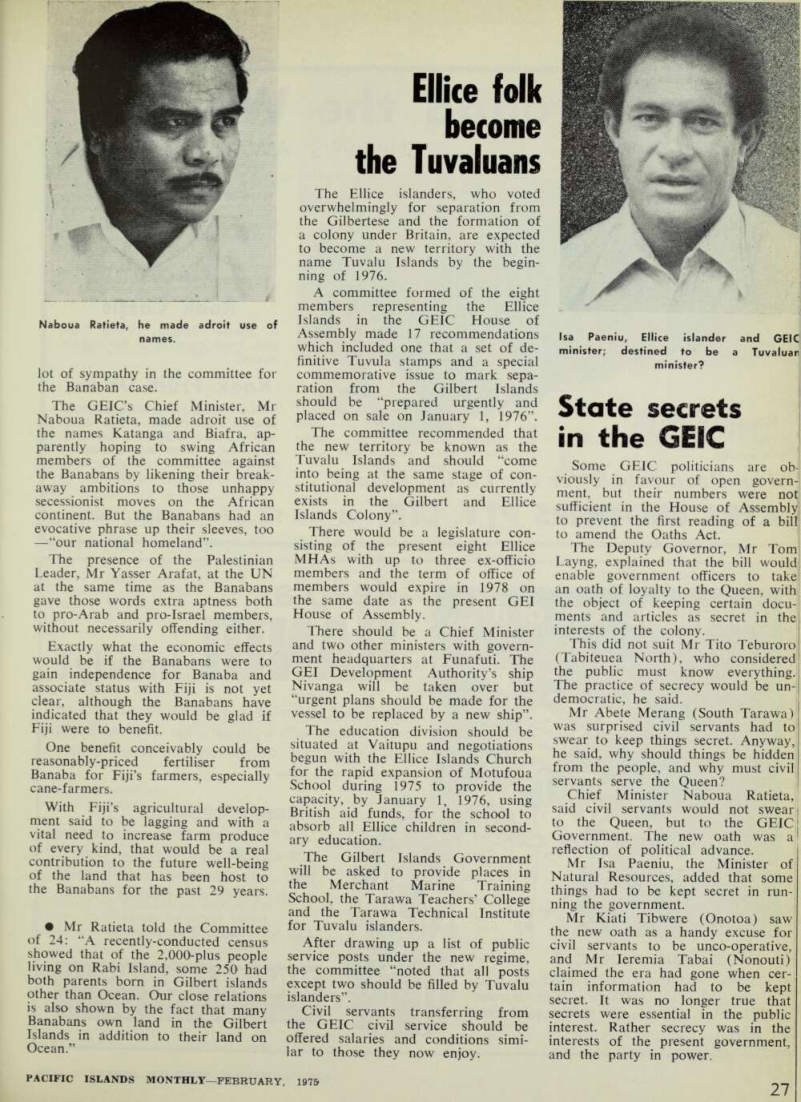
The GEIC’s Chief Minister, Mr Naboua Ratieta, made adroit use of the names Katanga and Biafra, ap parently hoping to swing African members of the committee against the Banabans by likening their break away ambitions to those unhappy secessionist moves on the African continent. But the Banabans had an evocative phrase up their sleeves, too —“our national homeland”.
The presence of the Palestinian Leader, Mr Yasser Arafat, at the UN at the same time as the Banabans gave those words extra aptness both to pro-Arab and pro-Israel members, without necessarily offending either.
Exactly what the economic effects would be if the Banabans were to gain independence for Banaba and associate status with Fiji is not yet clear, although the Banabans have indicated that they would be glad if Fiji were to benefit.
One benefit conceivably could be reasonably-priced fertiliser from Banaba for Fiji’s farmers, especially cane-farmers.
With Fiji’s agricultural develop ment said to be lagging and with a vital need to increase farm produce of every kind, that would be a real contribution to the future well-being of the land that has been host to the Banabans for the past 29 years. • Mr Ratieta told the Committee of 24: “A recently-conducted census showed that of the 2,000-plus people living on Rabi Island, some 250 had both parents bom in Gilbert islands other than Ocean. Our close relations is also shown by the fact that many Banabans own land in the Gilbert Islands in addition to their land on Ocean.”
Naboua Ratieta, he made adroit use of names.