Fiji —an independent state
p. 25 · Read in the full issue
of alcoholic euphoria
From Vijendra Kumar
in Lautoka
LAST year, Fiji’s drinkers con sumed a record 3,300,000 gallons of beer. By any standards, this is quite a lot of beer for a country with a population of just over 500,000. The Minister for Finance, Mr Charles Stinson, cal culated that 5.1 per cent of the national wage was squandered on beer.
Several political and commun ity leaders have lately expressed concern at the steep climb in the national drinking rate. They are more concerned at its devastating social impact on a community which is basically accustomed to a simple, easy-going life. In the absence of expert opinions by social psychologists to identify causes of an upsurge in the drink ing habit, a simplistic and perhaps correct rationale would be that people here just love their booze.
There is ample evidence to sup port this.
However, despite the increasing fondness for the bottle, Fiji has not yet produced the sort of alcoholics one hears about in Western countries. The big drink ing day is usually pay-day and not too few workers stagger home in the wee hours of the next morning minus their entire pay packets. A lot of drinking occurs at weekends in social clubs, night clubs and seedy guesthouses.
One alarming side effect of this excessive drinking is a sharp in crease in the crime rate. The police are finding it difficult to cope with offences associated with drinking. It is not unusual for drunks to turn violent and assault constables. There was recently an interesting duel between a con stable and belligerent drunk, the policeman using a wheel spanner and the drunk hurling a gin bottle and then chasing him with a cane knife.
Magistrates have become tired of hearing a felon plead drunken ness as an excuse for crimes such as robbery with violence, house
and shop breaking and more seri ous offences such as rape and violent assault.
All this, of course, means a windfall for Fiji’s two breweries —the Carlton in Suva and the South Seas Brewing Company at Lautoka. The latter is a new establishment and is involved in a tough battle to capture a per centage of a beer market almost exclusively held by Carlton. Both companies are running pro motional campaigns which further whet the already insatiable ap petite of the beer drinker.
Selling beer is big business— particularly in the illicit trade field. A senior police officer re cently told me that in Lautoka alone there were about 40 boot leggers. Most of them, he added, were women, mainly widows and divorcees who sometimes threw in a little prostitution to attract clientele. These places are re miniscent of the “speakeasies” of prohibition days in America.
Apart from these matronly sup pliers, many grocery merchants and petrol service stations sell beer and liquor illegally and quite openly. One Lautoka trader told me that he was making so much money out of it that he did not mind paying $lOO fine if police raided his shop.
“What I’d really mind is to lose a lot of my stock if they pounce on me too suddenly”, he added.
A shop wanting to sell liquor and beer must apply for a licence.
This often can be a costly and protracted process. Often, the Central Liquor Board rejects ap plications and does not give rea sons for its decision. So, many merchants, both in the country and the town, take the easy way out by selling illegally.
Recent legislation permitting the establishment of country taverns generated a lot of debate in the House of Representatives.
The government argued that this would check the urban drift and
lead to civilised drinking. It would cut down the concentration of drunks in urban centres. But these taverns could become a nuisance in rural areas as beer drinkers would merely shift from one pub to another.
The main streets of virtually all towns are unsafe at nights—parti cularly on pay-day. Drunks stag ger around, shouting obscenities and challenging people to fight.
They fight among themselves. A group of boisterous people sitting beside a street, drinking, singing, shouting and smashing glasses and bottles is a common sight, even though drinking in a public place like a street or park is illegal.
The government has rejected suggestions to cut down the open ing hours of public bars. It has also rejected a certain degree of prohibition because it would only lead to increased illicit traffic in liquor sales.
One parliamentarian suggested that the government should close both the breweries and ban all imports of liquor and beer. None of these is a practical solution.
It seems that the people of Fiji will just have to educate them selves as far as drinking habits go.
Others hope that the post independence state of euphoria will gradually pass and people will moderate their drinking.
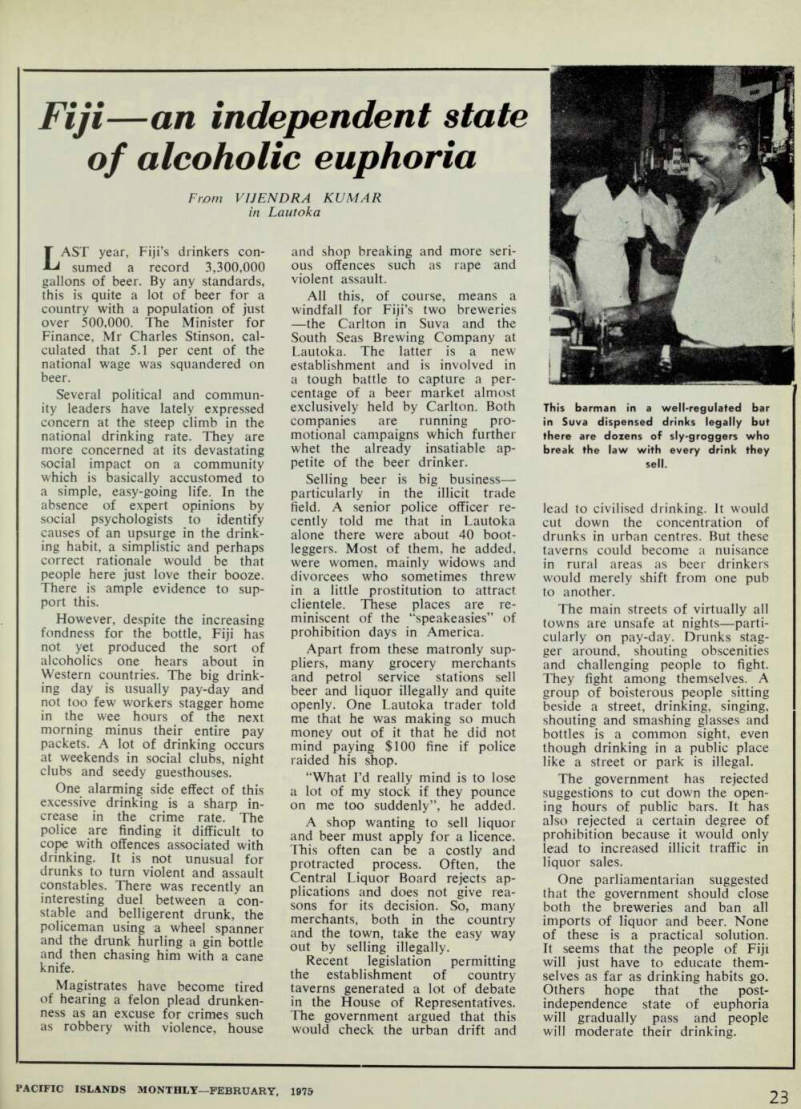
This barman in a well-regulated bar in Suva dispensed drinks legally but there are dozens of sly-groggers who break the law with every drink they sell.