say the Shortland folk
pp. 9-10 · Read in the full issue
Blood is much thicker than copper say the Shortland folk
By Denis Fisk
Bougainville, Papua New Guinea’s copper-rich and restless island, was expected to be on the agenda when Solomon Islands Chief Minister Mr Solomon Mamaloni met his PNG opposite number, Mr Michael So mare, in Port Moresby at the end of January.
Mr Mamaloni was scheduled to spend three days in PNG beginning on January 26 in response to an invitation from Mr Somare shortly after the latter’s election last August.
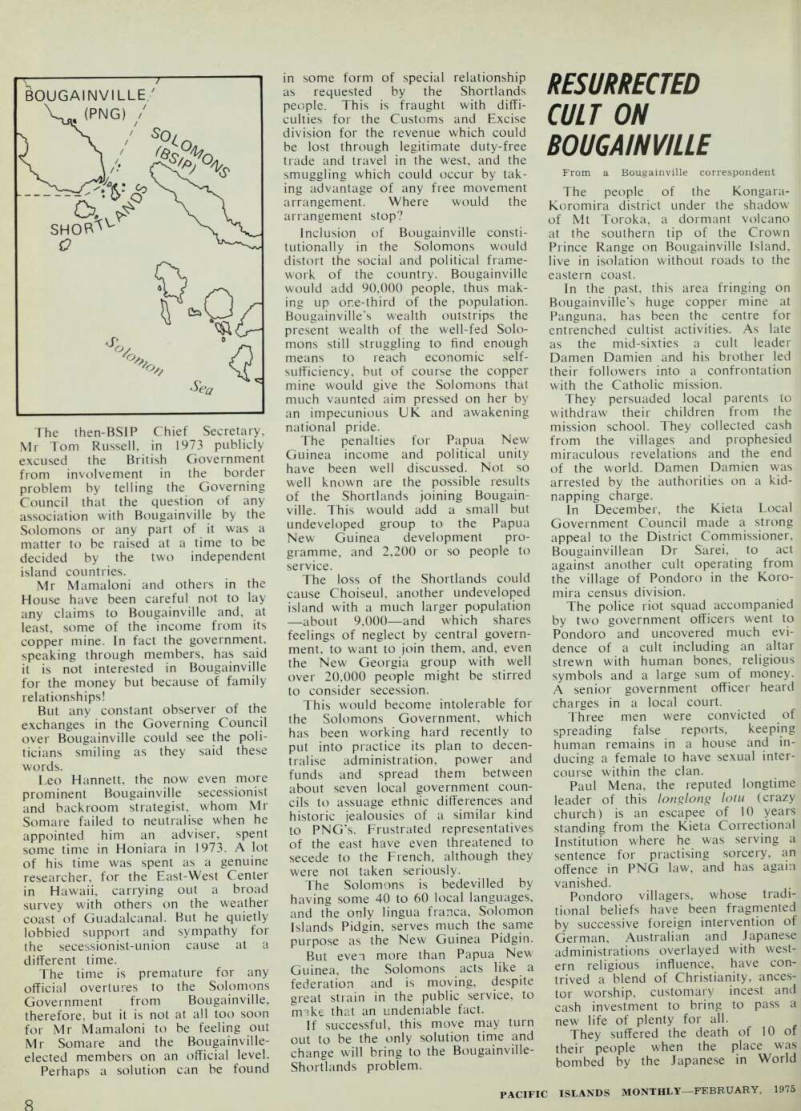
Bougainville is geographically in the Solomons and its people have close ties with the Solomons, especially with the people of the Shortland Islands.
The open desire of the Shortland people to be united in some way with their Bougainville cousins, and the Bougainvilleans like feelings, is po tentially the most explosive problem faced by the two Melanesian Chief Ministers. But, barring any sudden escalation of the so far simmering situation, they can be expected to be working mainly to understand each other’s position on the border. Both need to begin developing a rapport which could be of great benefit to the biggest and third biggest political entities in the South Pacific.
Understanding over Bougainville is needed more urgently now with PNG becoming independent this year and the Solomon Islands poss ibly becoming self-governing only months later.
Public statements by local leaders in BSIP in the past two years have been. bland in reply to occasional, but very strongly-voiced dissatisfac tion by Western district Solomon Islanders with their lot and their feelings of brotherhood with the Bougainvilleans.
In November, the latest move was made by the Shortland islanders, ad joining south Bougainville, as close as 10 miles away by canoe. Prepara tions were made for 60-year-old Nila paramount chief John Bitiae to visit a prominent family on Bougainville and offer to marry one of the family’s daughters, to demonstrate further the close relationship between the islands.
Chief Bitiae’s purpose also was to discuss these traditional ties and how to discover how many Shortland islanders want Bougainville to be come part of the Solomons or the Shortlands to become part of Bou gainville.
Shortlands people are well aware of the progress Bougainville has made in opinion and constitutionally towards governing itself as a region of Papua New Guinea and of the possibility of future independence.
The Shortland people, with many from Choiseul and New Georgia Islands, also in the Western district, share with South Bougainville people the unique characteristic in Melanesia of a blue-black skin which makes a mockery of the international border between them.
And the Shortlands and Bougain ville share a common grievance of past neglect at the easternmost and westernmost parts of their respective colonial groupings, due to distance from the administrative centres of Port Moresby and Honiara.
Bougainville’s mine secured it attention, belatedly if willingly, from the Johnson administration and then the Somare government. Mr Mama loni has promised a more even spread of funds for development for the small and remote Shortlands while urging the people to be patient about the border. He was “sure that a satis factory agreement over the border could be reached” between the two governments.
Mr Mamaloni was speaking in October to the Western Council president, a personable, intelligent natural leader, Mr Roy Kelosi, who had emphasised to the new Chief Minister that he had brothers, uncles and cousins living on Bougainville and he had to get a permit every time he wanted to visit them.
He pointed out, too, as had elected members of the national legislature at other times, that the Western district’s headquarters, Gizo, was too far from the Shortlands as a medical centre and a market, while the natural, booming marketplace for the development-hungry Shortland islanders was Bougainville. (Over)
The then-BSIP Chief Secretary, Mr Tom Russell, in 1973 publicly excused the British Government from involvement in the border problem by telling the Governing Council that the question of any association with Bougainville by the Solomons or any part of it was a matter to be raised at a time to be decided by the two independent island countries.
Mr Mamaloni and others in the House have been careful not to lay any claims to Bougainville and, at least, some of the income from its copper mine. In fact the government, speaking through members, has said it is not interested in Bougainville for the money but because of family
relationships!
But any constant observer of the exchanges in the Governing Council over Bougainville could see the poli ticians smiling as they said these words.
Leo Hannett, the now even more prominent Bougainville secessionist and backroom strategist, whom Mr Somare failed to neutralise when he appointed him an adviser, spent some time in Honiara in 1973. A lot of his time was spent as a genuine researcher, for the East-West Center in Hawaii, carrying out a broad survey with others on the weather coast of Guadalcanal. But he quietly lobbied support and sympathy for the secessionist-union cause at a different time.
The time is premature for any official overtures to the Solomons Government from Bougainville, therefore, but it is not at all too soon for Mr Mamaloni to be feeling out Mr Somare and the Bougainville elected members on an official level.
Perhaps a solution can be found
in some form of special relationship as requested by the Shortlands people. This is fraught with diffi culties for the Customs and Excise division for the revenue which could be lost through legitimate duty-free trade and travel in the west, and the smuggling which could occur by tak ing advantage of any free movement arrangement. Where would the arrangement stop?
Inclusion of Bougainville consti tutionally in the Solomons would distort the social and political frame work of the country. Bougainville would add 90,000 people, thus mak ing up one-third of the population.
Bougainville’s wealth outstrips the present wealth of the well-fed Solo mons still struggling to find enough means to reach economic self sufficiency, but of course the copper mine would give the Solomons that much vaunted aim pressed on her by an impecunious UK and awakening national pride.
The penalties for Papua New Guinea income and political unity have been well discussed. Not so well known are the possible results of the Shortlands joining Bougain ville. This would add a small but undeveloped group to the Papua New Guinea development pro gramme, and 2,200 or so people to service.
The loss of the Shortlands could cause Choiseul, another undeveloped island with a much larger population —about 9,000 —and which shares feelings of neglect by central govern ment, to want to join them, and, even the New Georgia group with well over 20,000 people might be stirred to consider secession.
This would become intolerable for the Solomons Government, which has been working hard recently to put into practice its plan to decen tralise administration, power and funds and spread them between about seven local government coun cils to assuage ethnic differences and historic jealousies of a similar kind to PNG’s. Frustrated representatives of the east have even threatened to secede to the French, although they were not taken seriously.
The Solomons is bedevilled by having some 40 to 60 local languages, and the only lingua franca, Solomon Islands Pidgin, serves much the same purpose as the New Guinea Pidgin.
But even more than Papua New Guinea, the Solomons acts like a federation and is moving, despite great strain in the public service, to rmke that an undeniable fact.
If successful, this move may turn out to be the only solution time and change will bring to the Bougainville-
Shortlands problem.