Meanwhile, the New Hebrides show goes on
pp. 7-9 · Read in the full issue
From a Vila correspondent
Abortion, family planning, and a request for minor political advance, were the major topics debated at a recent meeting of the New Hebrides
Advisory Council. Anglican Bishop
Rawcliffe asked the council to sup port him in saying that the New Hebrides did not want abortion on demand.
At present, legally, three different laws apply to abortion—the French and British laws are different, and the New Hebrides Native Criminals Code makes it a crime for New Heb rideans to perform or have an abor tion. As there would soon be one law for all in the New Hebrides the question of abortion on demand would arise.
Bishop Rawcliffe asked that the New Hebrides Christian Council, which represented all churches of the group, should be consulted before any legislation about abortion was introduced.
He also referred to allegations of abortion on demand at Paton Me morial Hospital, saying that, if they were substantiated, a statement of official policy should be issued.
Opinions should be sought from the Advisory Council and New Hebri
deans generally, so that something might not be started which was against the wishes and moral prin ciples of a large majority of inhabi tants.
Dr Kalsakau and Father Verlingue, echoed Bishop Rawcliffe’s concern.
Mr lolu Abbil added that the sexual behaviour of young people, after living in an urban area like Vila, was worrying. Open ideas about sex were picked up. When the young people returned to their villages they took those ideas with them, and helped destroy a way of life people had been brought up to respect.
The British Resident Com missioner, Mr R. W. H. du Boulay, agreed that allegations of abortion on demand at the Paton Memorial Hospital were very serious. Any in formation should be passed to the authorities for a thorough investi gation.
Dr Rogert Greenhough, Chief Me dical Officer of the British National Service, said the termination of preg nancy was not a component in fam ily planning, it was never intended to be, and there was no link between it and the family health programme.
Decisions to end pregnancies were not taken lightly. They were con
sidered by two doctors on the grounds of health of the mother and the baby, and had to conform to the law.
He added that advice on family planning and family health was broadcast regularly, and it was in tended simply to be advice. It was aimed at married people and there was no intention of trying to force people to limit the size of their families. The concern was for the health of the mother, the baby and other members of the family.
Turning to politics, the council dis cussed a draft joint local government regulation, which provides for muni cipal and rural communities to have councils. The composition of muni cipal councils will be multi-racial with a mayor at the head. Commun ity councils will have a chairman.
There will be a single ballot to elect councillors, by a majority vote.
Bishop Rawcliffe, while saying he was in favour of the proposals, wanted to know what the difference was between existing local councils and the new community councils.
What would happen if a local coun cil wanted to continue as a local council? And what would be the
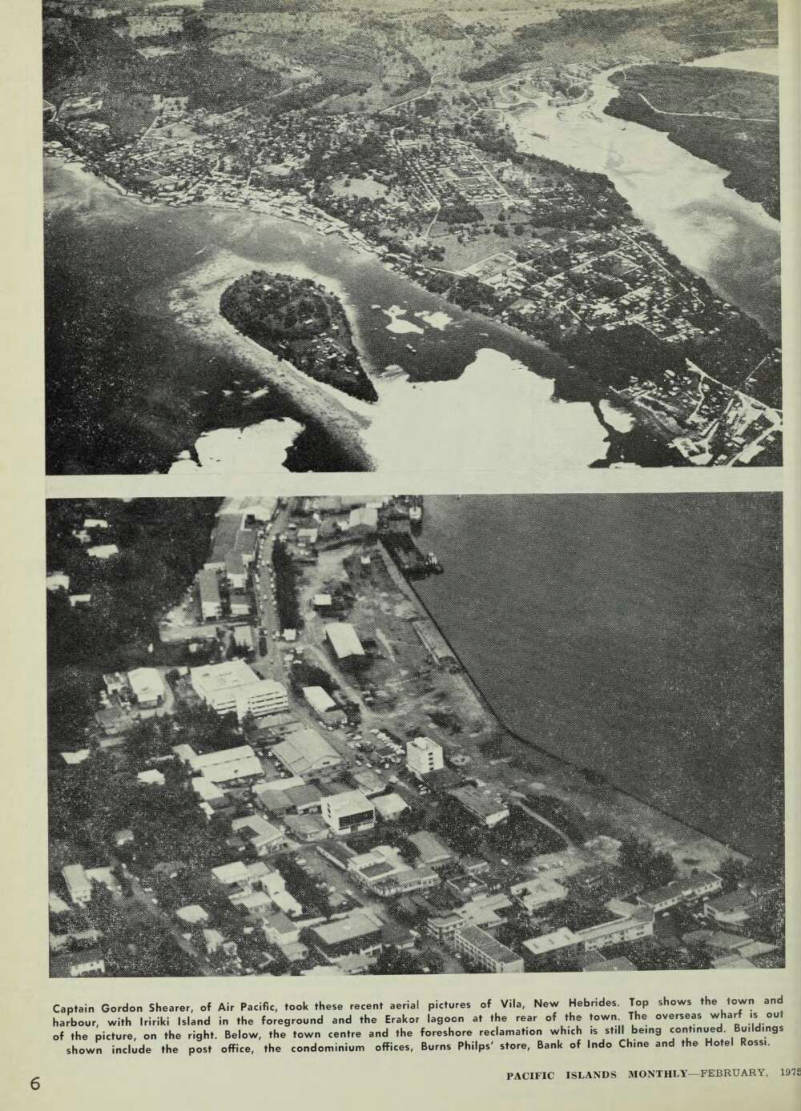
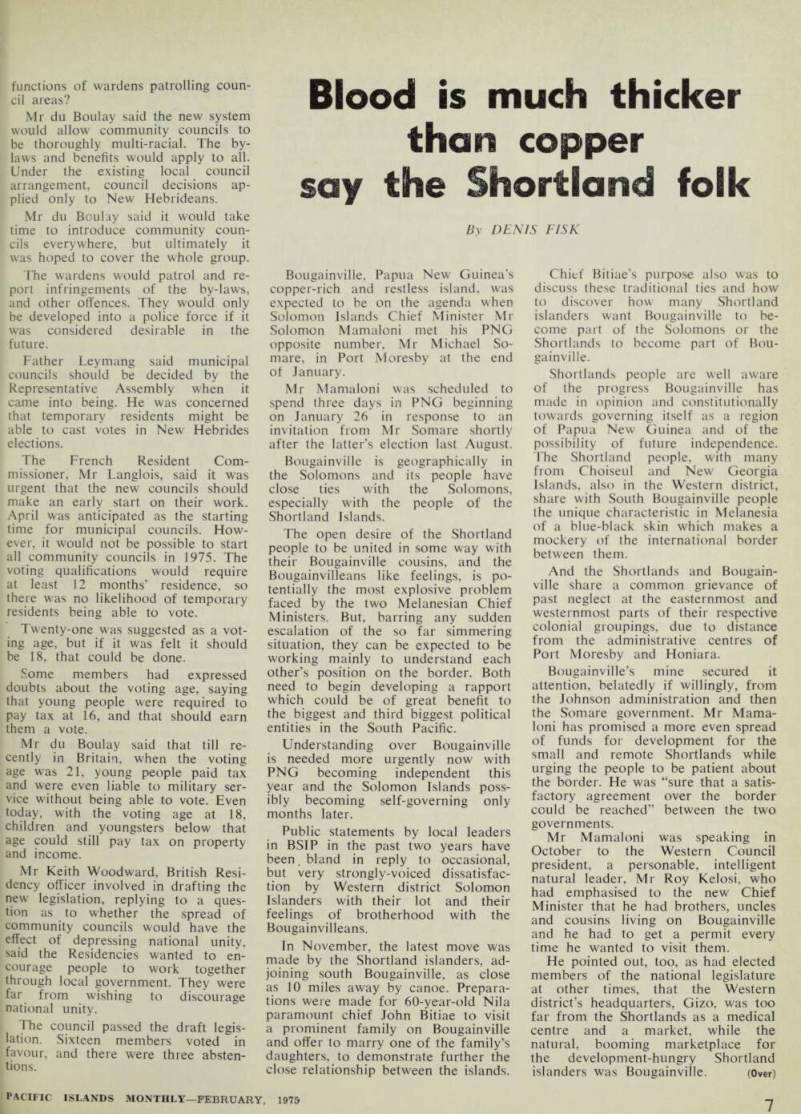
Captain Gordon Shearer, of Air Pacific, took these recent aerial pictures of Vila, New Hebrides. Top shows the town an harbour, with Iririki Island in the foreground and the Erakor lagoon at the rear of the town. The overseas wharf is out of the picture, on the right. Below, the town centre and the foreshore reclamation which is still being continued. Buildings shown include the post office, the condominium offices, Burns Philps' store, Bank of Indo Chine and the Hotel Rossi.
functions of wardens patrolling coun cil areas?
Mr du Boulay said the new system would allow community councils to be thoroughly multi-racial. The by laws and benefits would apply to all.
Under the existing local council arrangement, council decisions ap plied only to New Hebrideans.
Mr du Boulay said it would take time to introduce community coun cils everywhere, but ultimately it was hoped to cover the whole group.
The wardens would patrol and re port infringements of the by-laws, and other offences. They would only be developed into a police force if it was considered desirable in the future.
Father Leymang said municipal councils should be decided by the Representative Assembly when it came into being. He was concerned that temporary residents might be able to cast votes in New Hebrides elections.
The French Resident Com missioner, Mr Langlois, said it was urgent that the new councils should make an early start on their work.
April was anticipated as the starting time for municipal councils. How ever, it would not be possible to start all community councils in 1975. The voting qualifications would require at least 12 months’ residence, so there was no likelihood of temporary residents being able to vote.
Twenty-one was suggested as a vot ing age, but if it was felt it should be 18, that could be done.
Some members had expressed doubts about the voting age, saying that young people were required to pay tax at 16, and that should earn them a vote.
Mr du Boulay said that till re cently in Britain, when the voting age was 21, young people paid tax and were even liable to military ser vice without being able to vote. Even today, with the voting age at 18, children and youngsters below that age could still pay tax on property and income.
Mr Keith Woodward, British Resi dency officer involved in drafting the new legislation, replying to a ques tion as to whether the spread of community councils would have the effect of depressing national unity, said the Residencies wanted to en courage people to work together through local government. They were far from wishing to discourage national unity.
The council passed the draft legis lation. Sixteen members voted in favour, and there were three absten tions.