Islands Tackle Labour Problems
p. 79 · Read in the full issue
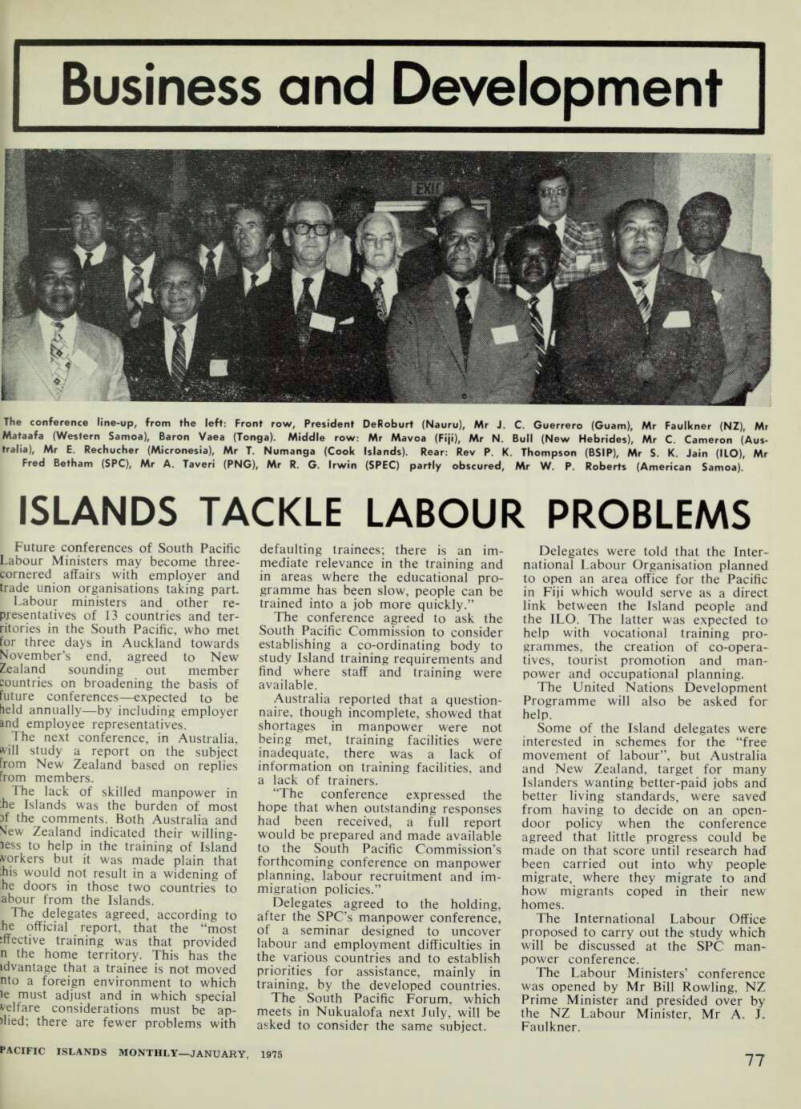
Future conferences of South Pacific Labour Ministers may become three cornered affairs with employer and trade union organisations taking part.
Labour ministers and other re presentatives of 13 countries and ter ritories in the South Pacific, who met for three days in Auckland towards November’s end, agreed to New Zealand sounding out member countries on broadening the basis of future conferences—expected to be held annually—by including employer and employee representatives.
The next conference, in Australia, will study a report on the subject from New Zealand based on replies from members.
The lack of skilled manpower in ;he Islands was the burden of most the comments. Both Australia and Mew Zealand indicated their willing less to help in the training of Island workers but it was made plain that his would not result in a widening of he doors in those two countries to abour from the Islands.
The delegates agreed, according to he official report, that the “most sffective training was that provided n the home territory. This has the idvantage that a trainee is not moved nto a foreign environment to which ie must adjust and in which special welfare considerations must be ap )lied; there are fewer problems with
defaulting trainees; there is an im mediate relevance in the training and in areas where the educational pro gramme has been slow, people can be trained into a job more quickly.”
The conference agreed to ask the South Pacific Commission to consider establishing a co-ordinating body to study Island training requirements and find where staff and training were available.
Australia reported that a question naire, though incomplete, showed that shortages in manpower were not being met, training facilities were inadequate, there was a lack of information on training facilities, and a lack of trainers.
“The conference expressed the hope that when outstanding responses had been received, a full report would be prepared and made available to the South Pacific Commission’s forthcoming conference on manpower planning, labour recruitment and im migration policies.”
Delegates agreed to the holding, after the SPC’s manpower conference, of a seminar designed to uncover labour and employment difficulties in the various countries and to establish priorities for assistance, mainly in training, by the developed countries.
The South Pacific Forum, which meets in Nukualofa next July, will be asked to consider the same subject.
Delegates were told that the Inter national Labour Organisation planned to open an area office for the Pacific in Fiji which would serve as a direct link between the Island people and the ILO. The latter was expected to help with vocational training pro grammes, the creation of co-opera tives, tourist promotion and man power and occupational planning.
The United Nations Development Programme will also be asked for help.
Some of the Island delegates were interested in schemes for the “free movement of labour”, but Australia and New Zealand, target for many Islanders wanting better-paid jobs and better living standards, were saved from having to decide on an open door policy when the conference agreed that little progress could be made on that score until research had been carried out into why people migrate, where they migrate to and how migrants coped in their new homes.
The International Labour Office proposed to carry out the study which will be discussed at the SPC man power conference.
The Labour Ministers’ conference was opened by Mr Bill Rowling, NZ Prime Minister and presided over by the NZ Labour Minister, Mr A. L Faulkner.