Fiji Gives A Friendly
p. 75 · Read in the full issue
Hand On Sugar
Papua New Guinea and Fiji have plenty in common. Both are Island nations, one independent, the other self-governing and soon to become independent. Each depends largely on an agricultural economy, with one important difference. Sugar is, and has been since soon after cession to Great Britain in 1874, the base of Fiji’s trade.
Papua New Guinea has a more diversified agriculture, earning ex port income in coffee, cocoa and tea, but without sugar.
PNG is interested in remedying the sugar situation, not as an export crop, for the present anyway, but enough to make it self-sufficient. The Fiji Prime Minister, Ratu Sir Kami sese Mara, when he toured Papua New Guinea on a state visit in May, 1974, quickly established rapport with the PNG Chief Minister, Mr Michael Somare. During discussions about mutual assistance, he pro mised that Fiji would help PNG to grow its own sugar.
There was point to his offer then, and there still is. Australian white sugar, allegedly with no food value, costs 30c a lb in PNG. Fiji’s un refined brown sugar at home, full of molasses, and with a high food value, was only 5c or 6c a lb. It Went up another 1c a lb in the latest budget.
Since Ratu Sir Kamisese’s tour, the world price of sugar has soared to unprecedented levels, with heavy de in the US, London and Japan, this demand could encourage Papua New Guinea to look beyond supply ing local needs and getting into the export market. But a careful study of the history of sugar marketing should first be made. The price has
been subject to severe fluctuations in yield, price and demand. As a tro pical crop, growers must always ex pect the season when a hurricane will come along and destroy most of the standing cane. There is always the possibility of drought.
The Fiji crop for 1974, although a fairly healthy 270,000 tons, is well short of the target of more than 400,000 tons through hurricane and dry weather. Because of long-standing market commitments, Fiji can’t take advantage of the current high prices.
And if previous history is any guide, every country which can grow sugar will try to get into the market next year. Again, using history as a guide, a sharp drop in prices can be expected.
The PNG Deputy Chief Minister, Dr John Guise, who is also Minister of Agriculture, has been charged with the task of starting a sugar in dustry. He had a visit to Fiji lined up for November but had to call it off. During his tour he was to visit the main cane areas of Viti Levu.
The PNG Cabinet, late in October, approved a $500,000 plan aimed at making PNG self-sufficient in sugar.
Dr Guise said there would be two pilot projects—one at Kemp Welch in the Central District, and the other in the Markham Valley, Those areas were chosen because they were close to the port of entry for about 70 per cent of PNG’s sugar requirements, and also because the climate and soil were suitable. Other areas were also being looked at for increased plantings.
Dr Guise said that he and the Finance Minister, Mr Julius Chan, would seek assistance for the indus try from international finance agen cies such as the World Bank, Asian Development Bank or the Inter national Development Agency. It was hoped that the project would start in the current financial year.
As well as the two pilot projects, the Department of Agriculture will encourage a second type of Indian sugar manufacturing known as gur that could be used for small scale village sugar processing. A prototype sugar hand crusher made by the De partment of Agriculture, Stock and Fisheries, has been tested and proved a success.
Dr Guise wants to involve village people in cane-growing.
Deputy Chief Minister John Guise.
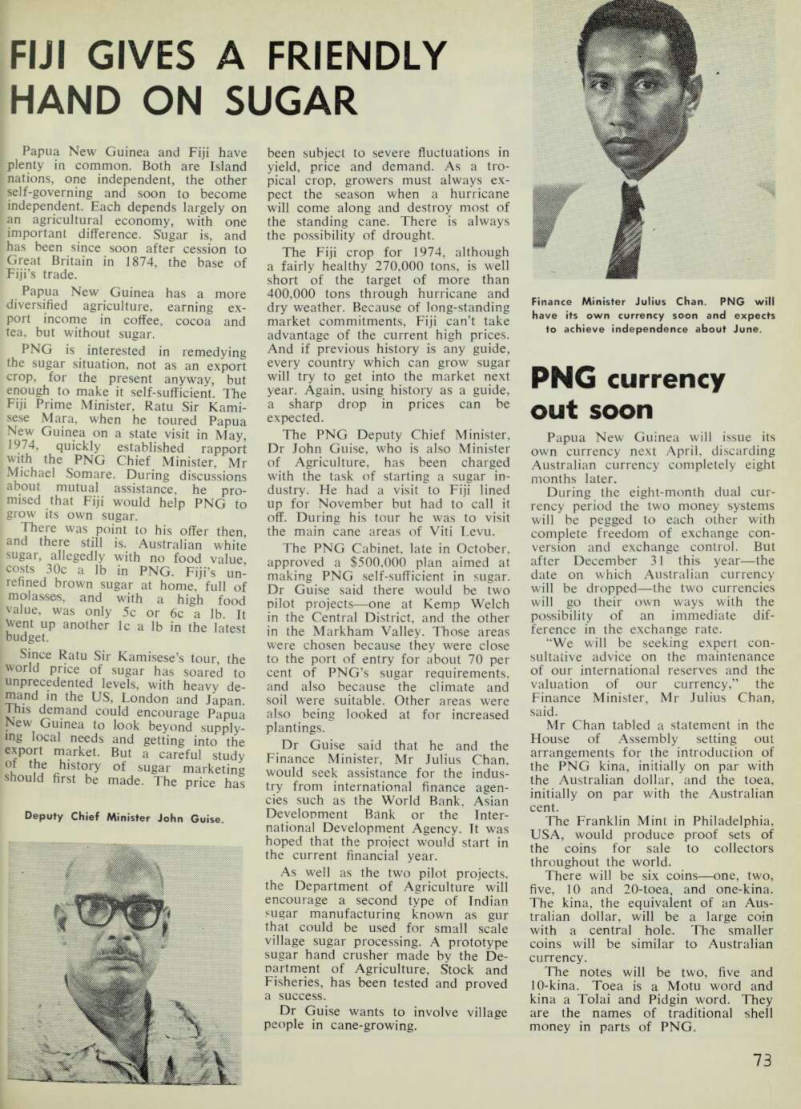
Finance Minister Julius Chan. PNG will have its own currency soon and expects to achieve independence about June.