Is Trade Plus Aid
p. 73 · Read in the full issue
Nz Programme For Png
From a Wellington correspondent
New Zealand has a favourable trade balance with Papua New Guinea. But any direct benefit to New Zealand is offset by the cost of aid which New Zealand gives to
Png.
There is an excellent relationship between the two countries, cemented by the firm friendship which existed between PNG Chief Minister Mr Michael Somare, and the late Mr Norman Kirk, when he was Prime Minister of New Zealand.
New Zealand is aiming at making its aid programme for the Pacific Islands equal to one per cent of the value of the gross national product.
It is an ambitious aim, and a pro gramme in which PNG gets a share.
New Zealand, in three years to the end of 1976, intends to spend $5 million in aid for PNG. This will make it New Zealand’s second big gest aid programme.
It is hoped to give PNG people more sophisticated skills to help them to become self-sufficient in many fields. Two examples are a forestry school, and the installation of freezers in coastal areas. The people are being taught how to maintain these freezers and store fish in them.
New Zealand has been trading with PNG for 15-20 years, but only since 1968 have NZ exports to that country been of any significance.
PNG was included in New Zealand’s general drive for trade which is directed at making New Zealand less dependent on dairy products and frozen mutton, the backbone of the country’s economy since the second half of the 19th century.
New Zealand’s exports to Papua New Guinea are worth S3i-$4 mil
lion a year, which is about one per cent of PNG’s total annual import bill, not a substantial share of the PNG market!
The main exports are food pro ducts, chiefly frozen lines, machines, component parts, electrical goods, agricultural implements and tools and completely knocked-down furni ture. The NZ Trade Department’s office in Brisbane handles all in quiries for NZ-PNG trade. However, New Zealand will eventually have a full-time trade representative in Port Moresby, possibly as early as 1976.
PNG’s main exports to New Zea land are timber and coffee. The tim ber trade has developed rapidly. New Zealand, traditionally a producer of soft woods, needs PNG’s kwila and taun for railway sleepers, wharves, power poles and other areas where hardwoods are needed. Incidentally, New Zealand interests operate a timber mill near Madang.
At present there is a five-weekly shipping service between the two countries. New Zealand interests would like to see a three-weekly ser vice, and believe that this will be offered. Ships sail with full bottoms from New Zealand, and in support of a more frequent service, New Zealand exporters say that ships are returning to New Zealand fully loaded.
New Zealand businessmen visit PNG frequently. On an official basis there have been two trade missions in the last four years, with excellent results. Apart from exporting goods to PNG, New Zealand businessmen have also invested in various projects there.
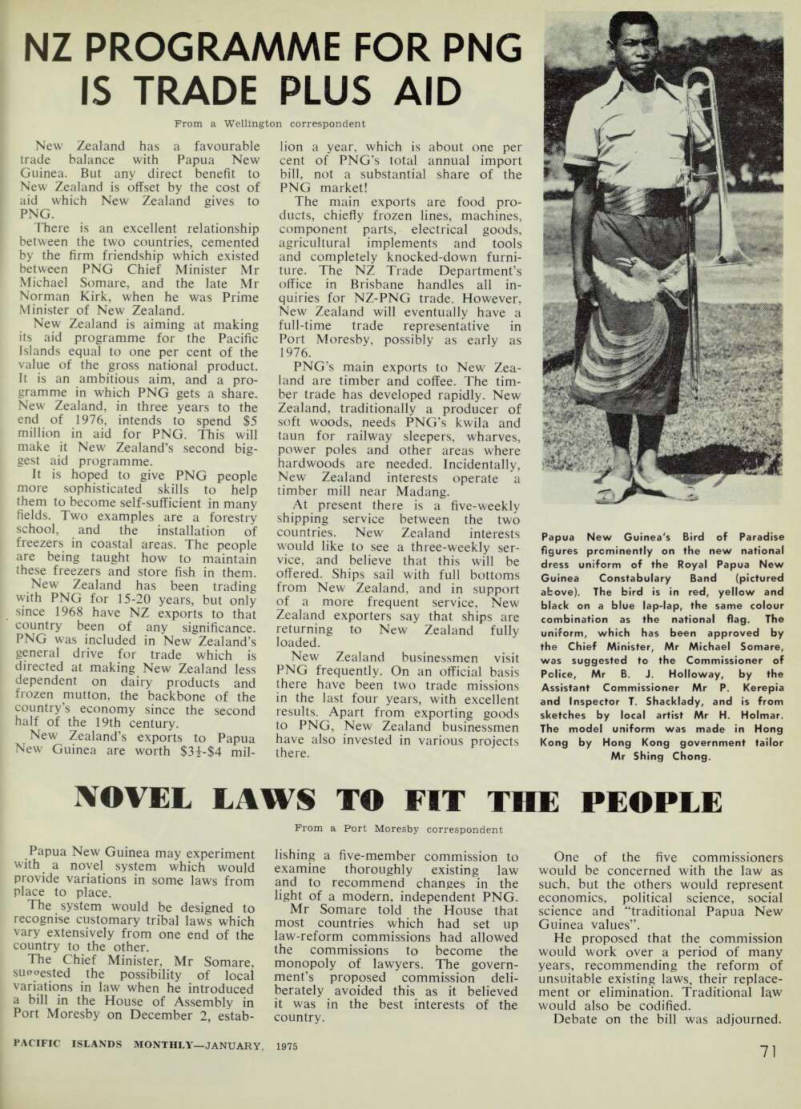
Papua New Guinea's Bird of Paradise figures prominently on the new national dress uniform of the Royal Papua New Guinea Constabulary Band (pictured above). The bird is in red, yellow and black on a blue lap-lap, the same colour combination as the national flag. The uniform, which has been approved by the Chief Minister, Mr Michael Somare, was suggested to the Commissioner of Police, Mr B. J. Holloway, by the Assistant Commissioner Mr P. Kerepia and Inspector T. Shacklady, and is from sketches by local artist Mr H. Holmar.
The model uniform was made in Hong Kong by Hong Kong government tailor Mr Shing Chong.