Pacific Transport
pp. 63-64 · Read in the full issue
Arbitrator Tells Air Pacific
To Cut Spending At The Top
A rise in Air Pacific fares seems inevitable after substantial pay in creases, ranging from 20 to 33 per cent awarded to local employees following an arbitration hearing.
The arbitrator, Mr Ramanlal Kapa dia, back-dated the rises to January 1, 1974.
They also qualify for two further cost-of-living adjustments, 9.37 per cent from July 1, 1974, and 4.53 per cent from October 1, 1974. The em ployees claimed increases of 40 per cent and more, while Air Pacific offered 10 per cent.
Mr Kapadia based his award on the pay scales of Qantas employees at Nadi Airport. The increases were needed to “promote the attraction of skills and to remove anomalies exist ing in the basic remuneration of per sons engaged in identical or com parable jobs”.
The Air Pacific Employees’ Asso ciation, in evidence, alleged mis management and extravagances by Air Pacific’s expatriate management executives. Mr Kapadia said the evi dence clearly indicated that by cut ting excessive spending at top managerial levels, and by effective training, Air Pacific could save much of the money it now spent on induce ment and other allowances to ex patriate staff. There was an absence of co-ordination in Air Pacific’s training programme.
Mr Kapadia said Air Pacific should plan its training in collaboration with the Department of Civil Aviation and Fiji National Training Council.
Ninety-six hourly-paid employees now receive 68c an hour, compared with 51c previously. Salaried staff, air hostesses and aircraft mainten ance engineers get another 20 per cent and licensed aircraft mainten ance engineers 25 per cent.
The vice-president of the associa tion, Mr G. P. Singh, opened out with a strong attack on the money spent on expatriates. He also attacked what he called other extravagances.
He alleged Air Pacific spent more on its 50 expatriate employees than on 400 local employees.
Some of the allegations by Mr Singh were: • A second BACIII was ordered and lay about for almost a year be fore it was leased. The cost of main taining it in that period was about $630,000; • Inexperienced Qantas aircraft maintenance engineers were secured to overhaul an aircraft in 30 days; they took five months; 9 An Air Nauru aircraft chart ered for $5,000 earned revenue of $1,600.
Mr Singh said: “Figures the com pany will bring out will show that we are subsidising Qantas at Nadi because of the staggering amounts we grant them for support services”.
He said that when a union cover ing Qantas employees in Sydney negotiated a big pay rise, Air Pacific automatically granted that increase.
The association’s demand was based, not only on relativity with Qantas and equal pay for equal jobs, but also on justice and fair treatment.
“The expatriates the company re cruits are not highly specialised at all”, Mr Singh said. “Most are drift wood. The expatriates are trained here. They are given all the oppor tunities to study and improve and once they are okay, they quit. This is a case of an under-developed country subsidising a developed country”.
Mr Singh also alleged that a black
expatriate did not get housing, edu cation and many other allowances, but there were some locals, who happened to be white, who did. The company had no localisation pro gramme, and no real incentives for locals to study and improve.
Better Conditions
On Moresby Waterside
Port Moresby waterside workers recently won better conditions, although the permanent men will not receive any direct pay increase. An arbitration tribunal which dealt with a dispute between the watersiders and the Employers’ Federation of PNG, recommended that its award be used as a pacemaker for other industries.
The ordinary working hours for the permanent men were reduced to 42 a week, from 44, which has the side effect of increasing overtime and penalty payments. Casual workers, who will get the benefit of the two hours by which the hours for per manent men were reduced, can now expect to earn $27.43 and be pro vided with five meals. By comparison any other worker in an urban situation earns $2O a week and provides his own food.
The average time worked by casuals is 32 hours on three days. In July, 1973, they worked only 1.1 days a week. Because the casual rates are so much higher than those paid to permanent workers, union demands
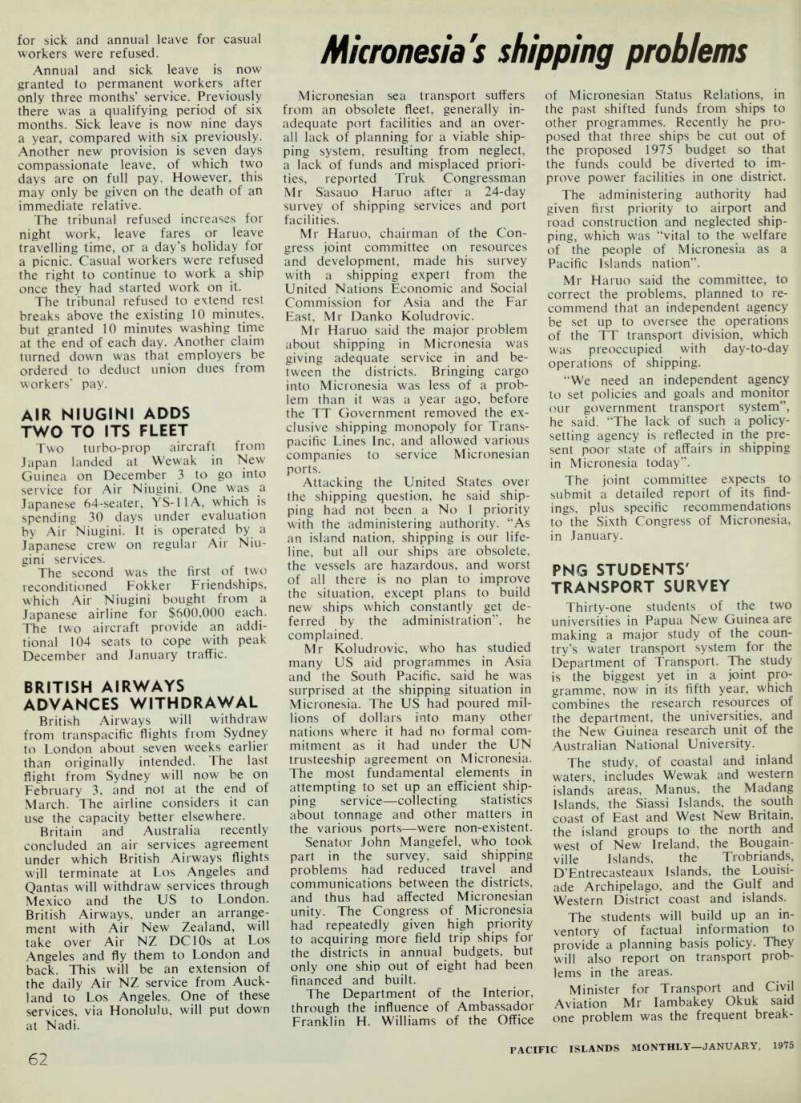
One job to be car ried out on this ship when she reached Suva recently was to change her name from the Scandi navian name of Heia to the Fijian Tabu Soro. The ship, which cost $305,475, re places the ill-fated Uluilakeba which foundered during cyclone Lottie last December with the loss of more than 70 lives.
for sick and annual leave for casual workers were refused.
Annual and sick leave is now granted to permanent workers after only three months’ service. Previously there was a qualifying period of six months. Sick leave is now nine days a year, compared with six previously.
Another new provision is seven days compassionate leave, of which two days are on full pay. However, this may only be given on the death of an immediate relative.
The tribunal refused increases for night work, leave fares or leave travelling time, or a day’s holiday for a picnic. Casual workers were refused the right to continue to work a ship once they had started work on it.
The tribunal refused to extend rest breaks above the existing 10 minutes, but granted 10 minutes washing time at the end of each day. Another claim turned down was that employers be ordered to deduct union dues from workers’ pay. air niugini adds
Two To Its Fleet
Two turbo-prop aircraft from Japan landed at Wewak in New Guinea on December 3 to go into service for Air Niugini. One was a Japanese 64-seater, YS-11A, which is spending 30 days under evaluation by Air Niugini. It is operated by a Japanese crew on regular Air Niu gini services.
The second was the first of two reconditioned Fokker Friendships, which Air Niugini bought from a Japanese airline for $600,000 each.
The two aircraft provide an addi tional 104 seats to cope with peak December and January traffic.
British Airways
Advances Withdrawal
British Airways will withdraw from transpacific flights from Sydney to London about seven weeks earlier than originally intended. The last flight from Sydney will now be on February 3, and not at the end of March. The airline considers it can use the capacity better elsewhere.
Britain and Australia recently concluded an air services agreement under which British Airways flights will terminate at Los Angeles and Qantas will withdraw services through Mexico and the US to London.
British Airways, under an arrange ment with Air New Zealand, will take over Air NZ DC 10s at Los Angeles and fly them to London and back. This will be an extension of the daily Air NZ service from Auck land to Los Angeles. One of these services, via Honolulu, will put down at Nadi.