Irian Jaya, a forthcoming
pp. 27-35 · Read in the full issue


bonanza —but who for?
From a special correspondent in Irian Jaya
In PIM in June there appeared an article by Dr R. S. Roosman, a poli tical scientist on the faculty of the University of Papua New Guinea, entitled, From a Dull Hollandia to a Colourful, Bustling Jayapura.
Understandably enough perhaps, university staff in Papua New Guinea, like Australian and Papua New Guinea politicians, prefer to take a lenient view of the “Indonesianiza tion” (to use Dr Roosman’s term) of those living on the other side of the border. Be that as it may, how ever brief Dr Roosman’s visit to Irian Jaya, one would have expected somewhat more insightful and criti cal reporting on the part of a poli tical scientist than is represented in the article.
More serious than the factual errors, which will be referred to pre sently, are the omissions. The reader js left with the impression that the “Indonesianization” (or “socializa tion”, to use another of Dr Roos man’s terms) of the native people of Irian Jaya is not only laudable but is proceeding without strain.
“Indonesianization”, of course, may be a name for something else,
and at the risk of offending some readers it seems desirable to draw attention to one or two aspects of the Indonesianization process that bear on present and future ethnic relationships within the Province of Irian Jaya and, may also bear on future relationships between Irian Jaya as a part of the Indonesian nation and an independent Papua New Guinea.
But first I’ll draw attention to a number of errors in Dr Roosman’s article. Reference is made to the uni versity but it is evident that if, in deed, a visit was made there, it did not involve any sort of inspection of the campus. The “specially-built dormitories” at the university in which the “local students are privi leged to stay” are old wartime huts now in an advanced stage of dila pidation.
Living conditions on the campus are in fact something of a shocker.
The dormitories are overcrowded and unsanitary, and toilet and mess facili ties are primitive in the extreme.
Dr Roosman refers to the Javanese settlement at Dosai, located beyond Sentani. It is true that Dosai and
other Javanese settlements in the area produce rice and a variety of veget able crops but to assert that this has “changed business life in the pro vincial capital” is sheer nonsense.
The fact is that relatively little of the rice grown by these settlers is marketed commercially in the capital because growers cannot compete, price-wise, with subsidised imported rice. Further, the entire Dosai area probably contributes less than 15 per cent to the Jayapura vegetable supply.
The experimental stations at Wamena, in the Highlands, which produce “abundant crops of Euro pean vegetables which are flown to Jayapura” are something of a mys tery.
There is no regular supply of vegetables from Wamena although vegetables from other areas of the Highlands, transported more or less regularly by Protestant mission air craft, are sold in the Jayapura market. These vegetables are grown by the native people and sold to missionaries who, in turn, sell them to middle-men at Sentani. The vegetables are then transported to the
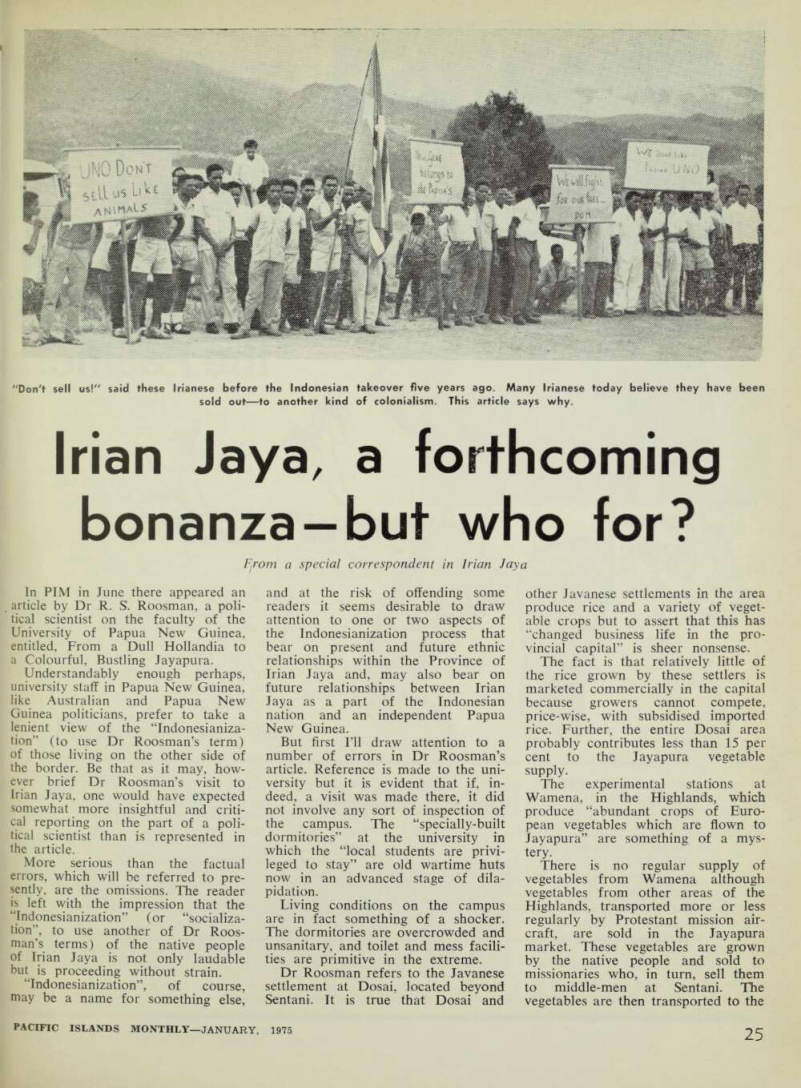
Don't sell us!" said these Irianese before the Indonesian takeover five years ago. Many Irianese today believe they have been sold out —to another kind of colonialism. This article says why.
Absorbed in an enormous nation
Jayapura market by taxi, where they are sold. The quantity of Highland vegetables reaching the Jayapura market is small indeed.
Concerning the foreigners working on contract for various United Nations agencies, the number is more like 50 or 60 than 400 to 500. Even if wives and children are included in the count the number would not exceed 150.
A few other points: The sand at Hamadi is grey and not a “beautiful white”, and the favourite weekend picnic spot is at Base G (where the sand is a “beautiful white”) and not Hamadi.
Work is not plentiful in Jayapura.
On the contrary, there is considerable unemployment particularly among the local people although it is true, as Dr Roosman points out, that one does not encounter beggers on the street. Neither, of course, does one encounter beggers on the streets of towns in Papua New Guinea, although they are an accepted part of the Indonesian scene.
If the crime rate in Jayapura is remarkably low, as Dr Roosman asserts, this is news to people who live there, who are of the opinion that it is remarkably high.
Five years have now passed since Pepera—the “Act of Free Choice” by which selected spokesmen of the Irian people opted to join the former Dutch colony under permanent Indo nesian rule so that all might enjoy the benefits of Indonesian citizenship.
At this point in time it is worth asking, perhaps, what these benefits
have been. From the Indonesian viewpoint, Irian Jaya is an integral part of the Indonesian nation and its inhabitants, therefore, are Indo nesians. At schools, colleges, the university and on the occasion of numerous public gatherings the Irian people are reminded of this fact, and are taught to identify with Indo nesia and to share in its aspirations for the future.
Whether or not many Irian people
choose to identify with Indonesia is another matter. The fact is they have been absorbed as a part of an enor mous nation made up of many diverse ethnic and cultural groups.
Those who have the opportunity and the aptitude and choose to be co operative may rise through the sys tem and achieve positions of res ponsibility in any field of the civil service and also, presumably in the military.
Relatively few Irian people have achieved positions of importance but this is to be attributed more to a lack of suitably qualified individuals than to any unwillingness on the part of the Indonesians to give responsi bility to the local people. Actually, it seems to be Indonesian policy to favour the employment of Irian people over others in the civil ser vice—at least at the middle echelon level.
Through the rapid spread of Ba hasa Indonesia the Irian people have been provided with a lingua franca.
In all areas of Irian Jaya where there has been sustained contact, the young people, at least, have a working knowledge of Bahasa Indonesian.
For a people with such tremendous linguistic diversity, the facility to communicate with one another in a
In the Baliem Valley, "virtually all the pine forests have been felled, against the wishes of the inhabitants".
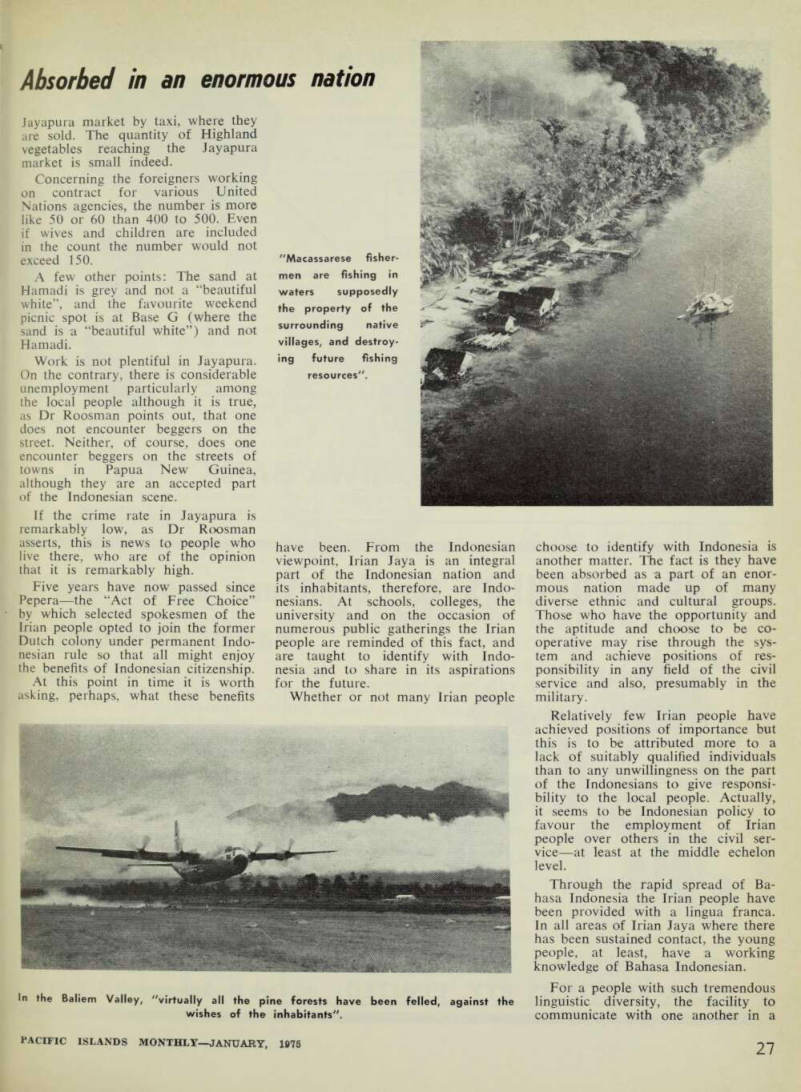
"Macassarese fisher men are fishing in waters supposedly the property of the surrounding native villages, and destroy ing future fishing resources".
Complex bureaucracy
common language is a great step forward; that the lingua franca is the language of those now respons ible for their welfare is of even greater significance for the Irian people.
With a good deal of United Nations help (largely made possible by the SUS3O-million gift from the Netherlands Government) Indonesia has expended considerable effort and money in such projects as road build ing, improvements in coastal ship ping facilities, telecommunications, airstrip building and so on.
The harsh critic will point out that there is surprisingly little to show for these efforts and the large sums supposedly expended on de velopment, and he may also point to the wastage and inefficiency that may be attributed, in part, to a complex bureaucracy compounded by para military rule, and in part from the lack of system in the matter of financial favours and other forms of recognition that must be made if pro jects are to edge forward.
But problems of this sort are manifest elsewhere in Indonesia and further, Indonesia is hardly alone in haying to combat problems of in efficiency and corruption. That there is relatively little to show for Indo nesian efforts in Irian Jaya (other than, perhaps, in the erection of government buildings and houses for military and government personnel) should not detract from the fact that some effort is being made.
If Indonesianization were nothing more than a matter of public works programmes, and teaching the local people to salute the flag and sing a few national songs in the Indonesian language, there would be no cause for apprehension. But this is not the case.
Because Irian Jaya is a part of Indonesia, Indonesians from other areas are more or less free to enter the province. This has meant the entry of thousands of immigrants, mostly from the Celebes, with whom the Irian people must compete for a livelihood.
Indonesianization also means that the resources of Irian Jaya belong to Indonesia. The exploitation of these resources is well under way and un doubtedly will intensify in the future.
What the Irian people are beginning to experience, in fact, is a massive rip-off of their resources, essentially for the benefit of Indonesia.
The visitor to Jayapura does not have to be particularly observant to notice that the work force engaged in road and building construction is made up not of local Irian people but of Macassarese.
Macassarese also predominate on the wharves loading and unloading ships, in pit-sawing activities, in the local fishing industry, and in the local fish and produce market where it is largely the Macassarese who operate as middle-men. As well, virtually all petty trading is in the hands of Macassarese.
This situation, whereby the Macas
sarese predominate in every avenue of unskilled and semi-skilled work as well as in the markets and in oppor tunities for petty trading, prevails not only in Jayapura but in every town of any size in Irian Jaya.
The numbers of Macassarese liv ing in Irian Jaya is unknown and the official figure, whatever it might be, is likely to be inaccurate because to a great extent the Macassarese population is a transient one.
Numbers of Macassarese are brought to Irian Jaya by labour con tractors to work on specific projects; others arrive on their own initiative
" Exploitation"
in search of work or trading oppor tunities and move from one town to another.
The Irian people in the towns laugh about the Macassarese and call them “birds” because, they say, they seem able to live anywhere and exist on practically nothing. Their pre sence, however, is particularly resented.
The fact is the Irian people do not share the dedicated work ethic of the Macassarese and are unable to compete with them for employ ment opportunities or as traders. Nor can they compete with them, it seems, in the competition for their own resources.
Macassarese and Buttonese fisher men are practising fishing techniques in Jayapura waters (supposedly the property of the surrounding native villages) which are destroying the future fishing resources. They are also engaged in timber activities on land which, by rights, belongs to the native people. It is largely the Macassarese who, through excessive hunting, have threatened crocodiles with extinction, thereby depleting a valuable resource.
The exploitation of Irian Jaya’s resources has barely begun, but if the practices now being followed are con tinued by Indonesia, the end result for the Irian people could be serious indeed.
As yet, the forestry industry is in its infancy but it is understood that with the exception of reserves set aside for timber mills at Hamadi and Manokwari, which are operated with foreign assistance, all the forest re serves of the province have been allocated to Indonesian exploiters without any regard to native land rights.
Conservation is hardly a forte of the Indonesians and it is doubtful whether any consideration has, or will be given, to re-afforestation. In the Baliem Valley virtually all the pine forests that remained have been felled to provide materials for government building projects in Wa mena. This was a police action earned out against the wishes of the k)ani inhabitants of the valley.
In swamp areas of the south coast, ironwood resources are threatened with extinction. The native people of jhe area are pressured by Forestry department and other government otticials, as well as by soldiers and Police, into cutting logs in return for tobacco and such trivia as plastic buckets, sarongs, notebooks and pen cils. Tfie timber is exported to Sura
baya and destinations outside Indonesia, but none of the export earnings are returned to the district to assist in local development.
The Indonesians claim to respect traditional native land rights. If these rights mean anything, the land and its timber should belong to the native people of the area.
Irian Jaya has rich resources in shrimp and tuna but how long these will last is open to some doubt. The grounds are being exploited by the Japanese in accordance with what must be one of the most liberal fishing agreements in recent times.
With regard to tuna fishing, one provision of the agreement was that
the Japanese should give training to local people in the techniques of tuna fishing so that at some future point in time they would be able to carry on with the industry themselves, No such training has been given, A few Irian men are employed as cheap labour to carry out menial tasks but the skilled work continues to be carried out by Japanese. The highest position held by an Irian man is that of bosun on one of the ships.
Unless government pressure is brought to bear, foreign companies are not likely to expend much time or money in training local labour so long as it is possible to recruit more
But will PNG seek to join with Irian?
highly-skilled labour from other areas of Indonesia. •. .• This appears to be the situation with regard to Freeport Sulphur Company, which at present is expicking the hugh copper resources on the south coast in the Kokonau area, and it is certainly the situation with regard to Indonesia Surveys (ISSA)—a seismographic firm carrying out surveys to locate oil resources in the Asmat region of the south coast of Irian Jaya.
Labour recruiting for ISSA (apparently at the insistence of the Indonesian authorities) is in the hands of recruiters who bring in some hundreds of outside labourers on a contract basis. Virtually no native Irian labour is employed. t u ♦ .v, f„ r In short, hen, the pattern for oanles in TrlaS 8 Java leemfto be eft abb shed ’and there is no reason re heliefe that the oil industry as
? Itlr develous the Soronf
lining wSS?
(if and when the huge deposits of
Gag Island are exploited) will offer significant employment opportunities to the local people.
Whether or not Irian Taya will benefit financially from all these resources in terms of revenue pumped back into the provincial economy remains to be seen. Assuming that big sums are channelled into local development, the question then arises, f or whose primary benefit—that of t h e native Irian people or the Indonesians who have settled either tern- Pprarily or permanently in the provmce? whether the Indonesian authorities h t recognise it or not large I?Ln neonb beheve . , be j ng exploited and ? a Java is subiecF to a neo th , • an - aya SUDjeCt 10 a neo colomal re g,me. 1° view of the extraordinary number of armed troops and military vehicles one may observe in any of in the major towns the Indonesian authorities might be hard pu, to contradict this view.
Of more immediate importance is the fact that many Irian people, and particularly the young people with some education, look upon an in dependent Papua New Guinea as their hope for the future. It is popu larly believed, that at a not-too distant time Papua New Guinea will demand union with Irian Jaya to make up one independent nation.
This is held to be so despite the pro testations of friendship and goodwill politicians in Papua New Guinea profess to feel towards Indonesia and the negative remarks one or two poli ticians have made about Irian poli tical refugees living within their border.
Hie hope of eventual union with Papua New Guinea may be a mere pipe dream, but the resentment of the Indonesian presence is real enough and not altogether without cause. Indonesianization, as has been suggested, has its less pleasant side.
Sporadic rebellion in various parts of Irian Jaya—particularly in the border regions—is nothing new. In dealing with these outbreaks in re cent years, the Indonesian military authorities have generally acted with commendable restraint.
But there is good reason to believe
that resistance to Indonesian author ity will increase rather than diminish and a series of localised rebellions with appeals to Papua New Guinea for assistance is not at all unlikely.
Whether or not such resistance would ever become sufficiently strong and co-ordinated to pose a serious threat to the Indonesian military authorities is a matter for speculation.
Only one thing, perhaps, is reason ably certain. Because of its resources in minerals and possibly in oil, the possession of Irian Jaya (which in earlier years was something of an economic disaster) is now viewed by Indonesia as being a likely bonanza.
This view may still turn out to be wrong but in either event, in the foreseeable future Indonesia is not likely to take kindly to anything in the nature of rebellion with nationalistic overtones and will prob ably react strongly to scotch any suggestion of union with Papua New Guinea.
“Indonesianization” may then take on a new dimension which will pose serious moral questions for Papua New Guinea politicians. If the poli ticians have not considered the possi bility suggested here then it is time, perhaps, that they did; in the view of this writer it is the likely course of events.