political rumours
p. 11 · Read in the full issue
Fiji’s grapevine sprouts political rumours
From Vuendra Kumar
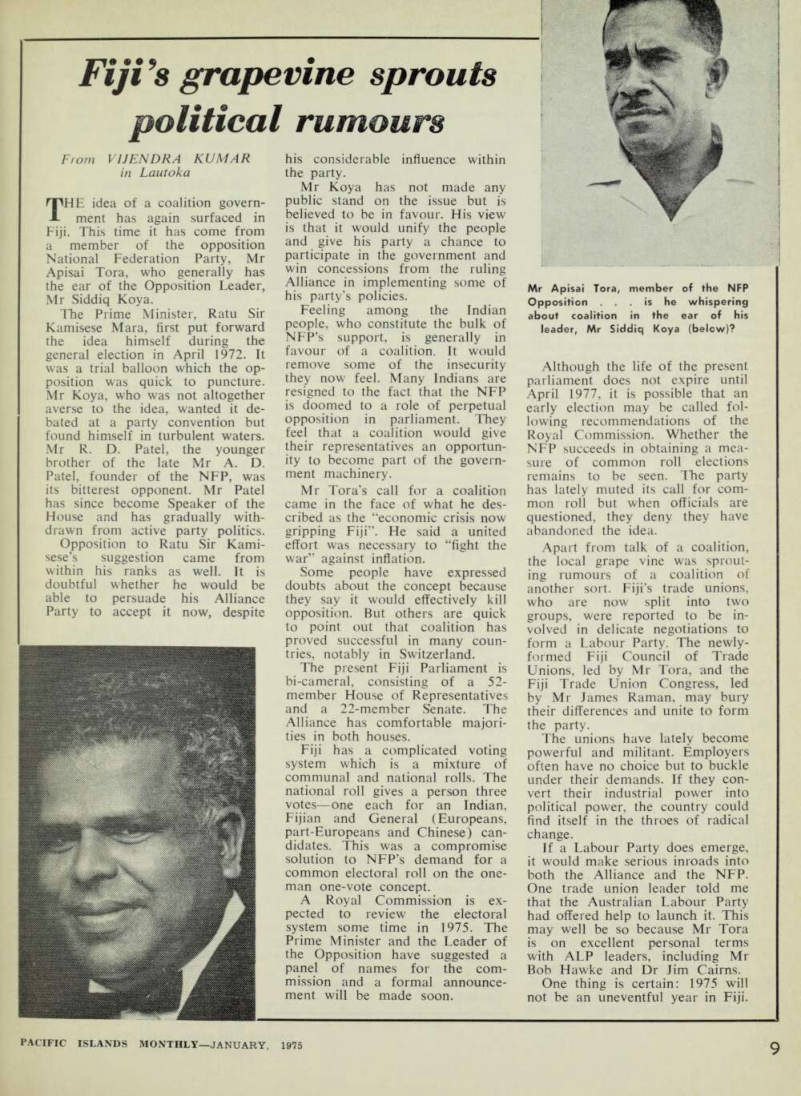
in Lautoka THE idea of a coalition govern ment has again surfaced in Fiji. This time it has come from a member of the opposition National Federation Party, Mr Apisai Tora, who generally has the ear of the Opposition Leader, Mr Siddiq Koya.
The Prime Minister, Ratu Sir Kamisese Mara, first put forward the idea himself during the general election in April 1972. It was a trial balloon which the op position was quick to puncture.
Mr Koya, who was not altogether averse to the idea, wanted it de bated at a party convention but found himself in turbulent waters.
Mr R. D. Patel, the younger brother of the late Mr A. D.
Patel, founder of the NFP, was its bitterest opponent. Mr Patel has since become Speaker of the House and has gradually with drawn from active party politics.
Opposition to Ratu Sir Kami sese’s suggestion came from within his ranks as well. It is doubtful whether he would be able to persuade his Alliance Party to accept it now, despite
his considerable influence within the party.
Mr Koya has not made any public stand on the issue but is believed to be in favour. His view is that it would unify the people and give his party a chance to participate in the government and win concessions from the ruling Alliance in implementing some of his party’s policies.
Feeling among the Indian people, who constitute the bulk of NFP’s support, is generally in favour of a coalition. It would remove some of the insecurity they now feel. Many Indians are resigned to the fact that the NFP is doomed to a role of perpetual opposition in parliament. They feel that a coalition would give their representatives an opportun ity to become part of the govern ment machinery.
Mr Tora’s call for a coalition came in the face of what he des cribed as the “economic crisis now gripping Fiji”. He said a united effort was necessary to “fight the war” against inflation.
Some people have expressed doubts about the concept because they say it would effectively kill opposition. But others are quick to point out that coalition has proved successful in many coun tries, notably in Switzerland.
The present Fiji Parliament is bi-cameral, consisting of a 52member House of Representatives and a 22-member Senate. The Alliance has comfortable majori ties in both houses.
Fiji has a complicated voting system which is a mixture of communal and national rolls. The national roll gives a person three votes—one each for an Indian, Fijian and General (Europeans, part-Europeans and Chinese) can didates. This was a compromise solution to NFP’s demand for a common electoral roll on the one man one-vote concept.
A Royal Commission is ex pected to review the electoral system some time in 1975. The Prime Minister and the Leader of the Opposition have suggested a panel of names for the com mission and a formal announce ment will be made soon.
Although the life of the present parliament does not expire until April 1977, it is possible that an early election may be called fol lowing recommendations of the Royal Commission. Whether the NFP succeeds in obtaining a mea sure of common roll elections remains to be seen. The party has lately muted its call for com mon roll but when officials are questioned, they deny they have abandoned the idea.
Apart from talk of a coalition, the local grape vine was sprout ing rumours of a coalition of another sort. Fiji’s trade unions, who are now split into two groups, were reported to be in volved in delicate negotiations to form a Labour Party. The newly formed Fiji Council of Trade Unions, led by Mr Tora, and the Fiji Trade Union Congress, led by Mr James Raman, may bury their differences and unite to form the party.
The unions have lately become powerful and militant. Employers often have no choice but to buckle under their demands. If they con vert their industrial power into political power, the country could find itself in the throes of radical change.
If a Labour Party does emerge, it would make serious inroads into both the Alliance and the NFP.
One trade union leader told me that the Australian Labour Party had offered help to launch it. This may well be so because Mr Tora is on excellent personal terms with ALP leaders, including Mr Bob Hawke and Dr Jim Cairns.
One thing is certain: 1975 will not be an uneventful year in Fiji.
Mr Apisai Tora, member of the NFP Opposition ... is he whispering about coalition in the ear of his leader, Mr Siddiq Koya (below)?