Worthwhile Christmas gift
pp. 8-9 · Read in the full issue
for the New Hebrides . . ..
By Stuart Inder
The decisions made at the Minis terial conference in London in No vember to discuss the political future of the New Hebrides have turned out to be a real Christmas present.
It looks now as if the London deci sions were the most important taken since the Condominium came into existence in 1914. The decisions have removed the likelihood of violence in the New Hebrides—for the situ ation had been explosive up to the time of the London conference.
The meeting was between British and French ministers responsible for the New Hebrides (it is in London and Paris where the control lies) and was the first ministerial conference in eight years. This is itself a com mentary on the persistence of past high level neglect of New Hebrides problems, and in the circumstances it’s a matter of grateful surprise that so much agreement was reached so quickly after so many years of stag nation.
The decisions were no doubt made as a result of some of the internal clamour for reform by many New Hebrideans who earlier in 1974 took their plight to the United Nations. Also they are the result of a sympathetic approach to London and Paris by the current British and French Resident Commissioners, Mr Roger du Boulay and Mr R. Lang lois, who are two competent and in telligent men.
The New Hebrides has a popu lation of 90,000, and is neither British nor French. Britain and France have separate administrations, and there is a condominium govern ment—an administration in name only—with no vital responsibility.
The most important of the Lon don decisions was the decision to establish a legislative assembly.
Elections for it will be held by Sep tember 30, with the first meeting scheduled to take place in Decem ber 1975.
The parliament will have 38 mem bers, all elected, plus the two resi dent commissioners, who will have no vote. There will be no official members.
Of the 38 elected, 24 will be New Hebrideans, The composition will be 17 rural members, six members representing Vila town (two British, two French, two New Hebridean), three repre
senting Santo town (one British, one French, one New Hebridean), eight representing the Chamber of Com merce (four British, four French) and four representing the Co- Operative Federation. Elections will be by universal suffrage, with Fiji pattem cross-voting on the special seats.
The assembly will have authority to allocate the New Hebrides budget and to raise its own funds. It will be able to introduce private members bills. It won’t be able to control de fence or foreign affairs.
Work on establishing electoral rolls and other machinery will begin right away.
Meanwhile, work will go ahead on plans to establish local government; there will be a streamlining of the departments built up by the two residencies with the aim of handing more authority to a condominium government; the criminal law will be unified along the lines of the French system (in civil law it will probably be the British system); there will be a detailed study of currency with the aim of establishing a separate New Hebrides currency tied to the franc; and all-important land re forms have been promised, without which there can be no real progress in the New Hebrides.
It was agreed in London that land reform was fundamental. The plan is for the land provisions in the protocol, to be scrapped and be re placed with joint regulations on New Hebridean land concepts. Much work
has already been done on a uniform land scheme by a British adviser working in the New Hebrides, Mr J. T. Fleming, and this work has been accepted in principle by the British and French ministers.
An important development to flow from London is that both parties agreed with the principle that a con dominium government should be strengthened and developed rather than the separate administrations.
This more than any one thing should unify the New Hebrides, and allow overall planned development instead of the kind of piecemeal, sometimes wasteful, development which has re sulted from the system of separate administrations and their national rivalries. Britain and France will develop a joint development plan for the New Hebrides.
There was a discussion on New Hebrides citizenship. New Hebrideans are currently people without real citizenship, who are protected by Britain and France inside and outside the condominium and who are issued
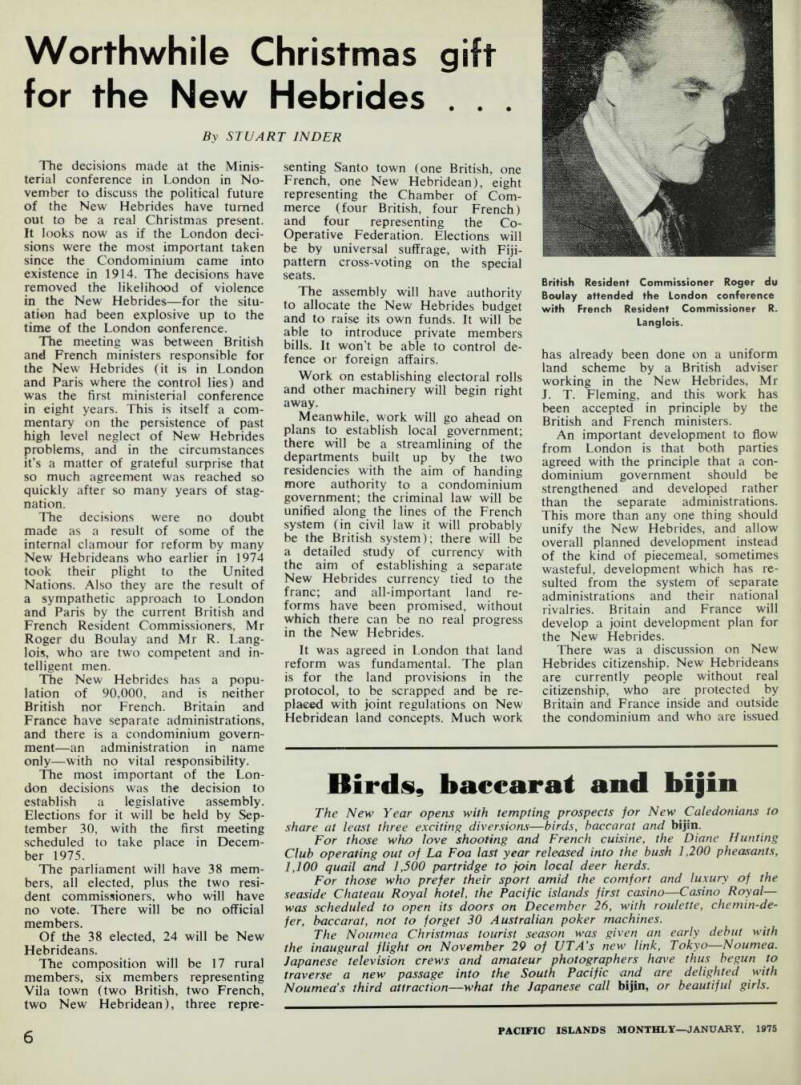
British Resident Commissioner Roger du Boulay attended the London conference with French Resident Commissioner R.
Langlois.
with nearly identifying documents in lieu of passport when they travel.
At the talks the French took the view that the right of entry of New Heb rideans to the UK, would be to pre judge independence. The French re main wary on the independence issue, and want to hasten slowly.
They have not promised independence.
TTie New Hebrides will in fact develop a passport which will con tinue to give the people of the New Hebrides double protection from two powers as citizens of an Anglo- French condominium, but just what the wording will be has yet to be decided.
It won’t be easy to find the right words that will grant them status as a separate people without at the same time conferring on them a certain
independence.
The New Hebrideans haven’t yet got Independence with a capital “I”, but following the London conference they now have the opportunity to be more independent than at any time since colonial rule began in those islands. The London meeting was thus a greater success than expected.